

In this article
Tirzepatide represents an important development in peptide-based metabolic research because one molecule can engage two incretin-related receptor systems.
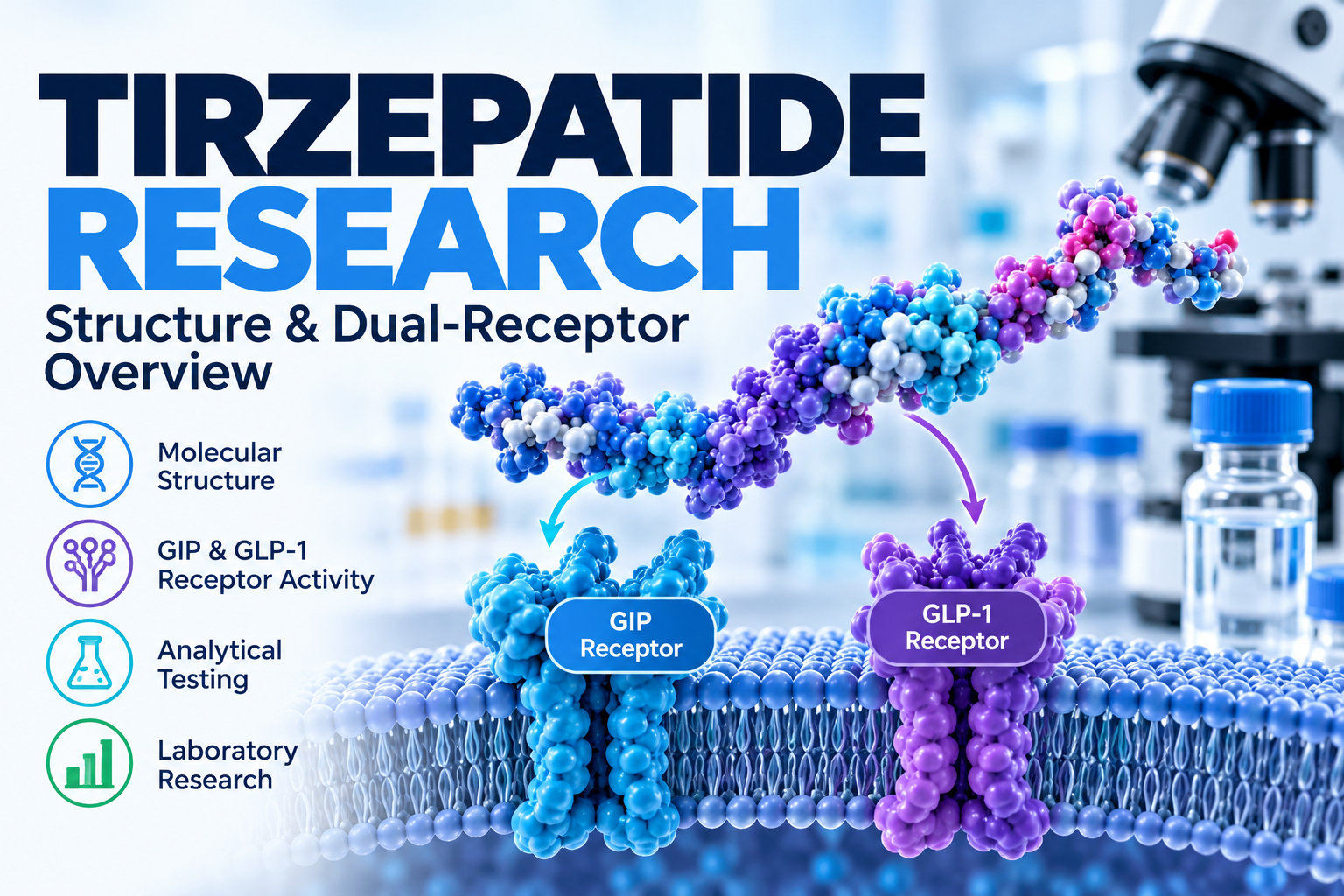
Its molecular design allows activity at both the glucose-dependent insulinotropic polypeptide (GIP) receptor and the glucagon-like peptide-1 (GLP-1) receptor.
This dual-target approach helped expand scientific interest beyond compounds built around GLP-1 signaling alone.
Today, tirzepatide is also an approved prescription medicine in the United States for specific indications. However, laboratory research involving the molecule remains valuable for understanding receptor pharmacology, peptide engineering, molecular signaling, and structure-function relationships.
This article looks at tirzepatide from a research perspective, including its molecular architecture, dual-receptor activity, analytical characteristics, and scientific background.
What Is Tirzepatide?
Tirzepatide is a synthetic peptide-based molecule engineered to activate two related receptor systems.
These are:
- GIP receptors
- GLP-1 receptors
Both belong to a wider family of biological signaling systems involved in metabolic regulation.
Tirzepatide is unusual because these two activities are incorporated into a single molecular structure.
Rather than studying two separate compounds together, scientists can investigate how one molecule interacts with both receptor families.
This design has made tirzepatide an important model in modern incretin research.
Understanding the Two Receptor Targets
To understand tirzepatide, it helps to look at its two primary receptor targets separately.
GIP Receptor
GIP stands for glucose-dependent insulinotropic polypeptide.
It is a naturally occurring peptide hormone associated with nutrient-responsive signaling.
The GIP receptor is found in several tissues and participates in biological pathways related to energy balance and metabolic communication.
Scientists study this receptor to better understand:
- Nutrient signaling
- Cellular responses
- Hormone communication
- Energy-related pathways
- Receptor pharmacology
GLP-1 Receptor
GLP-1 stands for glucagon-like peptide-1.
The GLP-1 receptor has been extensively studied in metabolic biology.
Researchers investigate its role in processes involving:
- Glucose-responsive signaling
- Appetite-related pathways
- Gastrointestinal signaling
- Pancreatic cell activity
- Metabolic communication
Tirzepatide provides researchers with an opportunity to study both receptor systems using one engineered molecule.
Why Tirzepatide Is Called a Dual Agonist
An agonist is a molecule capable of activating a receptor.
Because tirzepatide can activate both GIP and GLP-1 receptors, it is commonly described as a dual GIP/GLP-1 receptor agonist.
The term “dual” refers to the number of receptor systems involved.
It does not mean tirzepatide contains two separate drugs.
It is one molecular entity with activity across two receptor pathways.
That distinction is important when evaluating its pharmacology and molecular design.
Tirzepatide Is a 39-Amino-Acid Peptide
Tirzepatide is a linear peptide containing 39 amino acids.
Its design was developed from a native GIP-related peptide framework and modified to support activity at both GIP and GLP-1 receptors.
The molecule also includes a C20 fatty diacid component.
This structural feature contributes to albumin binding and helps extend the molecule’s persistence in biological systems.
For researchers, these modifications show how peptide engineering can influence both receptor activity and molecular behavior.
Why Structural Modification Matters
Naturally occurring peptides may have biological activity but can sometimes be cleared rapidly.
Researchers can modify peptide structures to alter properties such as:
- Molecular stability
- Receptor selectivity
- Protein binding
- Resistance to degradation
- Duration of activity
- Solubility characteristics
Tirzepatide provides a useful example of how several design features can be incorporated into one molecule.
Its structure is therefore relevant not only to metabolic research but also to broader peptide-engineering studies.
The Role of the Fatty Acid Component
One important feature of tirzepatide is its fatty diacid moiety.
This portion of the molecule supports interaction with serum albumin.
Albumin is a common protein found in circulation.
Binding to albumin can influence how quickly a peptide is cleared from a biological system.
From a research perspective, this illustrates an important peptide-design strategy.
Scientists can modify a peptide not only to influence receptor binding, but also to alter its pharmacokinetic behavior.
Why Dual-Receptor Research Is Interesting
Many earlier research compounds were designed primarily around one receptor.
Dual-target molecules offer another approach.
Researchers can ask questions such as:
- Does activating two pathways create a different signaling pattern?
- Does one receptor change the response produced by the other?
- Are both receptors activated with the same strength?
- Does receptor preference change at different concentrations?
- How do downstream signals differ between cell types?
These questions make dual agonists valuable tools for studying receptor interactions.
Tirzepatide Does Not Activate Both Receptors Identically
Dual activity does not necessarily mean equal activity.
A molecule can interact differently with each receptor.
Laboratory studies may evaluate:
- Binding affinity
- Receptor potency
- Signaling efficiency
- Concentration-response relationships
- Downstream pathway activation
Tirzepatide’s molecular profile has been characterized as having distinct activity at GIP and GLP-1 receptors rather than behaving identically at both targets.
This adds another level of interest for receptor pharmacology research.
Tirzepatide and Native Hormone Signaling
Both GIP and GLP-1 are naturally occurring signaling peptides.
They are released in connection with nutrient intake and participate in metabolic communication.
Tirzepatide does not simply reproduce either hormone exactly.
Instead, its molecular structure has been engineered to interact with both corresponding receptor systems.
This allows scientists to study how modified peptide architecture can combine features associated with multiple biological pathways.
Tirzepatide vs Single GLP-1 Receptor Agonists
Single-target GLP-1 receptor agonists primarily concentrate on GLP-1 receptor signaling.
Tirzepatide differs because GIP receptor activity is incorporated into the same molecule.
From a research standpoint, this creates several possible comparison models.
Scientists may compare:
- GLP-1-only signaling
- GIP-only signaling
- Combined GIP/GLP-1 signaling
- Concentration-dependent responses
- Differences in downstream pathway activation
These comparisons can help researchers investigate what the additional receptor target contributes.
Tirzepatide vs Triple-Receptor Compounds
Tirzepatide should also be distinguished from compounds such as retatrutide.
Tirzepatide targets two receptor families:
- GIP
- GLP-1
Retatrutide has been designed around three:
- GIP
- GLP-1
- Glucagon
This difference creates distinct experimental models.
Dual-receptor and triple-receptor compounds should not be treated as interchangeable simply because some of their targets overlap.
Their structures, receptor profiles, and signaling patterns differ.
Structure-Function Relationships in Tirzepatide Research
A major area of peptide science involves understanding how molecular structure influences biological function.
With tirzepatide, researchers can examine how structural modifications relate to:
- Receptor recognition
- Molecular stability
- Albumin association
- Cellular signaling
- Duration of action
- Target selectivity
This type of research can provide broader insights into how engineered peptide molecules behave.
Laboratory Approaches to Studying Tirzepatide
Tirzepatide can be investigated through several experimental approaches.
Depending on the research question, laboratories may examine:
- Receptor-binding characteristics
- Cell-based signaling
- Molecular structure
- Peptide stability
- Analytical separation
- Comparative receptor pharmacology
- Protein interactions
Each method answers a different scientific question.
Researchers should choose techniques based on the specific hypothesis being tested.
Receptor-Binding Studies
Binding assays can help researchers understand how strongly a molecule interacts with a receptor.
In tirzepatide studies, researchers may evaluate GIP and GLP-1 receptors independently.
This can help determine whether the molecule shows different preferences between the two targets.
Binding information may also be compared with functional assays.
A molecule may bind to a receptor but produce a different level of downstream activity.
Functional Receptor Assays
Functional assays examine what happens after receptor engagement.
Researchers may measure intracellular signals generated after tirzepatide interacts with a receptor.
Possible endpoints can include:
- Second-messenger production
- Protein activation
- Receptor internalization
- Gene-expression changes
- Cellular response patterns
These experiments help move beyond simple binding measurements.
They show whether receptor interaction produces a measurable biological response.
Why Concentration-Response Research Matters
Peptide activity often changes depending on concentration.
Researchers can expose experimental systems to several concentrations and measure the resulting response.
This produces a concentration-response curve.
Such experiments can help researchers estimate:
- Potency
- Maximum response
- Receptor sensitivity
- Differences between receptor systems
For a dual agonist, these comparisons are especially useful because the same molecule can be studied against two targets.
Molecular Identification in Laboratory Research
Researchers working with peptide materials need reliable sample identification.
Analytical techniques can help verify whether a laboratory sample matches its expected molecular characteristics.
Mass spectrometric approaches may provide information about:
- Molecular mass
- Molecular fragments
- Sample consistency
- Expected structural characteristics
These results can be evaluated alongside product documentation and batch information.
Chromatographic Analysis
Chromatography can provide another view of a peptide sample.
HPLC is one analytical technique commonly used with peptide materials.
Instead of describing the peptide’s biological activity, chromatography evaluates how components in the sample separate under controlled analytical conditions.
Researchers can examine:
- Retention behavior
- Main peak distribution
- Minor components
- Relative peak areas
- Batch-to-batch patterns
This can support broader characterization of research material.
Why Analytical Results Need Context
No single analytical measurement provides every piece of information.
A chromatogram cannot answer every question about molecular identity.
Likewise, a molecular mass result does not by itself describe all sample components.
Researchers often obtain a stronger picture by combining several forms of evidence.
These may include:
- Molecular characterization
- Chromatographic data
- Batch documentation
- Receptor assays
- Stability studies
The appropriate combination depends on the research goal.
Batch-to-Batch Documentation
Peptide research benefits from good material traceability.
Scientists may want to record:
- Product name
- Lot number
- Date received
- Analytical report number
- Storage location
- Experimental use date
This information becomes valuable when comparing results across multiple experiments.
If results change between studies, batch records provide one possible variable to review.
Why Storage Conditions Matter
Peptide materials can respond differently to environmental conditions.
Factors that may influence stability include:
- Temperature
- Moisture
- Light
- Container condition
- Time in storage
Researchers should follow product-specific storage documentation rather than applying a single rule to every peptide.
Proper storage records can also improve reproducibility.
Historical Development of Tirzepatide Research
Tirzepatide emerged from research aimed at creating molecules capable of combining more than one incretin-related signaling pathway.
Preclinical and early clinical studies helped establish its dual GIP/GLP-1 receptor profile.
Later research expanded into larger clinical development programs.
In the United States, tirzepatide was first approved in 2022 for adults with type 2 diabetes under the Mounjaro brand.
It was later approved under the Zepbound brand for chronic weight management, with additional approved indications subsequently added.
This development history makes tirzepatide an important example of how laboratory peptide research can progress into clinical pharmacology.
Why Tirzepatide Remains Relevant to Researchers
Clinical approval does not end scientific investigation.
Researchers continue studying approved molecules for many reasons.
These can include:
- Better understanding receptor biology
- Comparing signaling pathways
- Investigating molecular modifications
- Exploring tissue-specific responses
- Studying long-term receptor behavior
- Comparing related peptide designs
Tirzepatide’s dual-target structure makes it particularly useful for comparative receptor science.
Tirzepatide as a Model for Peptide Engineering
One of the broader lessons from tirzepatide research is how molecular engineering can change peptide behavior.
Researchers can modify a peptide to influence:
- Target selection
- Molecular persistence
- Protein association
- Degradation resistance
- Functional potency
Tirzepatide combines several of these design concepts.
This makes the molecule relevant to researchers interested in more than metabolic pathways alone.
Avoiding Confusion Between Research Material and Approved Medicine
Tirzepatide is also an active ingredient in approved prescription medicines.
However, a research-grade material sold for laboratory investigation should not be confused with an approved pharmaceutical product.
The two contexts are different.
Research materials are intended for controlled scientific use and analytical investigation.
They should not be treated as substitutes for prescription medicines.
Clear labeling is therefore important.
What Researchers Should Review Before Laboratory Work
Before studying a tirzepatide research sample, laboratories may want to review:
- Compound identification
- Batch or lot number
- Analytical documentation
- Chromatographic information
- Molecular characterization
- Storage requirements
- Testing date
- Research-use designation
These details can improve material traceability and experimental documentation.
Keeping Research Records Organized
Good records make laboratory results easier to review.
A tirzepatide research record may include:
- Supplier information
- Sample identifier
- Batch number
- Receipt date
- Storage history
- Analytical reports
- Experiment date
- Research notes
Organized records become especially useful when experiments are repeated over long periods.
Tirzepatide Research and Bayoupep USA
At Bayoupep USA, peptide compounds supplied for research are intended for laboratory investigation only.
Researchers studying compounds such as tirzepatide should evaluate each material according to its own molecular properties, batch records, analytical information, and research documentation.
Clear sample identification and careful recordkeeping can support better experimental consistency.
Research products offered by Bayoupep USA are not intended for human or veterinary use.
Final Thoughts
Tirzepatide is scientifically notable because its molecular design combines GIP and GLP-1 receptor activity within a single peptide-based compound.
Its 39-amino-acid structure, receptor profile, and lipid modification provide several areas for laboratory investigation.
Researchers can study the molecule from multiple perspectives, including receptor pharmacology, structural chemistry, signaling behavior, analytical characterization, and peptide engineering.
Tirzepatide also demonstrates how peptide design can move beyond single-target models toward more complex receptor strategies.
For laboratory researchers, careful sample identification, appropriate analytical methods, controlled experimental design, and strong documentation remain essential when investigating this dual-receptor molecule.