
In this article
Peptide purity is an important factor in laboratory research.
Many research peptides are marketed with purity levels above 99%. However, this number can be confusing without proper context.
A 99% purity result does not simply mean a sample is “perfect.” It usually reflects what an analytical method detected during testing.
Understanding peptide purity helps researchers evaluate product quality more carefully.
This guide explains what 99% peptide purity means, how laboratories measure it, and why other testing details also matter.
What Is Peptide Purity?
Peptide purity describes how much of a tested sample appears to contain the target peptide compared with other detected components.
Purity is normally shown as a percentage.
For example:
Peptide Purity: 99.2%
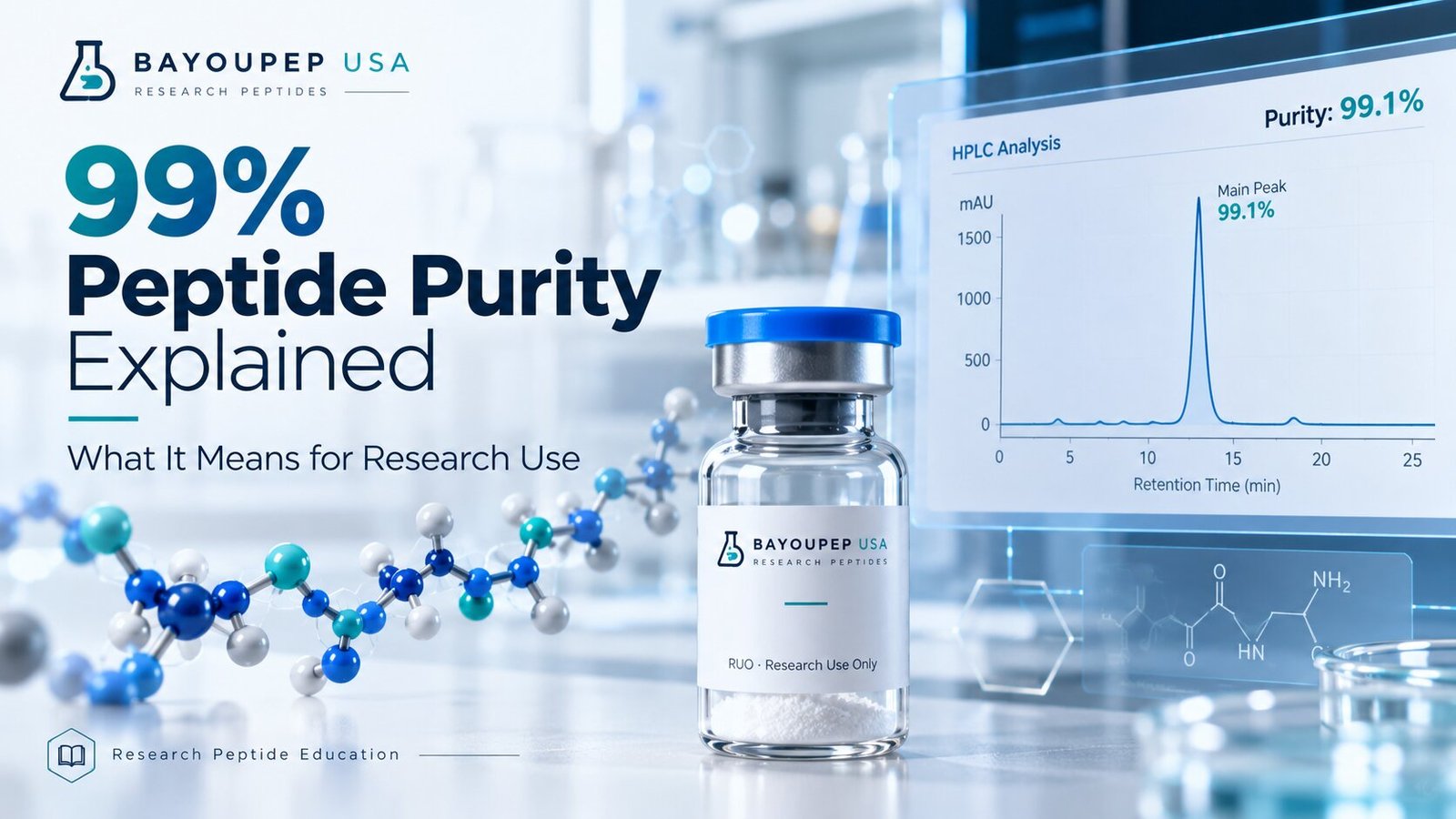
This generally means that the main detected peptide peak represented approximately 99.2% of the measured peak area under the specific testing conditions.
The remaining percentage may include:
- Related peptide fragments
- Synthesis byproducts
- Degradation products
- Other detected compounds
- Minor impurities
The exact meaning depends on the testing method used.
What Does 99% Peptide Purity Mean?
A peptide labeled as 99% pure generally contains a very high proportion of the intended peptide according to the analytical method used.
However, there is an important detail.
A purity percentage normally describes the relative composition detected during a specific laboratory test.
It does not automatically confirm every characteristic of the material.
For example, purity testing alone may not fully confirm:
- Peptide identity
- Exact peptide quantity
- Molecular structure
- Water content
- Salt content
- Residual solvents
- Biological activity
This is why researchers should review complete analytical documentation.
How Is Peptide Purity Tested?
High-Performance Liquid Chromatography is commonly used for peptide purity analysis.
It is usually shortened to HPLC.
HPLC separates components within a peptide sample.
Each component travels through the testing system at a different rate.
A detector records these components and produces a chromatogram.
Researchers can then examine the peaks shown on the graph.
The largest peak often represents the primary peptide.
Smaller peaks may represent impurities or related compounds.
Understanding an HPLC Chromatogram
An HPLC chromatogram normally displays several peaks.
Each peak represents something detected during testing.
The horizontal axis typically shows retention time.
The vertical axis represents detector response.
The main peptide usually creates the dominant peak.
The laboratory calculates the area represented by each peak.
For example, suppose a chromatogram shows:
- Main peptide peak: 99.1%
- Minor peak one: 0.5%
- Minor peak two: 0.3%
- Minor peak three: 0.1%
The reported peptide purity may therefore be approximately 99.1%.
This provides useful information about the sample’s composition.
Does 99% Purity Confirm Peptide Identity?
No.
Purity and identity are related but different measurements.
A highly pure sample may contain one dominant compound.
However, purity testing alone may not prove that the compound is the expected peptide.
Peptide identity is often checked using another analytical method.
Mass spectrometry is commonly used for this purpose.
It measures molecular mass and helps researchers compare the detected compound with the expected peptide.
For this reason, a strong analytical report may include both:
- HPLC purity analysis
- Mass spectrometry identity testing
Using multiple testing methods provides more useful research documentation.
What Is the Difference Between 98%, 99%, and 99.5% Purity?
The numerical difference appears small.
However, the difference can matter depending on the research setting.
Consider three samples:
- 98% purity
- 99% purity
- 99.5% purity
A 98% result means approximately 2% of detected peak area may come from other components.
At 99% purity, that amount falls to approximately 1%.
At 99.5%, detected impurities may represent approximately 0.5%.
These differences can be important during sensitive experiments.
Researchers should evaluate purity requirements based on their own laboratory procedures.
Why Does Peptide Purity Matter?
Research experiments depend on controlled materials.
Unexpected compounds can sometimes affect experimental observations.
Higher peptide purity may help reduce uncertainty caused by detected impurities.
Purity can matter when researchers study:
- Molecular interactions
- Receptor binding
- Cellular signaling
- Biochemical pathways
- Analytical behavior
- Peptide stability
- Laboratory assay performance
Consistent research materials also support repeatable experiments.
Can a Peptide Be 100% Pure?
Absolute 100% purity is difficult to demonstrate in practical laboratory testing.
Analytical instruments have detection limits.
Very small amounts of certain substances may remain below those limits.
Peptides can also contain trace levels of water, salts, solvents, or other materials depending on manufacturing and storage conditions.
Therefore, a very high reported purity should still be understood within the limits of the analytical method.
Researchers should focus on the full quality profile rather than expecting perfect numbers.
What Can Cause Peptide Impurities?
Peptide impurities can develop at different stages.
Peptide Synthesis
Synthetic peptides are often built one amino acid at a time.
During this process, incomplete reactions may create unwanted sequences.
Purification
After synthesis, the target peptide must be separated from other compounds.
The effectiveness of this step affects final purity.
Storage Conditions
Peptides can become less stable under poor storage conditions.
Heat, moisture, and light may influence degradation.
Transportation
Extended exposure to unsuitable conditions may affect some research materials.
Proper packaging can help protect peptide stability.
Handling
Repeated exposure to moisture or unsuitable laboratory environments can also affect sample quality.
What Are Common Peptide Impurities?
Different types of impurities may appear during peptide production.
These may include:
- Shorter peptide sequences
- Modified peptide chains
- Degradation products
- Residual synthesis compounds
- Trace solvents
- Salts
- Moisture
- Related molecular fragments
The type and amount of impurities depend on manufacturing methods and analytical conditions.
Does Higher Purity Always Mean Better Research Results?
Not automatically.
High purity can support reliable research, but many other factors also influence laboratory results.
Researchers should consider:
- Correct peptide identity
- Accurate documentation
- Proper storage
- Appropriate handling
- Reliable experimental methods
- Sample preparation
- Laboratory conditions
A 99% purity result is valuable information.
However, it should not be the only quality measurement considered.
Why Batch-Specific Purity Testing Matters
Peptide purity can vary between manufacturing batches.
One batch may test at 99.1%.
Another may test at 99.4%.
Researchers should therefore look for testing linked to the exact batch being purchased.
Batch-specific documentation improves traceability.
It also helps researchers connect laboratory materials with analytical records.
A generic purity report cannot provide the same level of detail.
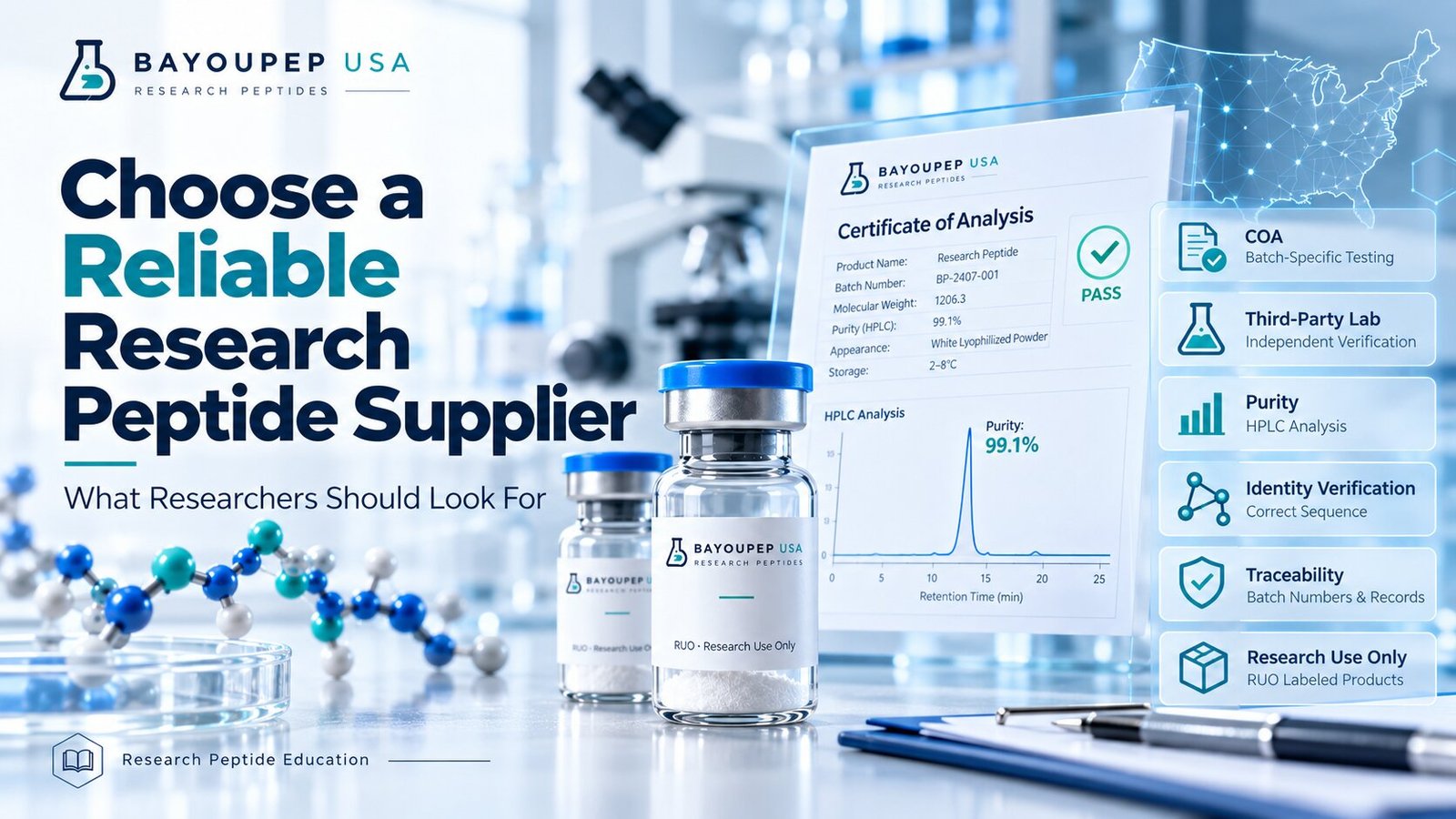
What Should Researchers Look for on a Purity Report?
Researchers should review more than the final percentage.
A useful purity report may include:
- Peptide name
- Batch or lot number
- Sample identification
- Testing date
- HPLC chromatogram
- Purity percentage
- Retention time
- Laboratory details
- Report number
Mass spectrometry data may also be provided separately.
These details make the report easier to evaluate.
Why Third-Party Testing Is Useful
Third-party testing means an independent laboratory evaluates the sample.
This provides another source of analytical information.
Independent testing may help verify manufacturer claims about peptide purity and identity.
However, researchers should still review the documentation carefully.
A third-party report should clearly show which sample was tested.
It should also identify the batch, testing method, and laboratory.
Purity Percentage vs Peptide Quantity
Purity should not be confused with peptide quantity.
For example, a vial may be labeled as containing a certain amount of peptide.
A 99% HPLC purity result does not automatically confirm that exact quantity.
Purity describes the proportion of detected compounds.
Quantity measures how much material is present.
These are separate analytical questions.
Researchers should understand the difference when reviewing laboratory documentation.
Does Appearance Indicate Peptide Purity?
Visual appearance cannot reliably confirm purity.
Many lyophilized peptides appear as white or off-white material.
However, appearance alone cannot confirm:
- Identity
- Purity percentage
- Molecular weight
- Sample quantity
Proper analytical testing is necessary.
Researchers should avoid judging peptide quality only by color or physical appearance.
Why Documentation Matters as Much as the Number
A purity claim becomes more useful when supported by clear documentation.
For example, a supplier might advertise “99% purity.”
Researchers should look for evidence supporting that statement.
Useful documentation may include:
- Batch-specific COA
- HPLC results
- Mass spectrometry results
- Independent laboratory information
- Testing dates
This creates better transparency.
Choosing High-Purity Research Peptides
Researchers evaluating peptide suppliers should look beyond marketing claims.
Important factors may include:
- Batch-specific testing
- Independent laboratory verification
- Clear Certificates of Analysis
- Product traceability
- Transparent purity results
- Proper packaging
- Research-only labeling
Quality documentation helps researchers make better purchasing decisions.
Bayoupep USA and Research Peptide Quality
At Bayoupep USA, research peptide quality and transparency are important considerations.
Researchers need dependable documentation when evaluating laboratory materials.
Clear purity information, batch-specific testing, and analytical reporting can make research products easier to assess.
A purity percentage should always be reviewed alongside supporting analytical results.
Bayoupep USA research products are intended strictly for laboratory research purposes.
They are not intended for human or veterinary use.
Final Thoughts
A 99% peptide purity result indicates a high proportion of the main detected peptide under specific testing conditions.
However, that number does not tell the complete story.
Researchers should also review identity testing, batch information, laboratory details, testing dates, and analytical graphs.
HPLC can provide useful purity information, while methods such as mass spectrometry can help support peptide identity.
The strongest approach is to evaluate the complete analytical profile.
Understanding peptide purity allows researchers to make more informed decisions when selecting and documenting materials for laboratory studies.