

In this article
Melanotan II, commonly shortened to MT-II, is a synthetic cyclic analogue of alpha-melanocyte-stimulating hormone, or α-MSH.
Unlike Melanotan I, which retains a longer linear α-MSH framework, Melanotan II uses a compact cyclic heptapeptide structure. This structural change makes MT-II an important research molecule for studying melanocortin receptors, peptide cyclization, receptor selectivity, and structure–activity relationships.
Research on Melanotan II has examined:
- Melanocortin receptor activation
- MC1R signaling
- MC3R and MC4R biology
- MC5R interactions
- cAMP signaling
- Pigmentation pathways
- Central melanocortin signaling
- Peptide conformation
- Receptor selectivity
- Structure–activity relationships
Melanotan II is generally considered a non-selective melanocortin receptor agonist rather than a compound that acts on only one melanocortin receptor. Early human research and later pharmacological studies described MT-II as a potent cyclic melanocortin analogue with activity across several receptor subtypes.
This broad activity is one of the main scientific differences between Melanotan II and Melanotan I.
For research purposes only. Not for human or veterinary use.
What Is Melanotan II?
Melanotan II is a synthetic peptide derived from the central pharmacological region of α-MSH.
Its commonly described structure is:
Ac-Nle-c[Asp-His-D-Phe-Arg-Trp-Lys]-NH₂
The peptide contains a lactam bridge that creates a cyclic structure. Early clinical research described MT-II as a lactam-bridged cyclic heptapeptide analogue of α-MSH.
Its compact cyclic design differs significantly from natural α-MSH.
Natural α-MSH contains 13 amino-acid residues.
Melanotan II uses only a shorter core region while preserving important residues involved in melanocortin receptor recognition.
Why Melanotan II Was Cyclized
Peptide cyclization is widely used in peptide chemistry.
A linear peptide can adopt many different shapes in solution.
Cyclization restricts this flexibility.
This may influence:
- Receptor binding
- Potency
- Selectivity
- Enzyme resistance
- Structural stability
Melanotan II was developed as part of research aimed at creating smaller and more potent analogues of α-MSH.
The cyclic design helps hold key receptor-binding residues in a more restricted conformation.
NMR studies of MT-II and related melanocortin compounds found defined structural features around the important melanocortin recognition sequence.
The Melanocortin System
The melanocortin system contains five receptors:
- MC1R
- MC2R
- MC3R
- MC4R
- MC5R
These receptors belong to the G protein-coupled receptor, or GPCR, family.
Natural melanocortin ligands are produced from the precursor protein:
Proopiomelanocortin, or POMC.
POMC gives rise to several biologically active peptides, including α-MSH and ACTH.
Each melanocortin receptor has different biological roles.
MC1R
MC1R is strongly associated with:
- Melanocytes
- Pigment production
- Skin biology
- Melanin synthesis
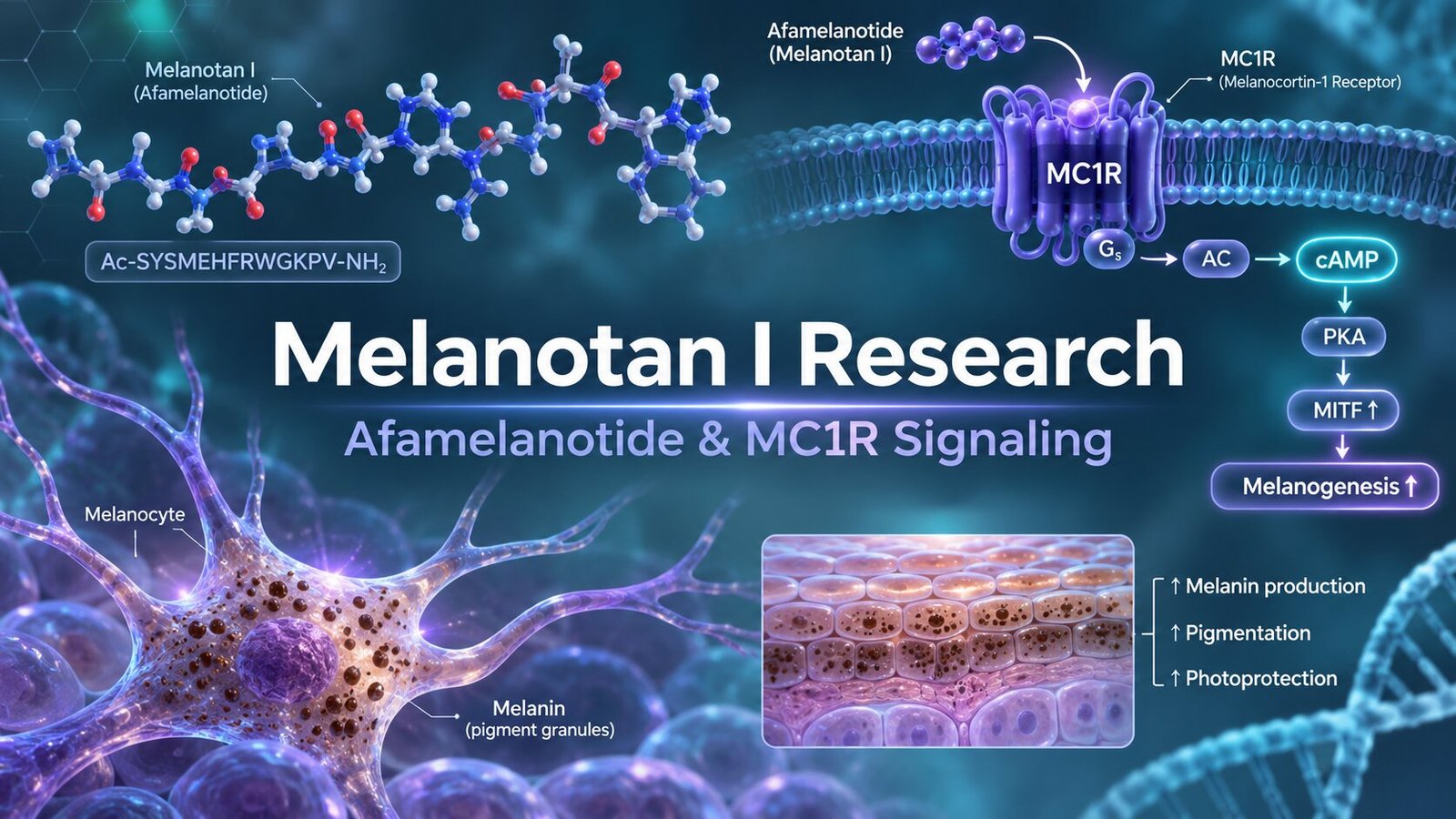
Activation of MC1R can stimulate cAMP signaling in melanocytes.
This can influence downstream pigmentation pathways.
MC2R
MC2R is different from the other melanocortin receptors.
It primarily responds to ACTH.
It is strongly associated with adrenal signaling and glucocorticoid production.
Melanotan II is not normally discussed as an important MC2R ligand.
MC3R
MC3R is expressed in several tissues, including parts of the central nervous system.
Research links MC3R to:
- Energy regulation
- Feeding pathways
- Neuroendocrine signaling
The receptor overlaps functionally with other central melanocortin receptors.
MC4R
MC4R is one of the most studied melanocortin receptors.
Research links it with:
- Energy homeostasis
- Appetite regulation
- Central nervous system signaling
- Sexual-function pathways
Melanotan II’s activity at MC4R helped make it an important research compound in central melanocortin biology.
MC5R
MC5R has been studied in:
- Exocrine gland physiology
- Peripheral signaling
- Secretory processes
Its physiological functions are less completely defined than those of MC1R or MC4R.
Why Melanotan II Is Considered Non-Selective
Melanotan II does not strongly isolate a single melanocortin receptor.
Research describes MT-II as a relatively non-selective melanocortin agonist.
That means it can be useful when researchers want to study broad melanocortin activation.
It is less useful when the goal is to isolate one receptor without additional controls.
Researchers may therefore use:
- Receptor-selective antagonists
- Knockout models
- Receptor-transfected cell lines
These tools can help determine which receptor produces a specific effect.
The Core Melanocortin Recognition Motif
Melanocortin peptides share an important sequence motif:
His-Phe-Arg-Trp
often abbreviated:
HFRW
This region plays a major role in receptor recognition.
Melanotan II preserves this core concept but contains D-Phe instead of the natural L-Phe form.
NMR research shows that the receptor-binding region of cyclic melanocortin analogues adopts a relatively defined conformation.
Why D-Phe Matters
D-Phe is the D-stereoisomer of phenylalanine.
Changing an amino acid from the natural L-form to the D-form can alter:
- Peptide conformation
- Enzyme recognition
- Receptor binding
- Metabolic stability
In Melanotan II, D-Phe is positioned within the core melanocortin receptor-recognition region.
This modification contributes to the structure–activity properties of the molecule.
Norleucine in Melanotan II
Melanotan II also contains norleucine, commonly abbreviated Nle.
Norleucine is structurally related to methionine but does not contain sulfur.
Its use in melanocortin analogues originally helped researchers develop peptides with improved chemical characteristics compared with native α-MSH sequences.
This same modification also appears in Melanotan I.
Why the Lactam Bridge Matters
The defining structural feature of Melanotan II is its cyclic lactam bridge.
A lactam is a cyclic amide.
In MT-II, side chains participate in formation of the ring.
This ring:
- Restricts peptide flexibility
- Stabilizes certain conformations
- Changes receptor presentation
- Influences pharmacological activity
It is one reason Melanotan II behaves differently from linear α-MSH analogues.
Linear vs Cyclic Peptides
Linear peptides can move through many conformations.
Cyclic peptides have fewer conformational possibilities.
That does not mean cyclic peptides are always stronger.
In fact, studies comparing linear and cyclic melanocortin core peptides found that cyclization can sometimes reduce receptor affinity depending on the exact sequence and ring design.
The biological effect therefore depends on the complete molecular structure.
Structure Is More Important Than Cyclization Alone
It would be incorrect to say:
“Cyclization automatically increases activity.”
Instead, activity depends on:
- Ring size
- Amino-acid sequence
- Stereochemistry
- Terminal modifications
- Receptor subtype
Melanotan II works as a useful example of how several design features can be combined in one molecule.
Conformational Research Using NMR
Nuclear magnetic resonance spectroscopy has been used to study Melanotan II.
Researchers examined MT-II and related cyclic melanocortin agonists and antagonists.
The studies identified relatively defined backbone structures around the receptor-recognition region.
A beta-turn was observed around important residues within the peptide.
This helps researchers understand why certain melanocortin analogues interact strongly with receptors.
Why Peptide Shape Matters
A receptor does not simply recognize amino-acid composition.
It recognizes a three-dimensional molecular surface.
Two peptides can contain similar residues but behave differently if their shapes differ.
Cyclization can change:
- Residue orientation
- Surface charge distribution
- Hydrophobic exposure
- Binding-pocket fit
Melanotan II is therefore useful for studying the relationship between peptide shape and receptor activation.
GPCR Signaling
Melanocortin receptors are G protein-coupled receptors.
MC1R, MC3R, MC4R, and MC5R commonly signal through Gs proteins.
Gs activation stimulates:
Adenylyl cyclase
which increases:
cyclic AMP, or cAMP.
A simplified pathway is:
Melanotan II → melanocortin receptor → Gs → adenylyl cyclase → cAMP
Researchers can measure this pathway in receptor-expressing cells.
cAMP as a Laboratory Endpoint
cAMP is one of the most useful experimental measurements in melanocortin research.
Researchers may expose cells to different concentrations of MT-II and measure intracellular cAMP.
This can provide information about:
- Potency
- Maximum receptor response
- Receptor subtype activity
A concentration-response curve can then be constructed.
Why Receptor-Specific Cell Lines Matter
Because Melanotan II activates multiple melanocortin receptors, mixed cell populations can be difficult to interpret.
A better approach is often to use cells engineered to express only one receptor.
Researchers could compare:
- MC1R cells
- MC3R cells
- MC4R cells
- MC5R cells
This allows direct comparison of receptor pharmacology.
MC1R and Pigmentation Research
MC1R is highly relevant to melanocyte biology.
When activated, MC1R can increase cAMP.
This influences pathways involving:
- MITF
- Tyrosinase
- Melanin synthesis
Melanotan II has historically been studied for its melanotropic activity because it can activate this receptor system.
Melanocyte Research Models
Researchers studying MC1R-related effects may use:
- Primary melanocytes
- Melanoma-derived cell lines
- Receptor-transfected cells
Possible endpoints include:
- cAMP
- Tyrosinase activity
- Melanin content
- Gene expression
- Cell viability
These experiments help separate receptor activation from downstream pigmentation.
Pigmentation Is Not a Single-Step Process
Melanin production requires several cellular processes.
These include:
- MC1R activation
- Transcriptional signaling
- Melanin synthesis
- Melanosome development
- Melanosome transport
A change in pigment does not reveal which step was affected.
Mechanistic studies therefore benefit from measuring several endpoints.
Central Melanocortin Research
Melanotan II has also been important in studies of central melanocortin signaling.
This research became especially relevant because receptors such as MC3R and MC4R are expressed in the nervous system.
Experimental studies have examined melanocortin involvement in:
- Feeding behavior
- Energy balance
- Autonomic pathways
- Sexual signaling
This broader receptor activity distinguishes MT-II from a peptide designed mainly for MC1R.
Human Research History
Early controlled studies evaluated Melanotan II in humans.
These experiments reported measurable pigmentation-related effects and also observed central physiological responses.
Later investigations studied its effects in men with erectile dysfunction and helped establish the role of melanocortin signaling in sexual-function pathways.
These historical studies are scientifically important.
However, they should not be interpreted as instructions for personal use.
Why the Sexual-Function Findings Were Important
The effects observed in early MT-II studies suggested that melanocortin pathways could influence sexual responses through the nervous system.
This was different from therapies acting directly on local vascular pathways.
The research eventually helped stimulate interest in more selective melanocortin compounds.
One important descendant of this research area is bremelanotide, also known as PT-141.
Melanotan II and PT-141
Melanotan II and PT-141 are closely related but not identical.
PT-141 was developed from melanocortin research involving Melanotan II.
Both are cyclic melanocortin peptides.
However, their structures and development goals differ.
Melanotan II
Research commonly includes:
- MC1R
- MC3R
- MC4R
- Pigmentation
- Central melanocortin signaling
PT-141
Research has focused more strongly on:
- Central melanocortin pathways
- Sexual-function signaling
- MC4R-related pharmacology
Therefore, PT-141 should not simply be described as another name for Melanotan II.
Melanotan II vs Melanotan I
The two compounds originate from α-MSH research but differ considerably.
Melanotan I
- Linear peptide
- 13-residue α-MSH analogue
- Also called afamelanotide
- Strong MC1R research focus
- Contains Nle4 and D-Phe7 substitutions
Melanotan II
- Cyclic heptapeptide
- Shorter structure
- Broader melanocortin activity
- Non-selective agonist profile
- Different central signaling research
These differences make the two suitable for separate scientific articles.
Why Melanotan I and II Should Not Be Grouped Together
The shared name can create confusion.
Their:
- Structures differ
- Receptor profiles differ
- Conformations differ
- Research histories differ
Researchers should record the exact compound rather than writing only “Melanotan.”
Melanotan II vs Natural Alpha-MSH
Natural α-MSH is a linear 13-residue endogenous peptide.
Melanotan II is shorter and cyclic.
Natural α-MSH evolved to operate within normal physiological regulation.
Melanotan II was synthetically designed as a potent experimental melanocortin ligand.
The difference provides a useful model for studying peptide engineering.
Melanotan II vs KPV
KPV is a three-residue fragment related to the C-terminal region of α-MSH.
Its main laboratory interests involve:
- Epithelial biology
- Inflammatory signaling
- NF-κB pathways
Melanotan II instead preserves the melanocortin receptor-binding pharmacophore and acts broadly at melanocortin receptors.
Their mechanisms should not be combined.
Melanotan II vs SNAP-8
SNAP-8 is an acetylated octapeptide inspired by SNAP-25-related biology.
Its proposed research area involves:
- SNARE proteins
- Vesicle fusion
- Exocytosis
Melanotan II instead acts through melanocortin GPCRs.
These peptides therefore represent completely different signaling systems.
Melanotan II and Receptor Selectivity Research
One major use of MT-II is as a reference compound in melanocortin pharmacology.
Researchers can compare MT-II with more selective molecules.
For example:
- MC1R-selective ligands
- MC3R-selective compounds
- MC4R agonists
- Melanocortin antagonists
This helps reveal how individual receptors contribute to a biological response.
Agonists and Antagonists
An agonist activates a receptor.
An antagonist blocks receptor activation.
Melanotan II is generally studied as an agonist.
Related cyclic peptides have also been modified to create antagonists.
Research comparing these molecules has helped identify structural features controlling melanocortin receptor function.
SHU9119 and Melanocortin Research
SHU9119 is a related cyclic melanocortin compound frequently used in receptor research.
Unlike MT-II, it shows antagonist activity at certain melanocortin receptors.
Comparing compounds such as MT-II and SHU9119 helps researchers understand how small structural changes can switch a peptide between agonist and antagonist behavior.
This is an important principle in peptide pharmacology.
Why One Amino-Acid Change Can Matter
Peptides are highly sensitive to sequence changes.
Replacing one residue may alter:
- Receptor affinity
- Receptor selectivity
- Agonist activity
- Antagonist activity
- Conformation
This makes the melanocortin system particularly useful for structure–activity studies.
Experimental Design for Melanotan II Research
A strong receptor experiment may include:
- Vehicle control
- Natural α-MSH
- Melanotan II
- Melanotan I
- Receptor-selective antagonist
- Receptor-negative cells
Researchers can then measure:
- cAMP
- Receptor binding
- Gene expression
- Cellular responses
This helps identify which observations are receptor dependent.
Dose-Response Research
Testing multiple concentrations provides more information than using one concentration.
A receptor-response experiment may determine:
- EC50
- Emax
- Relative potency
Researchers can then compare MT-II with other melanocortin ligands.
Time-Course Studies
Different signaling events occur over different periods.
For example:
- cAMP can rise quickly
- Gene expression may take longer
- Pigment accumulation requires additional time
Researchers should choose sampling times based on the endpoint.
Receptor Antagonist Controls
Because MT-II is non-selective, receptor antagonists are especially useful.
If an effect disappears after blocking MC4R, for example, that provides evidence for MC4R involvement.
Without receptor-specific controls, it may be difficult to identify the responsible pathway.
Knockout Models
Genetic knockout models can provide even stronger evidence.
Researchers may compare:
- Normal cells or animals
- MC1R knockout
- MC3R knockout
- MC4R knockout
Loss of an effect after removal of one receptor helps establish its role.
Receptor Internalization
GPCRs can become less responsive after prolonged stimulation.
This may involve:
- Receptor phosphorylation
- Arrestin recruitment
- Receptor internalization
- Desensitization
Melanotan II research could therefore examine not only receptor activation but also how receptors adapt after repeated exposure.
Biased Signaling
Modern GPCR pharmacology recognizes that one receptor can activate multiple pathways.
Different ligands may favor different signaling outputs.
Researchers may investigate whether melanocortin ligands produce different patterns involving:
- Gs
- cAMP
- Arrestins
- ERK signaling
This is known as biased signaling.
It could help explain differences between closely related melanocortin peptides.
Analytical Characterization of Melanotan II
Research-grade Melanotan II should be characterized analytically.
Common methods include:
- HPLC
- LC-MS
- High-resolution mass spectrometry
- Peptide mapping
The cyclic structure creates additional analytical considerations.
Researchers should confirm both:
- Correct sequence
- Correct ring formation
Why Ring Formation Must Be Verified
A peptide containing the correct amino acids but lacking the intended lactam bridge is not chemically identical to Melanotan II.
Incorrect cyclization could affect:
- Conformation
- Receptor binding
- Stability
- Biological activity
Therefore, identity testing should verify more than simple amino-acid composition.
HPLC Analysis
High-performance liquid chromatography can help assess:
- Main peak purity
- Secondary impurities
- Batch consistency
HPLC is useful for purity testing.
However, it should not be treated as complete proof of molecular identity.
Mass Spectrometry
Mass spectrometry can support identity testing.
It may detect:
- Expected molecular mass
- Synthesis impurities
- Truncated forms
- Degradation products
Combined HPLC and MS data provide stronger analytical confidence.
Purity and Identity Are Different Measurements
This distinction is important for every research peptide.
A sample may show:
99% purity
but still contain the wrong primary molecule.
Researchers should ask:
Purity:
How much of the detectable sample is the main component?
Identity:
Is the main component actually Melanotan II?
Both must be addressed.
Certificate of Analysis Review
A useful Melanotan II Certificate of Analysis may include:
- Product name
- Sequence
- Lot number
- HPLC purity
- Mass result
- Testing date
- Storage conditions
Researchers should prefer batch-specific documentation.
Storage Considerations
Peptide stability can be affected by:
- Temperature
- Moisture
- Light
- pH
- Oxidation
- Repeated freeze-thaw cycles
Researchers should follow the storage instructions provided for the specific lot.
Storage conditions for dry material and prepared solutions may differ.
Research Material vs Approved Medicine
Melanotan II should not be confused with an approved pharmaceutical product.
MT-II has been investigated experimentally, but that does not make research-grade Melanotan II a regulated medicine.
This distinction is particularly important because related melanocortin peptides may have approved pharmaceutical uses under different names and formulations.
Research material should remain clearly labeled for laboratory use only.
Evidence Limitations
Melanotan II has a substantial historical research record.
However, important limitations remain.
Much of the human research is:
- Relatively old
- Small in sample size
- Early phase
- Focused on narrow experimental questions
Modern interpretation should therefore rely heavily on receptor pharmacology and controlled mechanistic studies rather than broad claims.
Avoiding Unsupported Claims
Scientific content about Melanotan II should avoid claims such as:
- “Melanotan II is a safe tanning peptide.”
- “Melanotan II is approved for cosmetic tanning.”
- “Melanotan II works exactly like Melanotan I.”
- “Melanotan II only targets MC1R.”
More accurate statements focus on:
- Cyclic peptide structure
- Broad melanocortin receptor activity
- cAMP signaling
- Structure–activity relationships
Why Broad Receptor Activity Matters
A compound acting at several receptors can produce multiple biological effects.
That makes MT-II scientifically interesting but also makes interpretation more difficult.
An observed cellular or physiological effect may involve:
- MC1R
- MC3R
- MC4R
- MC5R
Researchers therefore need receptor-specific experiments.
Research Questions for Future Studies
Useful laboratory questions include:
- How strongly does MT-II activate each receptor subtype?
- How does its potency compare with α-MSH?
- How does cyclization alter receptor binding?
- Does MT-II produce biased signaling?
- How quickly do melanocortin receptors desensitize?
- Which structural residues control selectivity?
- How stable is MT-II under different laboratory conditions?
These questions remain relevant to modern peptide pharmacology.
Melanotan II Research and Bayoupep USA
Within the Bayoupep USA research catalog, Melanotan II should be presented as a cyclic melanocortin research peptide.
Researchers evaluating a sample should confirm:
- Correct peptide identity
- Cyclic structure
- Batch-specific purity
- Mass-spectrometry data
- Lot traceability
- Storage guidance
For research purposes only. Not for human or veterinary use.
Common Questions About Melanotan II
What is Melanotan II?
Melanotan II is a synthetic cyclic α-MSH analogue used in melanocortin receptor research.
Is Melanotan II a cyclic peptide?
Yes.
It is commonly described as a lactam-bridged cyclic heptapeptide.
What receptors does Melanotan II activate?
Research describes MT-II as a relatively non-selective agonist with activity across several melanocortin receptor subtypes, particularly MC1R, MC3R, MC4R, and MC5R-related systems.
What pathway do melanocortin receptors commonly activate?
Many melanocortin receptors signal through:
Gs → adenylyl cyclase → cAMP
Is Melanotan II the same as Melanotan I?
No.
Melanotan I is a longer linear α-MSH analogue.
Melanotan II is a shorter cyclic peptide with broader receptor activity.
Is Melanotan II the same as PT-141?
No.
They are related melanocortin peptides, but their structures and research histories differ.
Why is cyclization important?
Cyclization restricts peptide conformation and can change receptor binding, stability, and pharmacological activity.
What laboratory tests are useful for Melanotan II?
Useful analytical tools include:
- HPLC
- LC-MS
- Mass spectrometry
- Peptide identity testing
Is Melanotan II approved for human use?
Research-grade Melanotan II should not be presented as an approved pharmaceutical product.
Final Thoughts
Melanotan II is a compact cyclic analogue of α-MSH that played an important role in the development of modern melanocortin pharmacology.
Its defining features include:
- A cyclic lactam structure
- A conserved melanocortin receptor-binding motif
- D-Phe incorporation
- Broad melanocortin receptor activity
- Strong experimental potency
NMR research has shown that MT-II adopts a relatively defined conformation around its receptor-recognition region.
Its broad receptor profile also makes it different from Melanotan I.
Melanotan I retains a longer linear α-MSH structure and is strongly associated with MC1R research. Melanotan II is shorter, cyclic, and interacts more broadly with the melanocortin receptor system.
That broader activity has allowed researchers to investigate:
- MC1R pigmentation pathways
- MC3R signaling
- MC4R biology
- Central melanocortin pathways
- cAMP signaling
- Peptide cyclization
- Receptor selectivity
At the same time, its non-selective nature means experimental results require careful receptor-specific controls.
For strong laboratory work, researchers should combine:
- Receptor-specific cell systems
- Antagonist controls
- Dose-response analysis
- cAMP measurements
- HPLC purity testing
- Mass-spectrometry identity confirmation
- Verification of cyclic structure
- Batch traceability
Melanotan II is therefore best understood as a synthetic cyclic melanocortin agonist used to investigate receptor signaling, peptide conformation, and the relationship between molecular structure and melanocortin receptor activity.
This information is provided for scientific and educational research purposes only. Melanotan II research materials are not intended for human or veterinary use.