
In this article
Choosing a research peptide supplier requires careful evaluation.
Researchers need more than a product name and purity claim. They also need clear documentation, reliable testing, proper labeling, and transparent business practices.
The quality of research materials can influence laboratory consistency. Poor documentation may also make it harder to track samples between experiments.
For this reason, researchers should review several factors before choosing a peptide supplier.
This guide explains what to look for when evaluating research peptide suppliers in the USA.
Why Supplier Quality Matters
Research depends on controlled and well-documented materials.
When researchers purchase peptides, they need confidence that the product information matches the supplied material.
A reliable supplier should provide clear details about:
- Product identity
- Purity
- Batch information
- Testing methods
- Storage requirements
- Research-use restrictions
Transparent information makes materials easier to evaluate before laboratory use.
Supplier quality also matters for repeat research.
If a laboratory orders the same peptide again, consistent documentation can help researchers compare batches and maintain better records.
1. Look for Batch-Specific Testing
Batch-specific testing is one of the first things researchers should check.
A supplier may produce the same peptide in multiple batches. Each batch can have its own analytical results.
A current Certificate of Analysis should ideally connect directly to the product batch.
Researchers can look for:
- Batch number
- Lot number
- Sample identification
- Testing date
- Report number
These details improve traceability.
A generic COA used for every batch provides less useful information.
2. Check for Third-Party Laboratory Testing
Independent testing can add another level of transparency.
Third-party testing means a separate laboratory analyzes the submitted peptide sample.
The report may include purity and identity data.
Researchers should check whether the laboratory information is clearly displayed.
Useful details may include:
- Laboratory name
- Test date
- Analytical method
- Sample number
- Report identification
- Test results
Independent testing does not remove the need for careful review.
However, it provides additional analytical information beyond supplier claims.
3. Review the Certificate of Analysis
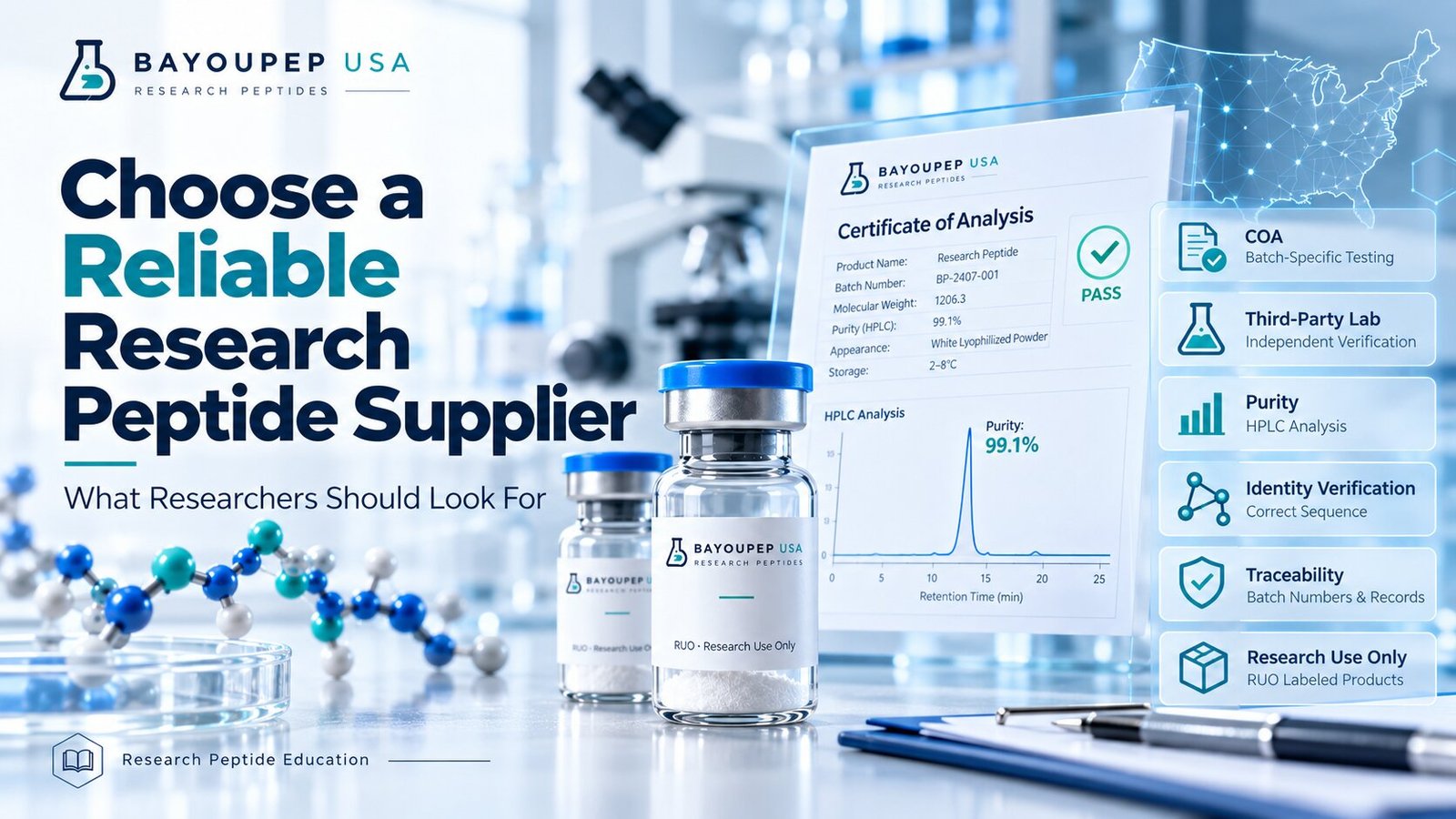
A Certificate of Analysis, or COA, is an important document.
Researchers should not focus only on the purity percentage.
A useful COA may contain several forms of information.
These can include:
- Peptide name
- Batch number
- Testing date
- HPLC results
- Purity percentage
- Mass spectrometry data
- Sample identification
- Laboratory information
The COA should match the product being purchased.
Researchers should also confirm whether the document applies to the current batch.
4. Understand the Purity Claim
Many peptide suppliers advertise products with purity above 99%.
This can be useful information, but it needs context.
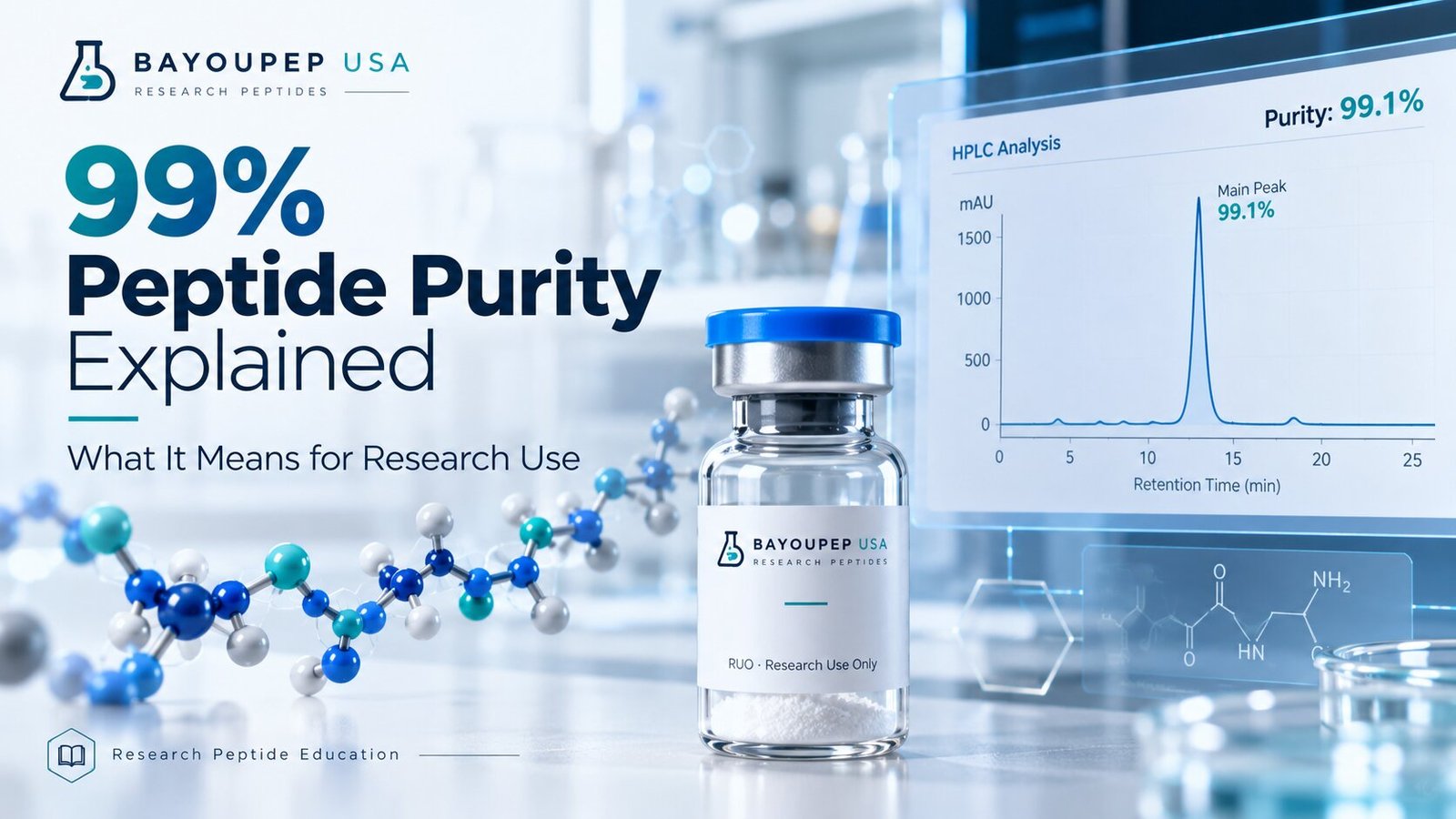
Purity is commonly measured using High-Performance Liquid Chromatography.
HPLC separates compounds in the sample and produces a chromatogram.
The main peak often represents the primary peptide.
However, a high purity percentage does not automatically confirm peptide identity.
Researchers should look for supporting analytical data whenever possible.
5. Look for Identity Verification
Purity and identity are not the same.
A sample may contain one dominant compound while still requiring confirmation of what that compound actually is.
Mass spectrometry is commonly used to support peptide identification.
The observed molecular mass can be compared with the expected value.
When choosing a supplier, researchers should look for analytical documentation that addresses both purity and identity.
This provides a more complete picture of the tested material.
6. Review Product Information Carefully
Reliable suppliers should provide clear product details.
A research peptide product page should ideally explain basic information such as:
- Peptide name
- Product amount
- Research designation
- Storage guidance
- Purity information
- Batch testing availability
Researchers should be cautious when product pages contain little useful information.
Clear descriptions make it easier to compare research materials and document purchases.
7. Confirm Research-Use-Only Labeling
Research peptides should be clearly labeled according to their intended purpose.
Many products are sold strictly for laboratory research.
Researchers should look for clear statements such as:
Research Use Only
or
Not for Human or Veterinary Use
This distinction is important.
A responsible research supplier should avoid presenting laboratory peptides as approved consumer products.
Clear labeling supports proper handling and research compliance.
8. Check Storage Information
Storage conditions can influence peptide stability.
Reliable suppliers should provide appropriate storage guidance.
Depending on the peptide and its form, storage considerations may involve:
- Temperature
- Light exposure
- Moisture
- Container sealing
- Laboratory handling
Researchers should follow product-specific storage instructions.
They should also maintain appropriate internal laboratory procedures.
A supplier that provides clear storage information demonstrates better product transparency.
9. Evaluate Product Packaging
Packaging helps protect research materials during transport and storage.
Researchers should consider whether products arrive in properly labeled containers.
Important packaging information may include:
- Product name
- Batch number
- Amount
- Research-use labeling
- Storage instructions
The container should also help protect the material from environmental exposure.
Packaging alone does not prove quality.
However, clear and professional labeling supports better laboratory organization.
10. Look for Clear Batch Traceability
Traceability allows researchers to connect a physical product with its analytical records.
This becomes especially useful during repeat studies.
For example, researchers may need to determine which batch was used during a particular experiment.
A clear system may include:
- Lot numbers
- COA references
- Order records
- Product labels
- Test reports
Better traceability supports better research documentation.
11. Review the Supplier’s Transparency
A trustworthy supplier should make important information easy to find.
Researchers should not have to search extensively for basic product details.
Useful transparency can include:
- Accessible COAs
- Clear testing information
- Contact details
- Shipping policies
- Product descriptions
- Research-use statements
- Storage guidance
Transparency does not guarantee product quality.
However, it makes supplier claims easier to evaluate.
12. Be Careful With Unsupported Claims
Researchers should review marketing language carefully.
A supplier should focus on research quality, testing, and product documentation.
Unsupported claims may create confusion.
Researchers should be cautious when a supplier makes strong statements without analytical evidence.
Quality should be supported by measurable information.
That includes laboratory testing, batch records, and clear documentation.
13. Check Whether Testing Is Recent
Testing dates can provide useful context.
A report created several years ago may not apply to a newly produced batch.
Researchers should look for current documentation connected to the product being purchased.
Recent testing is especially useful when combined with batch identification.
This makes the analytical record easier to verify.
14. Evaluate Customer Support
Customer support can also matter when ordering laboratory materials.
Researchers may need help locating documentation or confirming product information.
A reliable supplier should provide a clear way to ask questions.
Good support may help with:
- COA requests
- Batch information
- Storage questions
- Order status
- Product documentation
Support teams should provide factual information rather than unsupported claims.
15. Review Shipping and Handling Practices
Research peptides may require careful handling during shipment.
Researchers should review how the supplier packages and dispatches orders.
Shipping information may include:
- Packaging methods
- Order processing
- Tracking availability
- Delivery policies
- Handling guidance
The exact requirements vary between products.
Researchers should evaluate shipping alongside storage requirements.
16. Compare Suppliers Using Documentation
Price should not be the only factor when comparing peptide suppliers.
A lower price may seem attractive.
However, documentation and testing are also important.
Researchers can compare suppliers using several criteria:
- Batch-specific COAs
- Third-party testing
- Product traceability
- Clear purity data
- Identity verification
- Storage guidance
- Research-use labeling
A structured comparison helps researchers make more informed purchasing decisions.
17. Avoid Choosing Based Only on Purity Percentage
A 99% purity claim may look impressive.
However, researchers should ask what supports that number.
Does the supplier provide an HPLC chromatogram?
Is the report linked to a specific batch?
Was identity also evaluated?
Is the testing laboratory clearly identified?
These questions provide more useful information than the percentage alone.
18. Check Whether Products Are Clearly Organized
A well-organized product catalog can make research purchasing easier.
Researchers should be able to distinguish between individual peptides and blends.
Each product should have its own information.
This reduces confusion when reviewing different research materials.
Clear organization also helps laboratories maintain accurate purchase records.
19. Keep Your Own Laboratory Records
Even when a supplier provides strong documentation, researchers should maintain internal records.
Useful records may include:
- Supplier name
- Purchase date
- Product name
- Batch number
- COA
- Storage conditions
- Laboratory use date
These records improve traceability during future analysis.
They can also help researchers compare results between different batches.
Questions to Ask Before Choosing a Peptide Supplier
Researchers can use a simple checklist before placing an order.
Ask:
- Is a batch-specific COA available?
- Is the peptide independently tested?
- Is purity testing documented?
- Is identity verification available?
- Is the testing date current?
- Is the lot number clearly listed?
- Are storage instructions provided?
- Is the product labeled for research use only?
- Is the supplier easy to contact?
- Are product descriptions clear?
If important information is missing, researchers may want additional documentation before making a decision.
How Bayoupep USA Supports Research Transparency
At Bayoupep USA, research product transparency is an important part of the purchasing process.
Researchers benefit from clear analytical documentation when evaluating laboratory materials.
Batch information, purity results, third-party testing, and accessible product details can make peptide selection easier.
Researchers should always review available documentation before beginning laboratory work.
Bayoupep USA products are intended strictly for laboratory research purposes.
They are not intended for human or veterinary use.
Final Thoughts
Choosing a reliable research peptide supplier involves more than comparing prices.
Researchers should examine the complete quality and documentation process.
Start with batch-specific testing and a clear Certificate of Analysis.
Then review peptide purity, identity testing, traceability, storage information, and research-use labeling.
Independent testing can provide additional useful information.
Clear product documentation also helps researchers maintain better laboratory records.
A reliable peptide supplier should make quality information easy to access and understand.
Taking time to evaluate these factors can help researchers select better-documented materials for their laboratory work.