

In this article
Research peptides often carry the label Research Use Only, or RUO.
This label is important because it explains the intended purpose of the product. It also helps separate laboratory research materials from products intended for clinical, diagnostic, or consumer use.
For researchers, understanding the RUO label is part of proper purchasing, handling, documentation, and laboratory practice.
This guide explains what Research Use Only means, why peptide products carry this label, and what researchers should check before ordering RUO peptides.
What Does Research Use Only Mean?
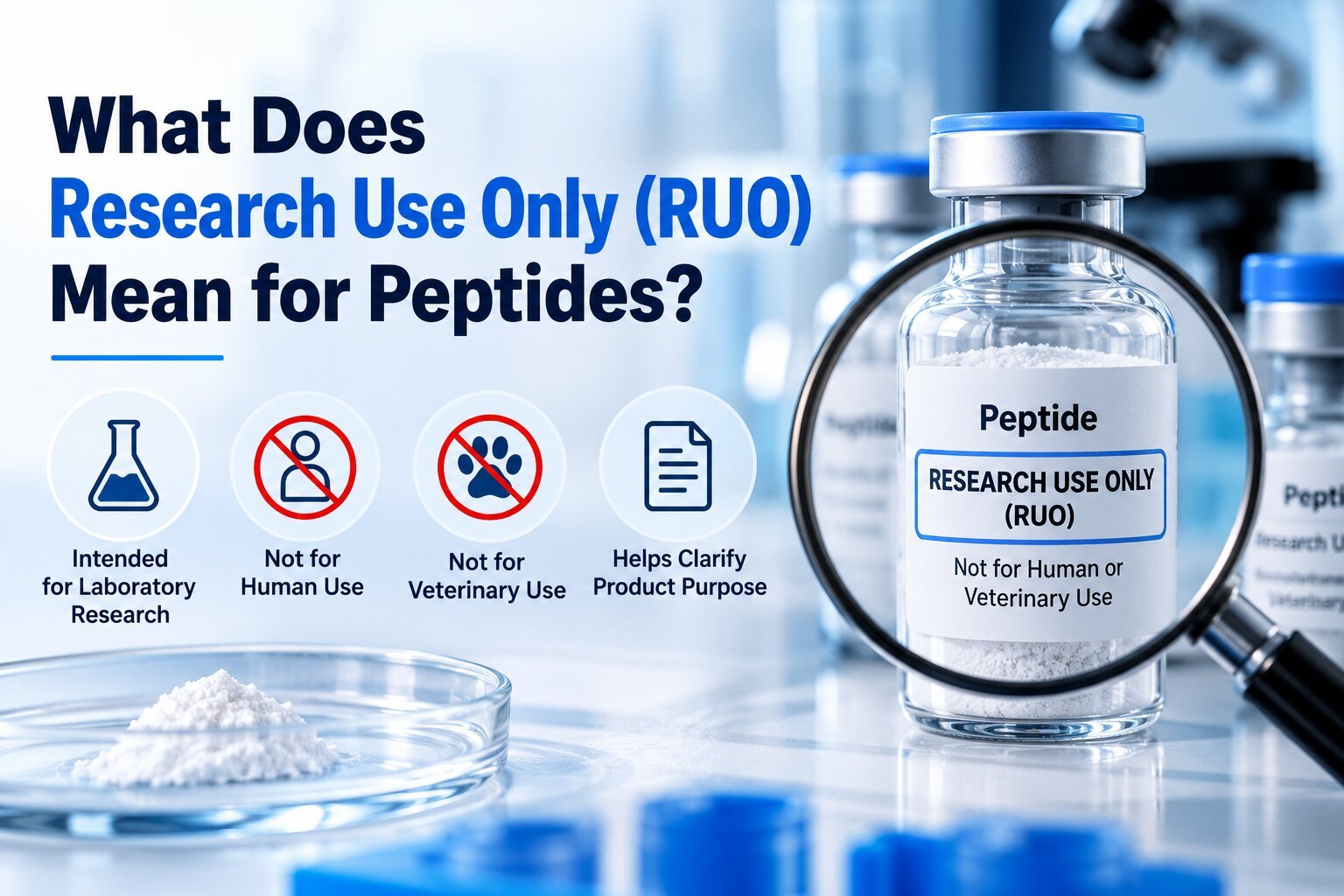
Research Use Only means that a product is intended for laboratory or scientific research.
The label indicates that the material is not intended for direct use in humans or animals.
RUO products may be used in controlled research settings to study areas such as:
- Molecular behavior
- Peptide structure
- Receptor interactions
- Cellular signaling
- Biochemical pathways
- Analytical characteristics
- Stability
- Laboratory assay performance
The exact research purpose depends on the peptide and the laboratory protocol.
The RUO designation helps clarify how the product should be treated.
What Does RUO Stand For?
RUO stands for:
Research Use Only
You may see this term on:
- Product labels
- Peptide vials
- Certificates of Analysis
- Product pages
- Packaging
- Laboratory documentation
Some suppliers may also use phrases such as:
For Research Purposes Only
or
Not for Human or Veterinary Use
These statements communicate a similar research-only purpose.
Why Do Research Peptides Carry an RUO Label?
Peptides can be used in many areas of scientific research.
However, a research peptide product is not automatically approved as a medicine, treatment, diagnostic product, or consumer item.
The RUO label helps make this distinction clear.
It tells buyers that the product is being supplied for scientific research rather than personal or therapeutic use.
This is especially important when peptide names may also appear in scientific or pharmaceutical discussions.
Researchers should evaluate the product based on its stated research purpose.
RUO Peptides Are Not Consumer Products
Research peptides are not intended to function like ordinary consumer products.
They are typically supplied for laboratory professionals, research groups, analytical laboratories, or other qualified research environments.
RUO peptides should not be treated as:
- Dietary supplements
- Prescription medicines
- Over-the-counter products
- Food products
- Cosmetic products
- Veterinary products
The product’s intended use should remain clear throughout purchasing and laboratory handling.
Why Clear RUO Labeling Matters
Clear labeling helps reduce confusion.
A research laboratory may store many types of materials at the same time.
Proper labels help researchers identify the purpose and status of each product.
An RUO label can support:
- Better sample organization
- Clearer laboratory records
- More accurate inventory control
- Improved handling procedures
- Better communication between research staff
Good labeling also helps researchers avoid mixing research materials with non-research products.
What Information Should an RUO Peptide Label Include?
The exact label may vary between suppliers.
However, useful information may include:
- Product name
- Batch or lot number
- Product amount
- Research Use Only statement
- Storage guidance
- Supplier information
Some labels may also include a product code or internal reference number.
Researchers should keep the label readable during storage.
If the material is transferred to another container, the new container should also be clearly identified according to laboratory procedures.
RUO Labeling and Batch Traceability
Batch traceability is important for laboratory research.
Researchers should be able to connect the physical product with its analytical documentation.
Useful traceability information may include:
- Batch number
- Lot number
- Certificate of Analysis
- Testing date
- Order record
- Product label
This information helps researchers identify which material was used in a specific study.
It can also make repeat experiments easier to document.
Does RUO Mean the Peptide Is Tested?
Not necessarily.
The RUO label explains intended use.
It does not automatically confirm product quality, purity, identity, or testing.
Researchers should evaluate these factors separately.
Important quality information may include:
- HPLC purity testing
- Mass spectrometry
- Certificate of Analysis
- Batch-specific documentation
- Third-party laboratory testing
RUO status and analytical quality are different considerations.
A responsible purchasing process should review both.
Does RUO Mean a Product Is 99% Pure?
No.
An RUO designation does not automatically indicate a certain purity level.
Purity must be measured using analytical methods.
For peptides, HPLC is commonly used to evaluate purity.
The resulting data may show the percentage associated with the main detected peptide peak.
Researchers should check the actual test report rather than assuming purity from the RUO label.
RUO Peptides and Certificates of Analysis
A Certificate of Analysis can provide useful information about a research peptide.
A COA may include:
- Product name
- Batch number
- Purity result
- HPLC data
- Molecular mass information
- Testing date
- Laboratory details
The RUO label explains product purpose.
The COA provides analytical information.
Both can support better research documentation.
Researchers should confirm that the COA matches the product batch they received.
Why Third-Party Testing Matters for RUO Products
Third-party testing can provide additional transparency.
An independent laboratory can analyze a submitted sample and provide analytical results.
This may help support claims about:
- Purity
- Identity
- Molecular mass
- Sample characteristics
Researchers should still review the report carefully.
The document should ideally show clear sample and batch identification.
Testing information is most useful when it can be linked directly to the purchased material.
RUO Peptides and Laboratory Storage
Research-use labeling does not replace proper storage.
Researchers should still follow product-specific storage instructions.
Important factors may include:
- Temperature
- Moisture
- Light exposure
- Container sealing
- Handling frequency
Some peptides may be more sensitive than others.
The correct storage method depends on the material and its form.
Researchers should always review product documentation.
Who Typically Uses Research Use Only Peptides?
RUO peptides may be used by qualified researchers working in controlled laboratory environments.
Examples may include:
- Academic research laboratories
- Private research organizations
- Analytical laboratories
- Biotechnology research groups
- Molecular biology laboratories
- Biochemistry research teams
The exact use depends on the scope of the research.
Laboratories should maintain appropriate internal procedures for handling research materials.
Why Researchers Should Review Product Descriptions Carefully
Product pages should clearly explain how a peptide is intended to be used.
Researchers should look for information about:
- Research designation
- Purity
- Testing
- Storage
- Product amount
- COA availability
- Batch information
A clear product page helps buyers understand what they are ordering.
Researchers should be cautious when important information is missing or unclear.
Common Misunderstandings About RUO Peptides
Several misunderstandings can occur around research-use labeling.
RUO Does Not Mean Approved for Treatment
A research-use designation does not mean a product is approved for medical treatment.
Its intended purpose remains laboratory research.
RUO Does Not Guarantee Quality
The label alone does not prove purity or identity.
Analytical testing is needed.
RUO Does Not Replace Laboratory Procedures
Researchers must still use proper storage, documentation, and handling practices.
RUO Does Not Mean Every Product Is the Same
Different peptides have different structures, storage needs, and research applications.
Each material should be reviewed individually.
What Should Researchers Check Before Ordering RUO Peptides?
A simple review process can help researchers compare products more carefully.
Before ordering, consider checking:
- Is the product clearly labeled Research Use Only?
- Is a batch-specific COA available?
- Is purity data provided?
- Is identity testing available?
- Is the testing recent?
- Is the batch number clearly listed?
- Are storage instructions provided?
- Is supplier contact information available?
- Is the product description clear?
- Is the material intended strictly for laboratory research?
These checks support better purchasing decisions.
Why Research Documentation Matters
Good documentation supports better laboratory organization.
Researchers may need to review product records long after an experiment ends.
Useful records may include:
- Product name
- Supplier name
- Batch number
- Date received
- COA
- Storage conditions
- Research date
- Internal sample ID
This information can help connect analytical results with the materials used.
It may also help when repeating experiments.
RUO Peptides and Responsible Laboratory Handling
Research materials should be handled carefully.
Laboratories should develop procedures that support:
- Clear labeling
- Restricted access
- Accurate inventory
- Appropriate storage
- Sample traceability
- Proper documentation
Each organization may have its own internal requirements.
Researchers should follow those procedures consistently.
How Bayoupep USA Presents Research-Use Products
At Bayoupep USA, research peptides are supplied for laboratory and research purposes.
Clear research-use labeling helps define how these materials are intended to be handled.
Researchers should review product documentation, batch information, analytical testing, and storage guidance before laboratory use.
Quality research decisions depend on more than a product name.
Transparent documentation helps researchers evaluate the material more carefully.
Bayoupep USA products are intended strictly for research use only.
They are not intended for human or veterinary use.
Final Thoughts
Research Use Only is more than a simple label.
It defines the intended purpose of a research peptide.
RUO peptides are supplied for controlled scientific and laboratory work, not for personal, therapeutic, or veterinary use.
Researchers should still evaluate purity, identity, testing, storage, and batch traceability separately.
A clear RUO label, strong documentation, and reliable analytical data can help support better research practices.
Understanding these distinctions makes it easier to select, document, and manage peptide materials responsibly.