

In this article
Tesamorelin is a synthetic peptide analog of human growth hormone-releasing factor, often abbreviated as GRF or GHRH.
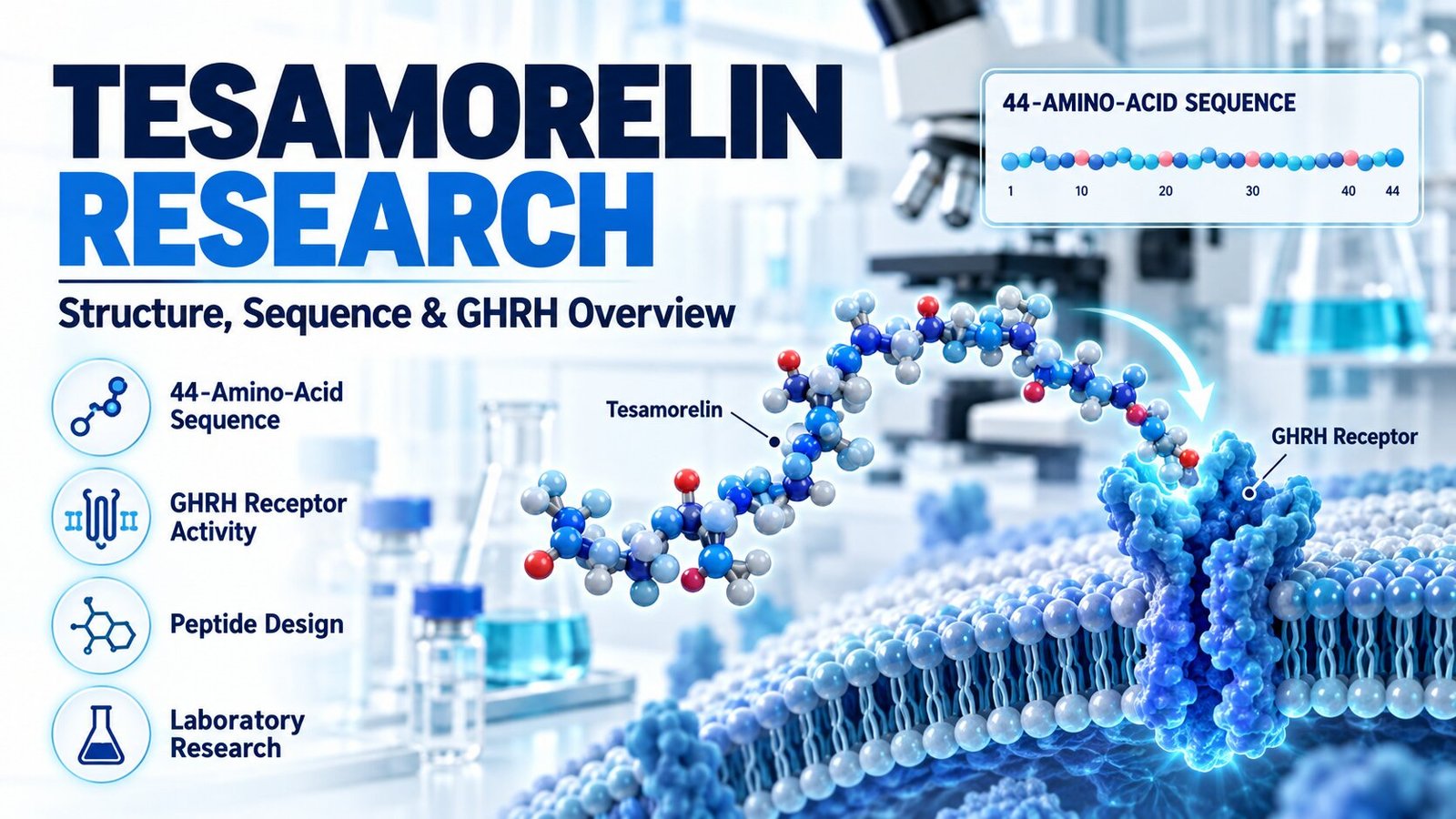
It has attracted scientific interest because its structure closely follows the natural 44-amino-acid human GRF sequence while adding a specific chemical modification at the N-terminal end.
That design allows researchers to study how peptide modification can influence receptor activity, molecular stability, and growth hormone-related signaling.
Tesamorelin is also the active ingredient in an FDA-approved prescription product for a specific medical indication. However, laboratory research involving the molecule remains valuable for understanding GHRH receptor biology, peptide engineering, and structure-function relationships.
This article examines tesamorelin from a research perspective, focusing on its sequence, molecular architecture, receptor pathway, analytical characteristics, and laboratory study applications.
What Is Tesamorelin?
Tesamorelin is a laboratory-synthesized analog of human growth hormone-releasing factor.
The molecule contains the complete 44-amino-acid sequence of human GRF with an additional hexenoyl group attached near its N-terminal tyrosine residue.
This modification distinguishes tesamorelin from the naturally occurring hormone.
From a research perspective, that makes tesamorelin useful for investigating how a small structural change can alter the behavior of a peptide without replacing its core sequence.
Tesamorelin as a GHRH Analog
Growth hormone-releasing hormone is produced naturally in the hypothalamus.
Its role is to communicate with growth hormone-releasing hormone receptors located primarily in the anterior pituitary.
When these receptors are activated, downstream signaling can influence growth hormone secretion.
Tesamorelin was designed to interact with the same receptor system.
Because of this, researchers often classify it as a GHRH receptor agonist or GRF analog.
This classification describes its molecular target rather than a broad therapeutic effect.
Understanding the 44-Amino-Acid Sequence
Tesamorelin follows the same 44-residue backbone found in human GRF.
The sequence begins with tyrosine and continues through a defined arrangement of amino acids ending in leucine amide.
The peptide sequence includes:
Tyr–Ala–Asp–Ala–Ile–Phe–Thr–Asn–Ser–Tyr–Arg–Lys–Val–Leu–Gly–Gln–Leu–Ser–Ala–Arg–Lys–Leu–Leu–Gln–Asp–Ile–Met–Ser–Arg–Gln–Gln–Gly–Glu–Ser–Asn–Gln–Glu–Arg–Gly–Ala–Arg–Ala–Arg–Leu–NH₂.
For researchers, sequence information is important because amino-acid order influences the molecule’s shape, receptor interaction, and analytical profile.
What Is the Hexenoyl Modification?
The defining structural modification in tesamorelin is a hexenoyl moiety attached to the N-terminal tyrosine.
The FDA describes this moiety as a six-carbon chain containing a double bond at position three.
This added group changes the molecule from native GRF while preserving its peptide backbone.
In laboratory research, such structural modifications are important because they can influence characteristics such as:
- Enzymatic stability
- Molecular persistence
- Receptor interaction
- Peptide degradation
- Pharmacokinetic behavior
Tesamorelin therefore provides a useful example of how peptide chemistry can be adjusted without completely changing the original biological sequence.
Molecular Weight and Chemical Characteristics
Tesamorelin has a free-base molecular weight of approximately 5135.9 Da.
The peptide is commonly prepared as an acetate salt.
Molecular weight is useful in laboratory analysis because it provides a reference point for identity testing.
Researchers can compare expected molecular characteristics with experimentally observed values.
This helps support sample verification.
How Tesamorelin Interacts With the GHRH Receptor
Tesamorelin functions by engaging the GHRH receptor.
This receptor belongs to the G protein-coupled receptor family.
When activated, it can initiate intracellular signaling pathways.
Researchers may examine responses such as:
- Cyclic AMP signaling
- Protein kinase activity
- Cellular messenger changes
- Receptor activation
- Hormone-related signaling
These experiments help scientists understand how peptide-receptor interactions translate into downstream biological activity.
Why GHRH Receptor Research Matters
The GHRH receptor plays an important role in endocrine signaling.
Studying this receptor can provide information about:
- Hormonal communication
- Pituitary signaling
- Receptor selectivity
- Ligand binding
- Intracellular responses
- Peptide structure-function relationships
Tesamorelin offers a defined molecular tool for investigating these questions.
Its close similarity to natural human GRF makes it especially useful for comparative research.
Tesamorelin vs Natural GHRH
Natural GHRH and tesamorelin are closely related but not identical.
Both share the same 44-amino-acid peptide backbone.
The major difference is the added hexenoyl group in tesamorelin.
That small modification may influence how the molecule behaves when exposed to enzymatic degradation or biological systems.
For laboratory studies, this creates a useful comparison model.
Researchers can investigate whether structural modification changes:
- Receptor activity
- Molecular stability
- Signal duration
- Degradation rate
- Experimental response
This type of comparison helps illustrate the relationship between peptide chemistry and function.
Why Peptide Stability Is Important in Research
Peptides can be vulnerable to enzymatic breakdown.
Their stability depends on sequence, structure, formulation, and environmental conditions.
Researchers often study peptide stability to understand how long a compound retains its expected molecular characteristics.
Factors that may influence stability include:
- Temperature
- Moisture
- pH
- Light
- Enzymatic exposure
- Container conditions
Tesamorelin’s modified N-terminal region makes stability research particularly relevant.
Structure-Activity Relationships in GHRH Analogs
Scientists have studied GHRH analogs for decades.
Research has shown that changing particular amino acids or introducing structural constraints can significantly alter receptor activity.
Some experimental GHRH analogs have displayed higher potency or longer activity than unmodified reference sequences.
These findings illustrate an important concept in peptide science:
Small structural changes can produce large functional differences.
Tesamorelin fits within this broader area of structure-activity research.
Why N-Terminal Modification Matters
The N-terminal region of many peptide hormones is especially important for receptor interaction and enzymatic stability.
Chemical modifications in this area can affect how quickly enzymes break down the molecule.
Researchers may therefore compare:
- Native peptide sequences
- Modified peptide analogs
- Different N-terminal substitutions
- Receptor activation strength
- Degradation resistance
Tesamorelin’s hexenoyl modification provides one example of this design strategy.
Laboratory Methods Used to Study Tesamorelin
Researchers can investigate tesamorelin using several analytical and biological techniques.
These may include:
- Receptor-binding assays
- Cell-based signaling studies
- Chromatographic analysis
- Mass spectrometry
- Stability testing
- Structural characterization
Each method addresses a different research question.
Combining several techniques can provide a more complete understanding of the molecule.
Receptor-Binding Experiments
Receptor-binding studies help researchers examine how strongly a compound interacts with its target receptor.
In tesamorelin research, these assays can help characterize interaction with the GHRH receptor.
Researchers may compare:
- Binding strength
- Concentration-response behavior
- Native GHRH
- Modified analogs
- Competitive ligands
These experiments provide information about receptor affinity and selectivity.
Functional Signaling Studies
Binding to a receptor does not always tell the whole story.
Researchers may also study what happens after receptor activation.
Functional assays can measure intracellular responses such as:
- Cyclic AMP production
- Signal amplification
- Protein activation
- Cellular response timing
These measurements help researchers determine how receptor engagement translates into functional activity.
Chromatographic Characterization
High-performance liquid chromatography can be used to examine tesamorelin research samples.
HPLC separates sample components according to their interaction with the chromatographic system.
Researchers may review:
- Main peak distribution
- Retention time
- Minor peaks
- Relative peak areas
- Batch consistency
This provides useful information about the composition of the tested material.
Mass Spectrometric Analysis
Mass spectrometry can support molecular characterization.
Tesamorelin has a known expected molecular mass, so experimentally detected mass values can be compared with the reference value.
Researchers may evaluate:
- Molecular ion signals
- Fragment patterns
- Expected mass
- Observed mass
- Sample identity
This kind of analysis helps confirm whether a sample is consistent with the intended molecule.
Why Sequence Confirmation Matters
Two peptide samples may appear similar but differ at the molecular level.
Sequence confirmation is therefore important for research quality.
A change involving even one amino acid may influence:
- Molecular mass
- Receptor binding
- Stability
- Biological behavior
Reliable characterization helps reduce uncertainty during experimental work.
Tesamorelin and Peptide Purity
Researchers often examine the relative composition of a peptide sample before beginning experiments.
A purity measurement may help identify whether the main component dominates the chromatographic profile.
However, laboratories should not evaluate tesamorelin based on a purity percentage alone.
Additional information such as molecular identity, sequence characteristics, batch records, and analytical methods provides better context.
Why Batch Traceability Matters
Each production batch may show small analytical differences.
Maintaining clear batch records allows researchers to connect experimental results to the exact material used.
Useful records may include:
- Batch number
- Sample identifier
- Analysis date
- Chromatographic report
- Molecular characterization
- Storage history
This becomes especially important during repeated studies.
Tesamorelin in Comparative Peptide Research
Tesamorelin can also be compared with other compounds that influence growth hormone-related pathways.
However, researchers should distinguish between different mechanisms.
For example, one peptide may act directly at the GHRH receptor.
Another compound may affect a different receptor associated with growth hormone release.
Even if two compounds are discussed within the same research category, their mechanisms may differ considerably.
This makes receptor-level comparison important.
Tesamorelin vs Shorter GHRH Fragments
Some research compounds are based on shorter segments of the GHRH sequence.
Tesamorelin differs because it retains the full 44-amino-acid human GRF backbone.
Shorter analogs may have different:
- Receptor properties
- Stability
- Molecular weight
- Structural behavior
- Experimental characteristics
Researchers should therefore avoid treating all GHRH-related peptides as equivalent.
What Can Cell-Based Studies Reveal?
Cellular research models can provide information about how tesamorelin activates signaling pathways.
Depending on the study, scientists may monitor:
- Messenger production
- Receptor responsiveness
- Dose-response patterns
- Signal duration
- Gene-expression changes
These experiments help researchers connect molecular binding with downstream cellular activity.
Why Experimental Controls Matter
Good controls make peptide research easier to interpret.
A tesamorelin experiment may include:
- Untreated cells
- Vehicle controls
- Native GHRH
- Reference agonists
- Receptor-blocking compounds
These comparisons help identify which effects are specifically associated with the tested peptide.
Research Documentation for Tesamorelin
Laboratory documentation should clearly identify the material being studied.
Researchers may record:
- Compound name
- Batch number
- Sample code
- Supplier
- Date received
- Storage conditions
- Analytical data
- Experimental dates
Well-maintained records improve repeatability and reduce confusion between samples.
Storage Considerations
Peptide materials can be sensitive to environmental conditions.
Researchers should follow the storage guidance supplied for the specific material.
Important considerations may include:
- Temperature
- Light exposure
- Moisture
- Container sealing
- Length of storage
Different formulations may require different conditions.
A single storage rule should not be assumed for all peptide samples.
Tesamorelin as an Example of Peptide Engineering
Tesamorelin is useful for understanding a broader concept in molecular research.
Scientists can begin with a naturally occurring peptide sequence and modify a specific region to influence molecular behavior.
This principle is widely used in peptide engineering.
Researchers may alter molecules to study changes in:
- Stability
- Receptor activity
- Protein interaction
- Enzymatic resistance
- Duration of signaling
Tesamorelin provides a practical example of this approach.
Tesamorelin Research and Bayoupep USA
At Bayoupep USA, peptide compounds supplied for research are intended for controlled laboratory investigation.
Researchers working with tesamorelin-related materials should review the available molecular information, batch records, analytical documentation, and storage guidance before beginning experimental work.
Each peptide should be evaluated according to its own sequence and molecular properties.
Bayoupep USA research products are intended only for laboratory research and are not intended for human or veterinary use.
Final Thoughts
Tesamorelin is a 44-amino-acid synthetic analog of human growth hormone-releasing factor with a distinctive hexenoyl modification at its N-terminal region.
That combination of a native peptide backbone and targeted chemical modification makes it an interesting subject for laboratory research.
Researchers can study tesamorelin from several perspectives, including receptor activity, molecular stability, sequence-function relationships, chromatographic behavior, and peptide engineering.
Its design also demonstrates an important principle in peptide science: a relatively small structural modification can influence how a molecule behaves without replacing its fundamental biological sequence.
Careful analytical characterization, appropriate controls, batch traceability, and strong laboratory documentation remain essential when studying tesamorelin or related GHRH analogs.