

In this article
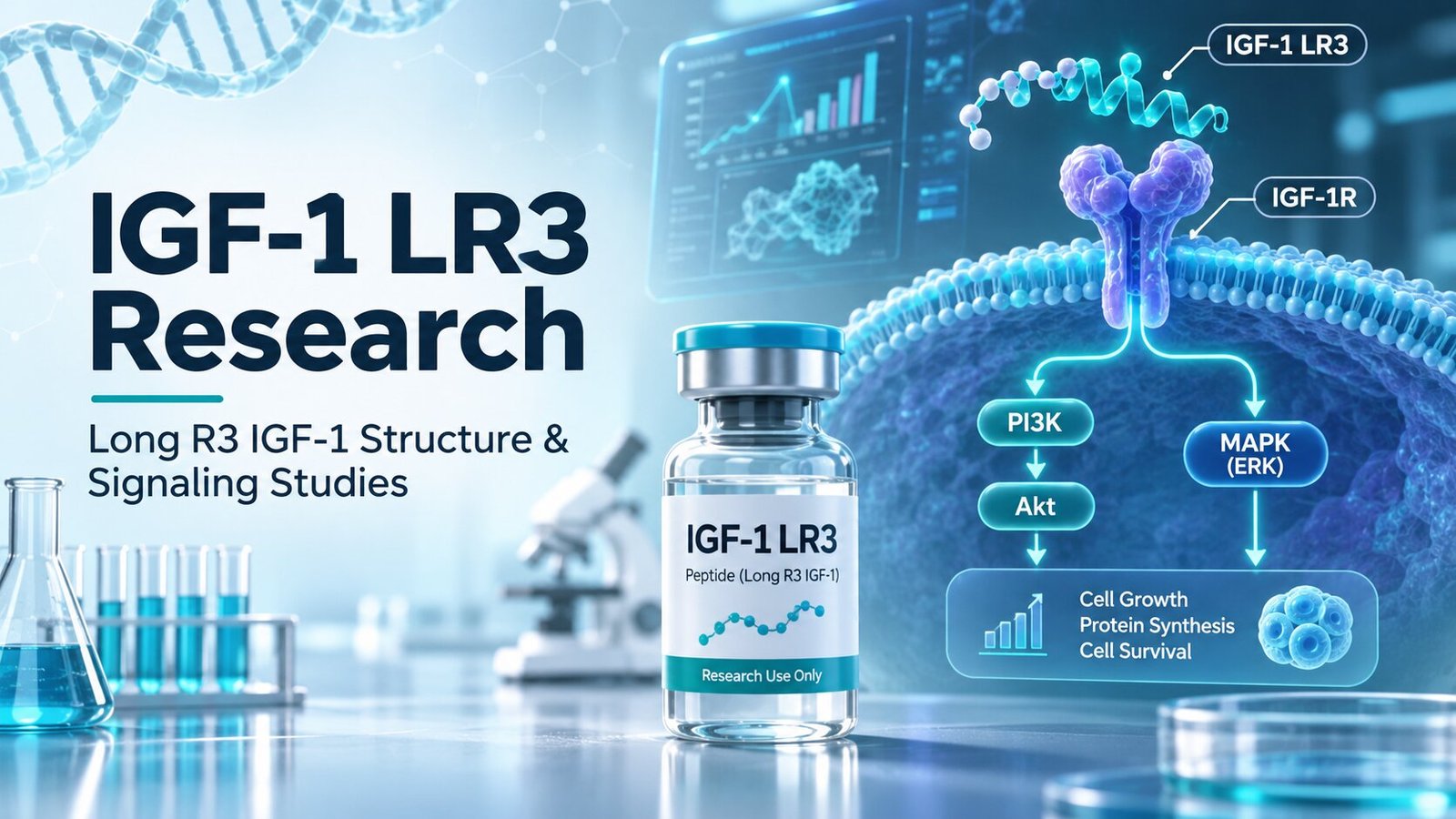
IGF-1 LR3, also known as Long R3 IGF-1, is a synthetic analogue of insulin-like growth factor 1. It was engineered to interact differently with IGF-binding proteins while retaining activity at the IGF-1 receptor.
This makes IGF-1 LR3 useful in laboratory research involving:
- IGF-1 receptor signaling
- PI3K/Akt pathways
- MAPK/ERK pathways
- Cell growth
- Cell survival
- Cell differentiation
- IGF-binding proteins
- Tissue-growth models
- Growth-factor pharmacology
The most important difference between IGF-1 LR3 and native IGF-1 is its reduced affinity for IGF-binding proteins, often called IGFBPs. Older experimental work showed that Long R3 IGF-1 binds IGFBPs far less strongly than native IGF-1, while remaining active at the IGF-1 receptor.
That difference changes how the analogue behaves in both cell and animal models.
For research purposes only. Not for human or veterinary use.
What Is IGF-1 LR3?
IGF-1 LR3 is a modified form of insulin-like growth factor 1.
Native IGF-1 is a naturally occurring peptide growth factor involved in many biological processes, including:
- Cell proliferation
- Tissue growth
- Differentiation
- Protein synthesis
- Metabolic regulation
IGF-1 LR3 was created to alter how the molecule interacts with IGF-binding proteins.
This gives researchers a tool for separating:
- IGF-1 receptor activity
- Binding-protein effects
- Growth-factor bioavailability
That distinction is especially important because IGFBPs strongly influence normal IGF biology.
Why IGF-Binding Proteins Matter
IGF-1 does not circulate freely in large amounts.
Much of it is associated with IGF-binding proteins.
These proteins can influence:
- Stability
- Tissue distribution
- Receptor access
- Clearance
- Biological activity
Six major high-affinity IGF-binding proteins are generally recognized:
- IGFBP-1
- IGFBP-2
- IGFBP-3
- IGFBP-4
- IGFBP-5
- IGFBP-6
IGFBP-3 is especially important in circulation.
Binding proteins can either prolong IGF persistence or reduce immediate receptor access.
This creates a complex regulatory system.
What Makes Long R3 IGF-1 Different?
Long R3 IGF-1 contains structural modifications designed to reduce binding to IGFBPs.
Historical studies describe two important features:
- A substitution at position 3
- An N-terminal extension
Earlier research comparing IGF analogues reported that the R3 modification replaces glutamic acid with arginine at position 3, while the “Long” form includes an additional N-terminal extension.
These changes strongly reduce affinity for IGFBPs.
That makes Long R3 IGF-1 less restricted by binding-protein sequestration.
Reduced IGFBP Binding Is the Main Research Feature
One of the clearest findings from older IGF research is that Long R3 IGF-1 binds much less strongly to IGF-binding proteins than native IGF-1.
One study reported that IGF-1 had roughly 1,000-fold greater affinity than LR3IGF-I for several IGFBPs.
This difference has major experimental consequences.
When IGFBPs are present in a cell-culture system, native IGF-1 can be partially sequestered.
Long R3 IGF-1 is less affected.
That may increase apparent biological potency in some models.
IGF-1 LR3 and the IGF-1 Receptor
The main receptor of interest is the IGF-1 receptor, or IGF-1R.
IGF-1R is a receptor tyrosine kinase.
When activated, it undergoes phosphorylation and recruits intracellular signaling proteins.
The receptor can influence pathways involved in:
- Cell growth
- Survival
- Metabolism
- Differentiation
- Protein synthesis
Long R3 IGF-1 retains activity at this receptor.
This is what makes it useful as an experimental IGF analogue.
IGF-1R Structure
IGF-1R is a multi-subunit receptor.
It contains extracellular and intracellular components.
When a ligand binds, the receptor undergoes conformational changes and autophosphorylation.
This creates docking sites for signaling molecules.
Two of the most important downstream pathways are:
- PI3K/Akt
- Ras/MAPK
These pathways explain much of the cellular activity associated with IGF-1R.
PI3K/Akt Signaling
The PI3K/Akt pathway is one of the best-known IGF-1R pathways.
A simplified sequence is:
IGF-1R → IRS proteins → PI3K → PIP3 → Akt
Activated Akt can then influence several downstream targets.
These include:
- mTOR
- GSK3β
- FOXO proteins
- Cell-survival pathways
The pathway is strongly associated with:
- Protein synthesis
- Cell survival
- Metabolic regulation
Modern reviews continue to identify PI3K/Akt as a central component of IGF-1 signaling.
mTOR Research
mTOR is one important downstream target of Akt.
It plays a role in:
- Protein synthesis
- Cell growth
- Nutrient sensing
- Metabolic control
Researchers studying IGF-1 LR3 may therefore measure:
- Akt phosphorylation
- mTOR activity
- Ribosomal signaling
- Protein synthesis
These endpoints help determine whether IGF-1R signaling is active.
MAPK/ERK Signaling
The second major pathway involves:
Ras → RAF → MEK → ERK
This is often called the MAPK or ERK pathway.
It can influence:
- Cell proliferation
- Cell-cycle progression
- Gene expression
- Differentiation
IGF-1R activation can recruit SHC and related signaling proteins that connect the receptor to Ras/MAPK signaling.
Why Both Pathways Should Be Measured
IGF-1R does not signal through only one pathway.
A strong experiment may measure both:
- PI3K/Akt
- MAPK/ERK
This is important because one cell type may favor survival signaling while another favors proliferation.
Researchers should therefore avoid assuming that one signaling endpoint represents the entire receptor response.
IGF-1 LR3 and Cell Proliferation
Long R3 IGF-1 has been used in many cell models to examine proliferation.
Because it interacts weakly with IGFBPs, it can appear more potent than native IGF-1 when binding proteins are present.
One fibroblast study reported that Long R3 IGF-1 stimulated proliferation more strongly than native IGF-1 under the experimental conditions.
This supports the idea that IGFBPs can limit IGF activity.
Why Cell-Culture Media Matter
Cell-culture conditions can strongly affect IGF experiments.
Researchers should consider:
- Serum content
- IGFBP secretion
- Cell density
- Growth-factor concentration
- Exposure duration
Some cells produce their own IGFBPs.
That can change the apparent potency of native IGF-1.
Long R3 IGF-1 may behave differently because it is less easily sequestered.
IGFBP-3 Research
IGFBP-3 is one of the most studied IGF-binding proteins.
It can influence:
- IGF availability
- Receptor access
- Cell survival
- Growth responses
Studies comparing IGF-1 and Long R3 IGF-1 have shown that reduced IGFBP binding can substantially change biological activity.
This makes IGFBP-3 especially useful in mechanistic experiments.
IGF-1 LR3 and Apoptosis Models
Long R3 IGF-1 has also been used in cell-survival research.
One study involving breast cancer cells found that Long R3 IGF-1 was more effective than native IGF-1 at countering apoptosis associated with IGFBP-3-related effects.
This illustrates how IGFBP affinity can influence cell-survival outcomes.
However, cancer-cell experiments should not be generalized to normal tissue.
Cancer Biology Requires Extra Caution
IGF-1R signaling is closely linked with:
- Cell growth
- Survival
- Proliferation
These pathways are also relevant to cancer biology.
Modern reviews describe important roles for IGF-1R signaling in several disease systems, including cancer.
This does not mean IGF-1 LR3 causes cancer.
It does mean growth-factor research requires careful interpretation.
Cell Type Strongly Influences Results
The same growth factor can produce different responses in:
- Fibroblasts
- Muscle cells
- Chondrocytes
- Cancer cells
- Stem cells
That is because each cell type may differ in:
- IGF-1R expression
- IGFBP production
- IRS proteins
- PI3K activity
- MAPK activity
Researchers should therefore avoid broad conclusions from one cell model.
Skeletal Muscle Research
The IGF system has long been studied in skeletal muscle biology.
Possible endpoints include:
- Myoblast proliferation
- Differentiation
- Protein synthesis
- Cell survival
Long R3 IGF-1 has been used experimentally because reduced IGFBP binding may increase receptor access in culture systems.
This makes it useful for studying the role of binding proteins in muscle-cell responses.
Myoblast Models
Myoblasts are precursor cells that can differentiate into muscle fibers.
Researchers may measure:
- Cell number
- Fusion
- Myogenic markers
- Protein synthesis
- Akt activity
Long R3 IGF-1 can help distinguish direct receptor signaling from IGFBP-dependent regulation.
Chondrocyte Research
Cartilage cells also respond to IGF signaling.
One study of rabbit chondrocytes found that Long R3 IGF-1 influenced IGFBP-related responses and remained active despite its low affinity for binding proteins.
This demonstrates that IGF-1 LR3 research extends beyond muscle models.
Tissue Growth Models
Animal studies have used Long R3 IGF-1 to examine tissue growth and endocrine feedback.
These studies have produced complex results.
For example, one guinea-pig study reported changes in organ weights after LR3IGF-I infusion but did not find a general increase in overall growth.
This is an important reminder that growth-factor biology is not always predictable.
Pig Studies Show Species Differences
A pig study found that Long R3 IGF-1 reduced several measures, including:
- Food intake
- Plasma IGFBP-3
- Endogenous IGF-1
- Growth hormone
and reduced average daily gain under the tested conditions.
This contrasts with some rodent findings.
Species differences therefore matter greatly.
Why Species Differences Matter
Hormonal systems differ between animals.
Important variables include:
- IGFBP levels
- Growth hormone patterns
- IGF-II levels
- Receptor expression
- Metabolism
A finding in a rat may not appear in a pig.
A finding in an animal model may not translate to humans.
This is especially important in endocrine research.
IGF Feedback Loops
The IGF system interacts with growth hormone.
Growth hormone can stimulate IGF-1 production.
IGF-1 can then influence feedback signaling.
Animal studies with Long R3 IGF-1 have shown changes in:
- Growth hormone
- Endogenous IGF-1
- IGFBP-3
These findings show that exogenous IGF analogues can affect the broader endocrine system.
Long R3 IGF-1 and Clearance
One important effect of reduced IGFBP binding is faster clearance.
This can seem counterintuitive.
A molecule may be more potent in a local cell system yet disappear faster from circulation.
Research comparing IGF-1 and LR3IGF-I found that LR3IGF-I was cleared from plasma more rapidly because it did not associate strongly with IGFBPs.
This shows that potency and persistence are not the same thing.
Binding Proteins Can Increase Circulating Stability
IGFBPs can reduce immediate receptor access.
However, they can also protect IGF molecules from rapid clearance.
This creates a tradeoff.
Strong binding may:
- Reduce free ligand
- Increase stability
Weak binding may:
- Increase receptor availability
- Increase clearance
Long R3 IGF-1 is useful for studying this balance.
Why “Long” Does Not Simply Mean Longer Circulation
The name “Long R3 IGF-1” can create confusion.
The “Long” designation refers to the structural extension.
It should not automatically be interpreted as meaning the molecule always circulates longer than native IGF-1.
Older clearance studies found faster removal of LR3IGF-I from plasma than native IGF-1 because of poor IGFBP binding.
This is an important scientific distinction.
IGF-1 LR3 vs Native IGF-1
The two molecules share receptor activity but differ in binding-protein interactions.
Native IGF-1
- Strong IGFBP association
- Normal physiological regulation
- Lower free availability under some conditions
IGF-1 LR3
- Greatly reduced IGFBP affinity
- Retained IGF-1R activity
- Different potency and clearance behavior
This difference makes LR3 useful as an experimental probe.
IGF-1 LR3 vs Growth Hormone
IGF-1 LR3 should not be confused with growth hormone.
Growth hormone acts through:
GH receptor
IGF-1 LR3 acts primarily through:
IGF-1 receptor
The two systems interact, but they are not identical.
Growth hormone can influence endogenous IGF-1 production, while IGF signalling has its own receptor pathways.
IGF-1 LR3 vs CJC-1295
CJC-1295 is a GHRH analogue.
Its primary receptor is:
GHRH receptor
CJC-1295 influences the growth hormone axis upstream.
IGF-1 LR3 acts farther downstream through IGF-1R.
This gives the two peptides very different research roles.
IGF-1 LR3 vs Tesamorelin
Tesamorelin is also a GHRH-related peptide.
Its main research focus is:
- GHRH receptor signaling
- Growth hormone release
IGF-1 LR3 directly engages the IGF receptor system instead.
The two should not be grouped as equivalent growth-factor compounds.
IGF-1 LR3 vs Ipamorelin
Ipamorelin acts primarily through the growth hormone secretagogue receptor.
Its major receptor is:
GHS-R1a
IGF-1 LR3 instead targets IGF-1R.
These are separate receptor pathways.
Receptor Specificity Matters
IGF-1R is closely related to the insulin receptor.
This creates another layer of complexity.
IGF-1 and insulin signaling can overlap.
Hybrid receptors can also form between:
- IGF-1R
- Insulin receptor
Modern reviews describe substantial cross-talk between these systems.
Researchers should therefore avoid assuming perfect receptor isolation.
IGF-1R and Insulin Receptor Cross-Talk
Both receptors belong to the receptor tyrosine kinase family.
They can activate overlapping downstream pathways.
These include:
- IRS proteins
- PI3K
- Akt
- MAPK
This overlap can make interpretation difficult in cells expressing both receptors.
Hybrid Receptor Research
Hybrid IGF-1R/insulin receptors may respond differently from either receptor alone.
Researchers studying IGF-1 LR3 may therefore need to consider:
- Receptor abundance
- Hybrid receptor formation
- Insulin concentration
- Cell type
This is especially important in metabolic research.
IGF-1 LR3 and Gene Expression
IGF-1R signaling can alter gene expression through several downstream pathways.
MAPK/ERK can affect transcription factors.
Akt can influence:
- FOXO proteins
- mTOR
- Cell-survival genes
Researchers may therefore examine transcriptomic changes after IGF-1 LR3 exposure.
Protein Synthesis Research
Akt and mTOR signaling can influence protein synthesis.
This is one reason IGF-related compounds are studied in muscle and tissue models.
Possible laboratory endpoints include:
- Phosphorylated Akt
- Phosphorylated mTOR
- S6 kinase
- Protein incorporation assays
These measurements help connect receptor activation to cellular output.
Differentiation Research
IGF-1R can also influence cell differentiation.
The effect depends strongly on the cell type.
Researchers may examine:
- Myogenic differentiation
- Cartilage differentiation
- Stem-cell pathways
IGF-1 LR3 may be useful when scientists want to reduce the confounding effect of endogenous IGFBPs.
Cell Survival Research
Akt signaling is strongly linked with cell survival.
Possible downstream targets include:
- BAD
- FOXO
- mTOR-related pathways
Modern IGF-1R reviews continue to describe cell-survival signaling as a central function of the pathway.
Non-Canonical IGF-1R Signaling
IGF-1R signaling is more complex than PI3K/Akt and MAPK alone.
Recent reviews describe non-canonical interactions involving:
- GPCR signaling
- Calcium pathways
- Arrestins
- EGFR cross-talk
- JAK/STAT
These mechanisms expand the possible cellular effects of IGF-1R activation.
Why Non-Canonical Signaling Matters
Two compounds may activate the same receptor but produce different signaling patterns.
This is sometimes called signaling bias.
Future IGF-1 LR3 research may compare:
- Akt
- ERK
- JAK/STAT
- Calcium signaling
- Receptor trafficking
This could provide a more complete pharmacological profile.
Experimental Design for IGF-1 LR3 Research
A strong experiment may include:
- Vehicle control
- Native IGF-1
- IGF-1 LR3
- IGFBP-treated group
- IGF-1R inhibitor
- Insulin receptor control
This can help determine which effects depend on:
- Receptor activation
- Binding proteins
- Cross-reactivity
IGFBP Competition Experiments
One useful experiment is to add IGFBP-3.
If native IGF-1 activity decreases while IGF-1 LR3 remains active, that supports the importance of reduced binding-protein affinity.
This type of design has been used historically to show how IGFBPs regulate growth-factor activity.
Dose-Response Studies
Researchers should generally test multiple concentrations.
A dose-response experiment can reveal:
- Potency
- Maximum effect
- Threshold concentration
- Toxicity
One concentration provides limited information.
Time-Course Studies
IGF signaling can change quickly.
Akt phosphorylation may appear within minutes.
Gene-expression changes may take hours.
Cell proliferation may require days.
Researchers should therefore select time points based on the endpoint being measured.
Receptor Inhibition Controls
IGF-1R inhibitors can help confirm receptor dependence.
If IGF-1 LR3 effects disappear after IGF-1R inhibition, that supports an IGF-1R-mediated mechanism.
However, inhibitor specificity should be verified.
Cell Viability Controls
Growth-factor studies should include cell viability measurements.
An apparent decrease in signaling could reflect:
- Cell death
- Nutrient depletion
- Toxicity
Viability controls help prevent false conclusions.
Analytical Characterization of IGF-1 LR3
Research-grade IGF-1 LR3 should be analytically characterized.
Useful methods may include:
- HPLC
- LC-MS
- Mass spectrometry
- Peptide mapping
- Protein quantification
Because IGF-1 LR3 is larger than many short peptides, analytical methods may require additional optimization.
HPLC Analysis
HPLC can help assess:
- Main peak
- Purity
- Secondary peaks
- Batch consistency
A high purity percentage does not independently confirm identity.
Mass Spectrometry
Mass spectrometry can help confirm:
- Expected molecular mass
- Sequence-related modifications
- Degradation products
- Truncated forms
This provides stronger identity evidence.
Sequence Verification
IGF-1 LR3 differs from native IGF-1 through specific structural modifications.
Researchers should verify that a sample matches the intended Long R3 form.
A generic “IGF-1” label is not enough.
Purity and Identity Are Different
A sample can be chemically pure but still be the wrong molecule.
Researchers should ask:
Purity: How much of the sample is the main component?
Identity: Is the main component actually IGF-1 LR3?
Both should be supported by analytical data.
Batch Traceability
Laboratory documentation should record:
- Product name
- Batch number
- Purity
- Identity method
- Storage conditions
- Experiment date
This improves reproducibility.
Storage Considerations
Growth-factor peptides can be sensitive to:
- Temperature
- Repeated freeze-thaw cycles
- pH
- Oxidation
- Surface adsorption
Researchers should follow batch-specific handling guidance.
Generic peptide-storage rules may not be sufficient for larger growth-factor analogues.
Adsorption to Laboratory Surfaces
Proteins and peptides can adsorb to:
- Plastic tubes
- Pipette tips
- Glass surfaces
This may reduce effective concentration.
Researchers should use consistent materials and handling procedures when comparing experiments.
Evidence Limitations
Long R3 IGF-1 has a substantial experimental history.
However, many studies are:
- Older
- Preclinical
- Species-specific
- Cell-based
Results should therefore be interpreted within their exact model.
Why Animal Growth Findings Are Not Universal
Older animal studies produced very different outcomes.
Some rodent studies reported increased potency.
Guinea-pig studies showed selective organ changes.
Pig studies reported reduced growth-related measures.
This variability is scientifically important.
It shows that endocrine systems cannot be generalized across species.
Human Evidence Is Not the Same as Research-Material Evidence
Research-grade IGF-1 LR3 should not be treated as a clinical product.
Laboratory research materials may differ in:
- Manufacturing
- Purity specifications
- Sterility
- Formulation
- Regulatory oversight
Scientific content should remain clearly research focused.
IGF-1 LR3 Research and Bayoupep USA
Within the Bayoupep USA research catalog, IGF-1 LR3 should be presented as a laboratory growth-factor analogue.
Researchers should confirm:
- Correct Long R3 identity
- Batch-specific purity
- Mass-spectrometry data
- Storage instructions
- Lot traceability
For research purposes only. Not for human or veterinary use.
Common Questions About IGF-1 LR3 Research
What is IGF-1 LR3?
IGF-1 LR3 is a modified analogue of insulin-like growth factor 1.
Why is it called Long R3 IGF-1?
The name refers to its N-terminal extension and the R3 amino-acid substitution described in historical IGF analogue research.
Does IGF-1 LR3 bind IGFBPs?
Yes, but its affinity is much lower than that of native IGF-1.
What receptor does IGF-1 LR3 activate?
Its main research target is the IGF-1 receptor.
What pathways are commonly studied?
The major pathways include:
- PI3K/Akt
- mTOR
- Ras/MAPK/ERK
Is IGF-1 LR3 the same as growth hormone?
No.
Growth hormone acts through the GH receptor.
IGF-1 LR3 acts primarily through IGF-1R.
Is IGF-1 LR3 clinically approved?
Research-grade IGF-1 LR3 should not be described as an approved therapeutic product.
Final Thoughts
IGF-1 LR3 is a modified growth-factor analogue designed to interact differently with IGF-binding proteins while retaining activity at the IGF-1 receptor.
Its defining research feature is greatly reduced affinity for IGFBPs.
This makes it useful for studying how binding proteins regulate IGF biology.
Long R3 IGF-1 research commonly focuses on:
- IGF-1R activation
- PI3K/Akt signaling
- MAPK/ERK signaling
- mTOR
- Cell proliferation
- Cell survival
- Differentiation
- IGFBP interactions
Older work also shows why interpretation must remain careful.
Long R3 IGF-1 can appear more potent than native IGF-1 in some cell systems, yet it may be cleared more rapidly from circulation because of weaker IGFBP association.
Animal findings also vary substantially between species.
For laboratory research, the strongest approach is to combine:
- Receptor-specific controls
- IGFBP comparisons
- Dose-response studies
- Signaling assays
- HPLC analysis
- Mass-spectrometry confirmation
- Batch traceability
IGF-1 LR3 is therefore best understood as a modified IGF-1 analogue used to study receptor signaling, binding-protein regulation, and growth-factor biology.
This information is provided for scientific and educational research purposes only. IGF-1 LR3 research materials are not intended for human or veterinary use.