
In this article
A Certificate of Analysis, often called a COA, is an important research document. It provides laboratory information about a tested peptide batch.
Researchers can use a COA to review identity, purity, and testing results. It can also help confirm whether the supplied material matches its label.
However, a COA may look technical at first. It can contain graphs, percentages, batch numbers, and analytical terms.
Understanding these details makes peptide research documentation easier to review.
This guide explains the main parts of a peptide COA. It also covers what researchers should check before evaluating a product.
What Is a Peptide Certificate of Analysis?
A peptide Certificate of Analysis is a laboratory testing report.
It contains analytical results for a specific peptide sample or batch. The report may be created by the manufacturer or an independent testing laboratory.
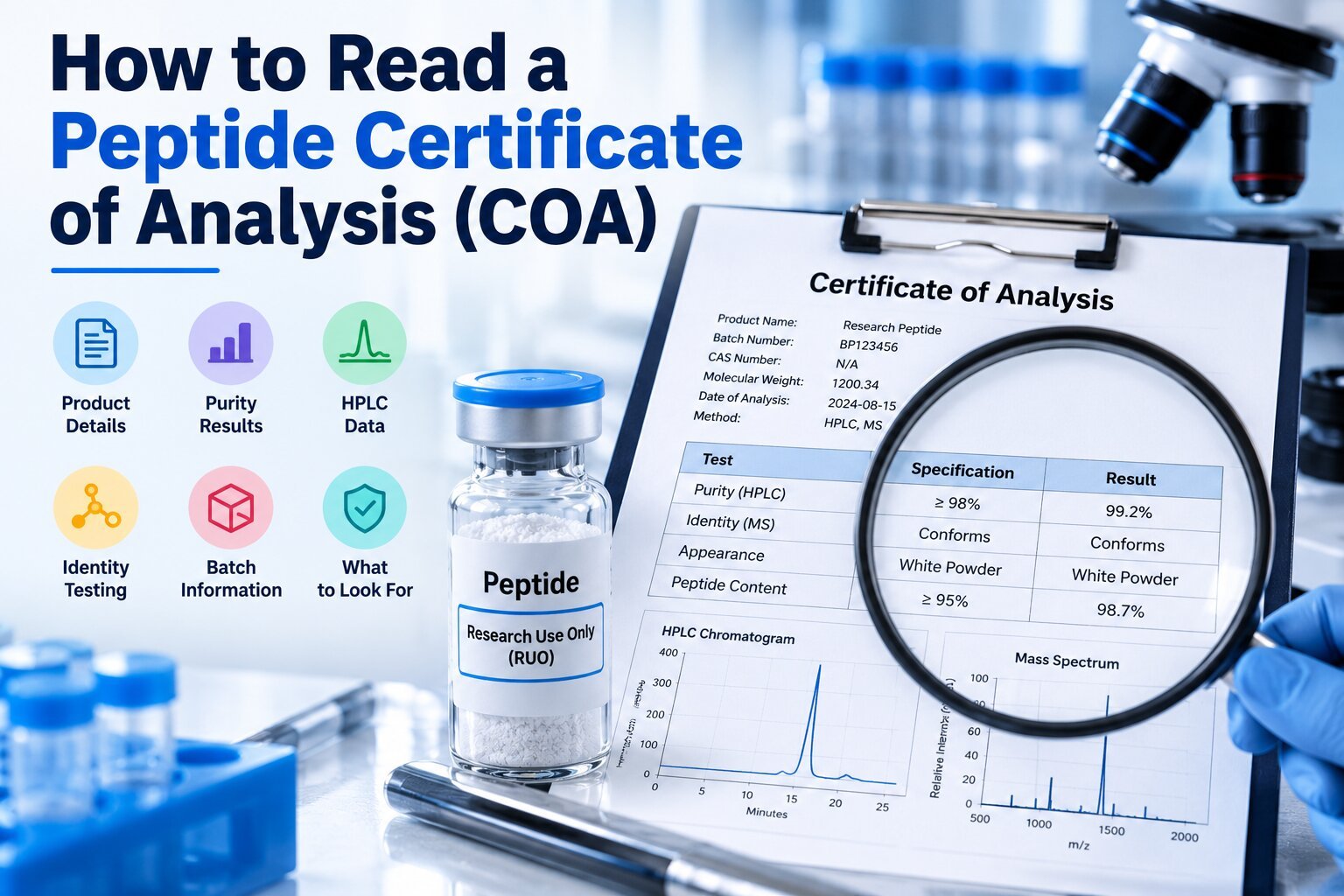
A detailed COA commonly includes information such as:
- Product or peptide name
- Batch or lot number
- Test date
- Sample identification
- Peptide purity
- Molecular mass results
- Testing method
- Laboratory details
- Analytical graphs
These details help provide greater transparency about the tested material.
For research products, batch-specific documentation is especially important. Different production batches may have different test results.
Why Is a COA Important in Peptide Research?
Research work depends heavily on consistency and accurate documentation.
If the identity or purity of a research material is uncertain, experimental results may become harder to interpret.
A COA provides useful analytical information about the peptide before research begins.
It can help researchers evaluate several important questions.
Does the sample match the expected peptide?
Does testing indicate a high level of purity?
Was the sample tested using a recognized analytical method?
Does the document clearly identify the tested batch?
A COA does not replace good laboratory procedures. However, it provides another useful layer of quality documentation.
-
Check the Peptide Name
Start by reviewing the product or sample name.
The name listed on the COA should match the material being evaluated.
Some peptides have similar names or related sequences. Therefore, researchers should carefully compare the document with the product label.
If the peptide is part of a research blend, the report should clearly explain what material was tested.
Clear sample identification helps reduce confusion between different compounds.
-
Look for a Batch or Lot Number
A strong COA should usually identify the tested batch.
The batch number may also appear as a lot number.
This information connects the laboratory report with a particular production run.
For example, a supplier may manufacture the same research peptide several times. Each batch may receive its own identification number.
Researchers should compare this number with the batch information supplied with the product.
A matching batch number improves traceability.
A general COA without clear batch identification provides less specific information.
-
Review the Testing Date
The testing date shows when the laboratory analysis occurred.
This can help researchers understand how recent the report is.
A current batch should ideally have documentation linked to that batch. Using an old COA for a newly produced batch may not provide useful batch-specific evidence.
The testing date may appear near the top or bottom of the report.
It may also appear next to the laboratory signature or report number.
-
Understand Peptide Purity
Purity is one of the most common values shown on peptide COAs.
It is normally displayed as a percentage.
For example, a laboratory result may show:
Purity: 99.1%
This figure generally represents the proportion of the detected material associated with the main peptide peak under the stated analytical method.
Higher purity indicates fewer detected impurities under those test conditions.
However, researchers should not judge a complete COA from one percentage alone.
The testing method, chromatogram, identity confirmation, and sample details also matter.
A purity number without supporting laboratory information provides limited context.
-
Check the HPLC Results
High-Performance Liquid Chromatography, or HPLC, is commonly used to evaluate peptide purity.
HPLC separates different components within a sample.
The laboratory then creates a chromatogram.
A chromatogram usually contains peaks displayed across a graph.
The main peptide often creates the largest peak. Smaller peaks can indicate other detected components.
The COA may include:
- Main peak percentage
- Retention time
- Peak area
- Chromatogram graph
Researchers should check whether the purity percentage matches the analytical data shown.
A clearly presented HPLC report offers more information than a purity claim alone.
-
Review Mass Spectrometry Data
Mass spectrometry is another common analytical method.
It helps laboratories evaluate the molecular mass of a peptide.
Every peptide has an expected molecular weight based on its molecular structure.
During testing, the laboratory compares observed mass data with the expected value.
A close match can help support peptide identity.
The COA may show terms such as:
- Expected molecular mass
- Observed molecular mass
- Calculated mass
- Mass spectrum
This part of the report is especially useful because purity and identity are different measurements.
A sample can show a strong purity result while still requiring identity confirmation.
-
Understand the Difference Between Purity and Identity
Purity and identity should not be treated as the same thing.
Purity evaluates how much of the detected sample relates to the primary component.
Identity helps determine whether that primary component is actually the expected peptide.
This distinction is important.
For example, HPLC may show one dominant compound in a sample. However, another analytical method may still be needed to confirm what that compound is.
This is why detailed peptide testing often uses more than one analytical technique.
-
Look for the Testing Laboratory
A COA should clearly identify the laboratory responsible for testing.
Useful details may include:
- Laboratory name
- Report number
- Testing date
- Signature or authorization
- Laboratory contact information
- Testing method
Third-party laboratory testing can provide additional transparency.
It means the analytical work was completed by a separate testing organization rather than relying only on internal supplier information.
Researchers can also review whether the laboratory information appears complete and traceable.
-
Check the Sample Identification Details
The report should explain what sample the laboratory received.
This may include a sample number, product code, lot number, or submitted description.
Sample identification helps connect the analytical results with the tested material.
Researchers should compare these details carefully.
Missing or unclear sample identification can make the report more difficult to verify.
-
Review the Chromatogram Carefully
A chromatogram is one of the most useful sections of an HPLC report.
It normally displays several elements.
The horizontal axis often represents retention time.
The vertical axis represents detector response.
Each detected component may appear as a peak.
The largest peak normally represents the primary compound under the stated testing conditions.
Smaller peaks may represent impurities or other detected substances.
Researchers do not always need advanced analytical knowledge to review the basic structure.
However, professional interpretation may be required for detailed analytical decisions.
-
Check Whether the COA Is Batch-Specific
Batch-specific testing is valuable for research documentation.
A supplier may display excellent results from one production batch. Those results do not automatically represent every future batch.
Researchers should therefore look for:
- Matching lot numbers
- Matching sample numbers
- Recent testing dates
- Product-specific results
A current batch-specific COA provides clearer traceability.
Common Warning Signs When Reviewing a COA
Not every COA contains the same level of detail.
Researchers may want to examine a report more carefully when certain information is missing.
Possible warning signs include:
- No laboratory name
- No batch number
- No testing date
- No analytical method
- No chromatogram
- No mass data
- Unclear sample identification
- Purity claims without supporting results
- COAs reused across unrelated batches
Missing information does not automatically prove poor product quality.
However, complete documentation makes analytical results easier to evaluate.
Why Third-Party Testing Matters
Independent laboratory testing can provide additional confidence in research documentation.
A third-party laboratory evaluates a submitted sample separately from the supplier.
This can help provide objective analytical data about the material.
Common testing methods may include HPLC and mass spectrometry.
Researchers should still review the report carefully.
Third-party testing is most useful when the COA clearly identifies the laboratory, sample, batch, date, and analytical results.
How Bayoupep USA Approaches Research Peptide Documentation
At Bayoupep USA, research transparency is an important part of product quality.
Researchers should have access to clear information about the materials they purchase.
Batch-specific testing and analytical documentation can make it easier to review identity and purity before laboratory research begins.
Research materials should always be evaluated carefully, stored correctly, and handled according to appropriate laboratory procedures.
Bayoupep USA products are intended strictly for laboratory and research purposes.
They are not intended for human or veterinary use.
Final Thoughts
Reading a peptide Certificate of Analysis becomes easier once you understand its main sections.
Start with the peptide name and batch number. Then review the test date, purity percentage, HPLC results, and mass spectrometry data.
Researchers should also confirm the testing laboratory and sample information.
Most importantly, do not focus only on a large purity percentage.
A useful COA should provide supporting analytical data and clear batch traceability.
Careful review of peptide documentation can support better research planning, stronger recordkeeping, and more consistent laboratory practices.