
In this article
Quality documentation is important in peptide research.
Researchers need to know what material they are working with, how pure it is, and whether the supplied product matches the expected peptide.
This is where third-party testing can help.
Third-party testing means an independent laboratory evaluates a peptide sample separately from the supplier. The resulting report can provide additional information about purity, identity, and batch quality.
For research teams, this extra layer of verification can make product evaluation more transparent.
This guide explains why third-party peptide testing matters and what researchers should look for in an independent laboratory report.
What Is Third-Party Peptide Testing?
Third-party peptide testing is analytical testing performed by an independent laboratory.
The testing laboratory is separate from the company selling or manufacturing the peptide.
A supplier submits a sample for analysis.
The laboratory then evaluates the material using one or more analytical methods.
Depending on the testing package, the report may include:
- Peptide purity
- Peptide identity
- Molecular mass
- Sample information
- Batch details
- Testing date
- Chromatograms
- Analytical spectra
The goal is to provide independent analytical information about the submitted sample.
Why Independent Testing Matters
A supplier can make claims about its own products.
However, independent testing can provide another source of evidence.
This can help researchers evaluate whether product claims are supported by laboratory data.
Third-party testing may improve transparency by showing:
- Who performed the analysis
- What sample was tested
- Which methods were used
- What results were recorded
- When the analysis took place
These details can help researchers make more informed purchasing decisions.
Third-Party Testing vs Internal Testing
Internal testing is performed by the supplier or manufacturer.
Third-party testing is performed by a separate laboratory.
Both can provide useful information.
However, independent testing adds separation between the seller and the analytical process.
This can make the results easier to evaluate objectively.
Researchers should still review the report carefully.
Third-party status alone does not make every report complete or useful.
What Can Third-Party Testing Verify?
Different laboratory methods answer different questions.
A third-party report may help evaluate several aspects of a peptide.
These can include:
Purity
Purity testing estimates how much of the detected sample is associated with the main peptide component.
Identity
Identity testing helps determine whether the main compound matches the expected peptide.
Molecular Mass
Mass-based testing can compare the observed molecular mass with the expected value.
Batch Consistency
Batch-specific testing can help researchers compare one production batch with another.
Each of these measurements provides a different type of information.
Why Purity Testing Is Important
Purity is one of the most common measurements shown on peptide reports.
It is usually expressed as a percentage.
For example:
Purity: 99.2%
This percentage generally reflects the main detected peptide peak under the stated analytical method.
Higher purity indicates fewer detected impurities under those conditions.
However, purity should not be reviewed by itself.
Researchers should also look at the testing method, chromatogram, batch number, and identity data.
How HPLC Is Used in Peptide Testing
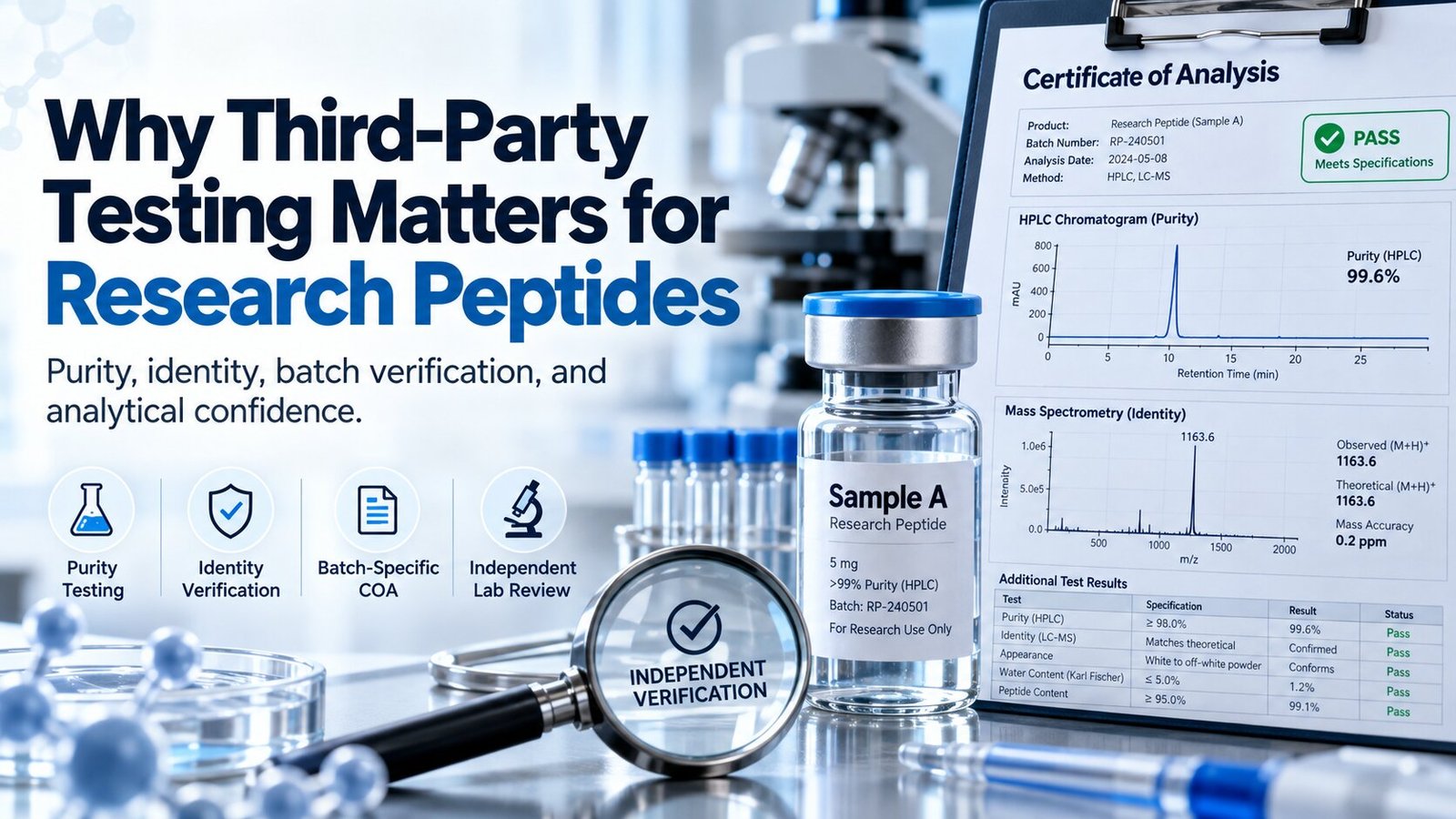
High-Performance Liquid Chromatography, commonly called HPLC, is widely used for peptide purity analysis.
HPLC separates compounds within a sample.
As the sample passes through the system, different components are detected at different times.
The result is a chromatogram.
A chromatogram typically contains:
- A main peptide peak
- Smaller secondary peaks
- Retention time
- Peak area
- Detector response
The main peak often represents the primary peptide component.
Smaller peaks may reflect other detected substances.
The laboratory can calculate the relative area of the main peak to estimate purity.
Why a Chromatogram Matters
A purity number is useful.
A chromatogram provides more context.
For example, two reports may both state 99% purity.
However, the shape and distribution of smaller peaks may differ.
Researchers should therefore look for the underlying analytical data when available.
A detailed report provides more useful information than a percentage alone.
How Mass Spectrometry Supports Peptide Identity
Purity and identity are different measurements.
A highly pure sample may still require confirmation of what the main compound actually is.
Mass spectrometry can help with this.
The technique measures mass-related characteristics of the detected molecule.
The laboratory compares the observed data with the expected molecular mass.
A close match can support peptide identity.
This makes mass spectrometry an important complement to purity testing.
Why Purity Does Not Equal Identity
This distinction is important.
A sample can show one dominant HPLC peak.
That may indicate high purity.
However, the dominant compound could still require identity confirmation.
For this reason, researchers should avoid assuming that a high HPLC result proves identity.
A stronger analytical profile may include both:
- HPLC purity testing
- Mass spectrometry identity testing
Together, these methods provide more complete information.
Why Batch-Specific Testing Matters
Research peptides are produced in batches.
Each batch may have slightly different analytical results.
For this reason, researchers should look for reports linked to the exact batch being purchased.
A useful third-party report may include:
- Batch number
- Lot number
- Sample ID
- Test date
- Product name
- Laboratory report number
These details improve traceability.
A report from an older or unrelated batch is less useful.
What Is Batch Traceability?
Batch traceability means connecting the physical product with its analytical documentation.
This allows researchers to identify which tested material they actually received.
Good traceability can connect:
- Product label
- Batch number
- Certificate of Analysis
- Third-party report
- Order record
- Internal laboratory record
This information becomes especially useful during repeat studies.
Why Testing Dates Matter
The date of testing is another important detail.
An old report may not represent a newly manufactured batch.
Researchers should check whether the testing date makes sense for the product being purchased.
Recent batch-specific testing provides better context than an undated report.
Testing dates also help laboratories organize records.
What Should a Third-Party Report Include?
Researchers should review the report itself.
A useful report may include:
- Testing laboratory name
- Report number
- Sample identification
- Product name
- Batch number
- Testing date
- Analytical method
- Purity result
- HPLC chromatogram
- Mass spectrometry data
- Authorized signature or approval
Not every report has the same format.
However, clear documentation makes results easier to evaluate.
Why the Laboratory Name Matters
A third-party report should identify who performed the testing.
The laboratory name adds accountability.
Researchers may also look for:
- Contact information
- Report identifiers
- Testing method details
- Accreditation information when relevant
A report with no clear laboratory identity may be more difficult to verify.
What Researchers Should Look for in HPLC Data
Researchers do not always need advanced chromatography training to perform a basic review.
They can still check whether the report contains:
- A visible chromatogram
- A main peptide peak
- Retention time
- Purity percentage
- Sample information
- Testing date
The purity result should correspond with the analytical data shown.
If the report contains only a number without supporting information, researchers may want more detail.
What Researchers Should Look for in Mass Spectrometry Data
Mass spectrometry data may appear as a spectrum.
Researchers should check whether the report lists:
- Expected molecular mass
- Observed molecular mass
- Sample identification
- Testing method
- Spectrum
- Interpretation
The observed result should be reasonably consistent with the expected peptide.
The exact interpretation may require technical expertise.
Why Supplier Transparency Matters
Third-party testing is most useful when suppliers make the results easy to access.
Researchers should not have to search extensively for basic analytical information.
A transparent supplier may provide:
- Batch-specific COAs
- Independent testing reports
- Purity data
- Identity data
- Storage information
- Research-use labeling
Easy access to documentation helps researchers evaluate products before purchase.
Can a COA Be Considered Third-Party Testing?
Sometimes.
A Certificate of Analysis may come from:
- The manufacturer
- The supplier
- An independent laboratory
Researchers should check who created the document.
A COA alone does not automatically mean independent testing occurred.
Look for the laboratory name and report information.
Common Warning Signs in Testing Documentation
Researchers may want to review reports more carefully when they notice:
- No laboratory name
- No testing date
- No batch number
- No sample ID
- No analytical method
- No chromatogram
- No identity data
- Reused reports across multiple batches
- Purity claims without supporting evidence
These issues do not automatically prove poor quality.
However, they reduce transparency.
Why Third-Party Testing Supports Reproducibility
Reproducibility is important in research.
Researchers often need to repeat experiments under similar conditions.
Consistent and well-documented materials can help support this process.
Third-party testing can provide a reference point for each batch.
If results differ between studies, researchers can compare analytical records.
This may help identify whether sample differences played a role.
Why Independent Testing Helps With Supplier Comparison
Researchers may compare several peptide suppliers.
Price is one factor.
Documentation is another.
Independent testing can make comparison easier.
Researchers can evaluate:
- Purity results
- Identity verification
- Batch-specific data
- Report completeness
- Testing recency
- Laboratory transparency
This provides a more structured basis for supplier selection.
Third-Party Testing and Research Use Only Products
Research Use Only products are intended for laboratory research.
The RUO label explains intended use.
Third-party testing addresses analytical quality.
These are separate concepts.
A product can be labeled RUO without being independently tested.
Researchers should therefore review both:
- Product-use designation
- Analytical documentation
This helps provide a more complete understanding of the material.
Does Third-Party Testing Guarantee Perfect Quality?
No.
Third-party testing provides useful analytical information.
It does not guarantee that a sample is perfect.
Every testing method has limitations.
Results also depend on:
- Sample preparation
- Instrument sensitivity
- Laboratory methods
- Detection limits
- Reporting standards
Researchers should use third-party testing as one part of a broader quality review.
Why One Test May Not Be Enough
Different analytical methods answer different questions.
HPLC can evaluate purity.
Mass spectrometry can support identity.
Other methods may evaluate different sample characteristics.
For this reason, researchers should avoid relying on a single number.
A more complete analytical profile provides stronger context.
How Researchers Can Use Third-Party Reports
Researchers can use testing documentation in several ways.
For example, they may:
- Verify product claims
- Compare batches
- Maintain internal records
- Review sample quality
- Support repeat experiments
- Document material sources
Reports should be stored with other laboratory records.
This can improve long-term traceability.
Keeping Third-Party Testing Records
Laboratories should maintain organized records.
Useful documentation may include:
- Supplier name
- Product name
- Batch number
- COA
- Third-party report
- Date received
- Storage information
- Internal sample ID
These records can help researchers connect experimental results with the materials used.
How Bayoupep USA Supports Research Transparency
At Bayoupep USA, research transparency is an important part of product evaluation.
Researchers benefit from clear testing information when selecting peptide materials.
Batch-specific documentation, purity data, and independent laboratory testing can make research products easier to assess.
Researchers should always review available analytical reports before laboratory use.
Bayoupep USA products are intended strictly for research purposes.
They are not intended for human or veterinary use.
Final Thoughts
Third-party testing adds an independent layer of information to peptide research products.
It can help researchers evaluate purity, identity, molecular mass, and batch consistency.
HPLC and mass spectrometry are two important analytical methods commonly used in peptide testing.
Researchers should also review batch numbers, testing dates, laboratory details, and supporting graphs.
Most importantly, a single purity percentage should never be the only factor considered.
Clear, batch-specific, independent testing can support better product evaluation, stronger documentation, and more consistent laboratory research.