
In this article
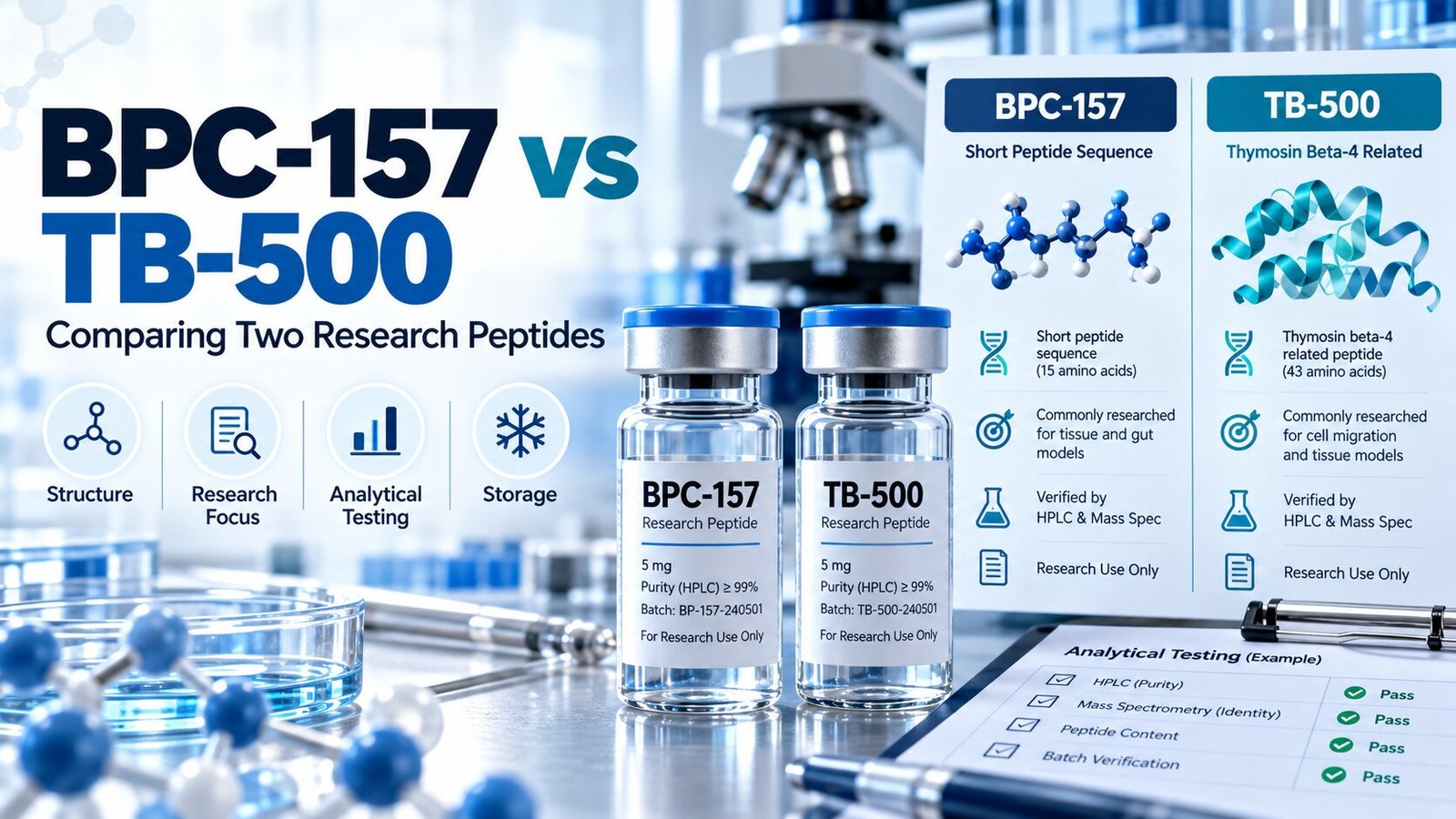
BPC-157 and TB-500 are two research peptides that often appear in laboratory discussions.
Although they are sometimes mentioned together, they are not the same compound. They differ in structure, research background, and the biological pathways scientists may study.
For researchers, it is important to understand these differences before comparing data or designing experiments.
This article explains the key distinctions between BPC-157 and TB-500, including their origins, molecular characteristics, research focus, and laboratory considerations.
What Is BPC-157?
BPC-157 is a synthetic peptide used in research settings.
It is commonly described as a 15-amino-acid peptide.
Researchers study BPC-157 to better understand peptide behavior, signaling pathways, tissue models, and other biological processes.
Its relatively short sequence makes it distinct from many larger peptide compounds.
In laboratory settings, BPC-157 may be evaluated for properties such as:
- Molecular stability
- Cellular signaling
- Tissue-related pathways
- Receptor interactions
- Experimental response patterns
The exact research purpose depends on the study design.
What Is TB-500?
TB-500 is a synthetic peptide associated with research involving thymosin beta-4-related sequences.
Thymosin beta-4 is a naturally occurring protein fragment studied in several areas of biology.
TB-500 research may focus on topics such as:
- Cellular movement
- Cytoskeletal organization
- Tissue models
- Protein interactions
- Experimental signaling pathways
Like BPC-157, TB-500 is intended for laboratory research rather than consumer use.
Are BPC-157 and TB-500 the Same?
No.
BPC-157 and TB-500 are separate research peptides.
They have different sequences and different research backgrounds.
This means researchers should not treat them as interchangeable materials.
Important differences may include:
- Amino acid sequence
- Molecular weight
- Structural properties
- Research origin
- Analytical profile
- Experimental use
Each peptide should be evaluated independently.
BPC-157 vs TB-500: Key Differences
A simple comparison can help clarify the distinction.
| Feature | BPC-157 | TB-500 |
| Peptide type | Synthetic research peptide | Thymosin beta-4-related research peptide |
| Sequence | Short peptide sequence | Different peptide structure |
| Research focus | Signaling and tissue-related research | Cellular movement and structural pathways |
| Identity testing | Often supported by mass spectrometry | Often supported by mass spectrometry |
| Purity testing | Commonly evaluated by HPLC | Commonly evaluated by HPLC |
| Intended use | Research use only | Research use only |
The exact laboratory application depends on the protocol.
Why Researchers Compare BPC-157 and TB-500
Researchers may compare peptides when studying different mechanisms within related biological models.
For example, one peptide may be selected for a signaling-focused study.
Another may be selected for a cellular structure or migration-focused study.
Comparing them can help researchers explore whether two compounds produce different experimental patterns.
However, the comparison should be based on controlled methods.
Researchers should avoid assuming that similar marketing categories mean similar molecular behavior.
Molecular Structure Matters
A peptide’s structure influences how it behaves in a laboratory system.
BPC-157 and TB-500 differ in amino acid composition and molecular characteristics.
These differences can influence:
- Solubility
- Stability
- Binding behavior
- Analytical results
- Experimental handling
Researchers should therefore use peptide-specific procedures.
One storage or preparation method may not automatically apply to another peptide.
Why Peptide Sequence Is Important
A peptide sequence determines the order of amino acids.
This order affects the shape and behavior of the peptide.
Even small sequence differences can change:
- Molecular interactions
- Stability
- Charge
- Binding characteristics
- Experimental response
Researchers should verify sequence information when comparing peptide products.
A product name alone does not provide enough analytical detail.
Comparing Molecular Weight
Molecular weight is another useful comparison point.
Each peptide has an expected molecular mass based on its sequence.
Mass spectrometry can help confirm whether a tested sample matches this expected value.
When reviewing BPC-157 or TB-500 documentation, researchers may look for:
- Expected molecular mass
- Observed molecular mass
- Mass spectrum
- Sample ID
- Batch number
This helps support identity verification.
How HPLC Is Used With BPC-157 and TB-500
HPLC is commonly used to evaluate peptide purity.
The process separates compounds within a sample.
A chromatogram then displays the detected components.
Researchers can review:
- Main peak
- Secondary peaks
- Retention time
- Peak area
- Purity percentage
Both BPC-157 and TB-500 should be evaluated using product-specific analytical data.
A high purity result should still be supported by identity testing.
Why Purity Is Not Enough
Purity tells researchers how much of the detected material is associated with the main component.
It does not automatically prove that the component is the expected peptide.
For this reason, researchers should consider both:
- HPLC purity testing
- Mass spectrometry identity testing
This is especially important when comparing different peptides.
A 99% purity result for BPC-157 and a 99% result for TB-500 do not mean the compounds are similar.
They only describe the relative purity of each tested sample.
Research Focus of BPC-157
BPC-157 is often studied in experimental models involving signaling and tissue-related biological processes.
Researchers may explore questions involving:
- Cellular pathways
- Molecular communication
- Tissue models
- Experimental stress responses
- Peptide stability
The exact study depends on the research objective.
Researchers should rely on published scientific methods and validated protocols.
Research Focus of TB-500
TB-500-related research may focus more heavily on cellular movement and structural processes.
Areas of investigation can include:
- Cytoskeletal behavior
- Cell migration
- Protein interactions
- Tissue models
- Experimental repair pathways
These research areas are not identical to those commonly associated with BPC-157.
This is why direct substitution between the two peptides is not appropriate.
Can BPC-157 and TB-500 Be Studied Together?
In some experimental settings, researchers may study more than one peptide.
However, combined research introduces additional variables.
Researchers should carefully consider:
- Concentration
- Sequence
- Sample compatibility
- Analytical method
- Experimental controls
- Stability
- Storage
Combined studies require clear documentation.
Each compound should be traceable to its own batch and analytical report.
Why Batch-Specific Testing Matters
Batch-specific testing is important for both peptides.
Each production batch can have its own analytical profile.
Researchers should verify:
- Batch number
- Testing date
- HPLC purity
- Mass spectrometry results
- Sample identity
This helps maintain traceability.
It also makes repeat studies easier to document.
Storage Considerations
Storage requirements may differ between peptides.
Researchers should review the specific product documentation.
Important storage factors may include:
- Temperature
- Light exposure
- Moisture
- Container sealing
- Handling frequency
Lyophilized material may have different storage needs from a dissolved peptide solution.
Researchers should avoid assuming that BPC-157 and TB-500 require identical storage conditions.
Handling Research Peptides
Laboratory handling should be consistent and documented.
Researchers should maintain clear records for:
- Product name
- Batch number
- Date received
- Storage location
- Date opened
- Internal sample ID
This is useful when comparing experimental results.
Proper records help researchers identify which peptide and batch were used in each study.
Why Third-Party Testing Is Useful
Independent testing can provide another layer of analytical verification.
Researchers may review third-party reports for:
- Purity
- Identity
- Molecular mass
- Batch information
- Testing date
Third-party testing is particularly useful when comparing multiple research products.
It provides a more structured basis for evaluating material quality.
BPC-157 and TB-500 Should Not Be Compared by Marketing Claims Alone
Marketing language can oversimplify research peptides.
Two products may be grouped together because they are used in similar research discussions.
That does not mean they have the same molecular behavior.
Researchers should focus on:
- Sequence
- Molecular weight
- Analytical data
- Published research
- Experimental design
These factors provide more useful information than broad product categories.
What Researchers Should Check Before Ordering
Before purchasing BPC-157 or TB-500 for laboratory research, consider reviewing:
- Product identity
- Batch number
- HPLC results
- Mass spectrometry data
- Certificate of Analysis
- Third-party testing
- Storage guidance
- Research-use labeling
These details help researchers compare products more carefully.
BPC-157 and TB-500 Research Documentation
Good documentation is important when working with either peptide.
A laboratory record may include:
- Supplier
- Product name
- Batch number
- COA
- Third-party report
- Storage conditions
- Research date
- Internal sample ID
This supports better traceability and repeatability.
How Bayoupep USA Supports Peptide Research
At Bayoupep USA, research peptides are supplied for laboratory and research purposes.
Researchers should evaluate each peptide based on its own structure, testing, and documentation.
Clear purity information, batch-specific records, and identity testing can help support better research decisions.
BPC-157 and TB-500 are distinct research peptides and should be treated as separate laboratory materials.
Bayoupep USA products are intended strictly for research use only.
They are not intended for human or veterinary use.
Final Thoughts
BPC-157 and TB-500 are both research peptides, but they are not interchangeable.
They differ in sequence, molecular characteristics, research background, and experimental focus.
BPC-157 is commonly studied in signaling and tissue-related research models.
TB-500-related research often focuses on cellular movement, structural processes, and related biological pathways.
Researchers should compare these peptides using analytical data rather than assumptions.
HPLC purity testing, mass spectrometry, batch-specific documentation, and careful laboratory records can help support more reliable research.
Understanding the differences between BPC-157 and TB-500 makes it easier to select the appropriate material for a specific research question.