
In this article
AOD9604 is a synthetic peptide fragment derived from the C-terminal region of human growth hormone.
It has been studied because it represents a much smaller molecular section of the full growth hormone protein. This makes it useful for research into peptide fragments, structure-function relationships, metabolism, and molecular signaling.
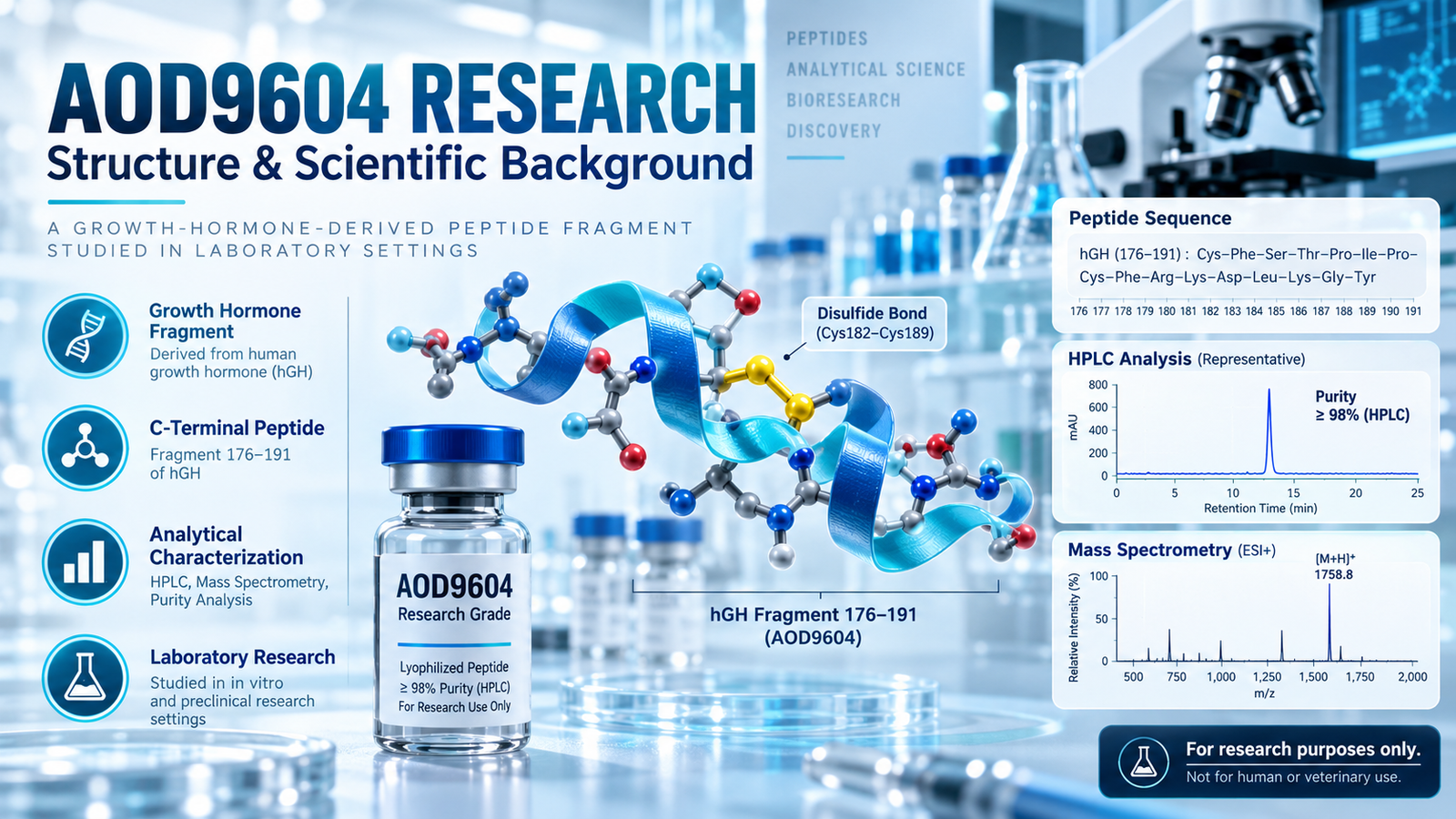
AOD9604 is commonly associated with the growth hormone sequence spanning residues near positions 176 to 191. Scientific literature also describes it more precisely as the human growth hormone 177–191 fragment with an additional tyrosine residue placed at the N-terminus.
This article reviews AOD9604 from a laboratory research perspective, including its structure, scientific history, analytical characterization, and experimental background.
For research purposes only. Not for human or veterinary use.
What Is AOD9604?
AOD9604 is a synthetic peptide related to the C-terminal region of human growth hormone.
Unlike full-length human growth hormone, AOD9604 contains only a small section of the original protein sequence.
This smaller structure allows researchers to examine whether particular regions of a large hormone can produce biological effects independently from the full molecule.
That concept is important in peptide science.
A large protein may contain different functional regions, and individual fragments can sometimes behave differently from the parent molecule.
Published analytical research describes AOD9604 as a peptide composed of the C-terminal human growth hormone sequence from amino acids 177 to 191 with an additional tyrosine residue at the N-terminal end.
Why Is AOD9604 Often Called hGH Fragment 176-191?
AOD9604 is frequently referred to as hGH fragment 176-191.
This name reflects its relationship with the C-terminal portion of human growth hormone.
However, scientific naming can vary slightly depending on how the added N-terminal tyrosine is counted.
For clarity, researchers should rely on the exact sequence rather than the shorthand name alone.
FDA substance records list AOD9604, also known as LAT-8881, with a defined peptide sequence and a cyclic disulfide feature within the molecule.
This is a good example of why precise molecular documentation matters in peptide research.
Understanding the C-Terminal Region of Growth Hormone
Human growth hormone is a much larger protein.
AOD9604 represents only a small portion of its C-terminal region.
The C-terminus is simply the end portion of a peptide or protein chain.
Researchers became interested in this section because earlier work suggested that some biological effects associated with growth hormone might be linked to smaller structural regions rather than the entire protein.
This led to experiments examining isolated and modified peptide fragments.
Why Researchers Study Hormone Fragments
Studying a fragment can help answer an important scientific question:
Does one part of a larger protein retain a distinct biological function?
Researchers may compare:
- Full-length hormone
- Natural peptide fragments
- Synthetic fragments
- Modified analogs
- Related control peptides
These comparisons can help scientists identify which parts of a protein contribute to specific experimental responses.
AOD9604 is one example of this type of fragment-based research.
AOD9604 and Full-Length Human Growth Hormone Are Not the Same
AOD9604 should not be treated as a smaller version of full human growth hormone with identical activity.
Its structure is different.
Its receptor behavior is also different.
Experimental research in mice reported that AOD9604 did not compete for the human growth hormone receptor and did not produce the same receptor-mediated cell proliferation observed with intact hGH.
This finding is important because it suggests that the peptide fragment may act through pathways different from the classical growth hormone receptor mechanism.
Why Receptor Differences Matter
Receptor activity is central to understanding peptide behavior.
Two related molecules can originate from the same parent protein yet interact with biological systems in different ways.
Researchers may examine:
- Receptor binding
- Cellular activation
- Signal duration
- Downstream pathways
- Gene expression
AOD9604 provides a useful research model because it shares structural ancestry with growth hormone while not reproducing all of the full hormone’s receptor behavior.
Molecular Structure of AOD9604
AOD9604 is a relatively short peptide.
Its sequence contains amino acids associated with the C-terminal region of human growth hormone, plus an added tyrosine residue.
FDA substance records identify the following sequence:
Tyr-Leu-Arg-Ile-Val-Gln-Cys-Arg-Ser-Val-Glu-Gly-Ser-Cys-Gly-Phe
The sequence also includes a disulfide connection between two cysteine residues.
This structural feature can influence the shape and stability of the molecule.
Why Disulfide Bonds Matter
A disulfide bond forms between two cysteine residues.
These bonds can help stabilize peptide conformation.
In laboratory research, disulfide structure may affect:
- Molecular shape
- Stability
- Receptor interaction
- Folding behavior
- Analytical characteristics
Researchers examining AOD9604 should therefore consider not only amino-acid order but also the internal structural connection within the peptide.
AOD9604 and Structure-Function Research
AOD9604 fits into a broader field known as structure-function research.
This area examines how specific molecular features influence biological activity.
Scientists may ask:
- Which amino acids are essential?
- Does shortening a protein preserve activity?
- Does a cyclic structure change behavior?
- Does receptor interaction remain the same?
- Does the fragment follow a different signaling pathway?
These questions help researchers understand how proteins can be broken down into functional domains.
Early Research Background
AOD9604 was studied in animal models during early investigations into growth hormone fragments.
One study examined its metabolic effects in obese Zucker rats.
The researchers compared AOD9604 with untreated controls and evaluated metabolic measurements over time.
Other animal research investigated the effects of the fragment in obese and lean mice.
These studies contributed to interest in whether the C-terminal region of growth hormone had biological properties distinct from the full hormone.
AOD9604 and Lipid Metabolism Research
A significant portion of early AOD9604 research focused on lipid metabolism.
Animal studies examined measures such as:
- Fat oxidation
- Lipolytic activity
- Plasma glycerol
- Energy expenditure
- Body-weight change
One mouse study reported increased fat oxidation and changes in lipolysis-related markers after treatment with the fragment.
These findings were preclinical and should be interpreted within the specific animal models used.
Beta-Adrenergic Pathway Research
Researchers also investigated whether beta-adrenergic signaling contributed to the observed effects in animal models.
One study examined AOD9604 in normal mice and beta-3 adrenergic receptor knockout mice.
The researchers reported that the effects seen in wild-type animals were not reproduced in the beta-3 receptor knockout animals.
This suggested that beta-adrenergic signaling might be involved in some of the fragment’s experimentally observed metabolic effects.
Why Knockout Models Are Useful
Knockout models are designed so that a specific gene or receptor is missing.
They help researchers investigate whether a particular pathway is necessary for an experimental effect.
For example, if a compound produces a response in normal animals but not in animals lacking a specific receptor, that receptor may be important to the mechanism.
Such experiments are especially useful when a peptide does not behave through the expected parent-hormone receptor.
AOD9604 and the Growth Hormone Receptor
One important research finding was that AOD9604 did not behave like full human growth hormone at the growth hormone receptor.
In cell-based experiments, researchers reported that the peptide did not compete for hGH receptor binding and did not trigger the same proliferative response.
This supports the idea that peptide fragments can retain some biological properties while losing others.
It also highlights why a fragment should not automatically be assumed to reproduce the biology of its parent protein.
Why Animal Findings Need Careful Interpretation
Many early AOD9604 studies used rodent models.
Animal research is valuable for exploring biological mechanisms.
However, results from mice or rats cannot automatically be applied to humans.
Species may differ in:
- Receptor distribution
- Metabolism
- Enzyme activity
- Peptide clearance
- Cellular signaling
Researchers should therefore interpret AOD9604 findings within the exact model used.
Human Research History
AOD9604 later progressed into human clinical research.
However, the development program did not establish the expected effectiveness for obesity.
An FDA review presented in 2024 noted that a larger study involving more than 500 participants did not demonstrate significant weight loss compared with placebo and that development for obesity was terminated.
This history is important when discussing AOD9604 scientifically.
Preclinical findings do not guarantee successful clinical outcomes.
Why Negative Research Results Matter
Scientific research is not only about positive findings.
Negative or unsuccessful results are also valuable.
They can help researchers:
- Refine hypotheses
- Reconsider biological mechanisms
- Improve experimental design
- Identify species differences
- Avoid unsupported conclusions
The history of AOD9604 provides an example of why early animal results need independent confirmation in later research stages.
Analytical Identification of AOD9604
AOD9604 has also been studied from an analytical chemistry perspective.
Researchers have developed methods to identify the peptide and its metabolites in biological samples.
One study used solid-phase extraction followed by analytical detection techniques to identify AOD9604 in urine.
This type of work is important for understanding:
- Molecular detection
- Sample stability
- Metabolism
- Fragmentation
- Analytical sensitivity
Metabolite Research
The same analytical study identified several possible AOD9604 metabolites after incubation in serum and urine.
One metabolite showed greater stability than the parent peptide under the studied conditions.
Metabolite research helps scientists understand what happens to a peptide after it enters a biological environment.
Researchers may investigate:
- Cleavage sites
- Degradation speed
- Stable fragments
- Enzymatic processing
- Detection windows
These studies can provide important information about peptide stability.
Peptide Degradation Research
Short peptides can be broken down by enzymes known as proteases and peptidases.
The rate of degradation depends on several factors.
These may include:
- Amino-acid sequence
- Structural folding
- Disulfide bonds
- Temperature
- Sample environment
- Enzyme exposure
AOD9604 provides a useful model for studying how small cyclic peptide fragments behave under different laboratory conditions.
Why Sequence Verification Matters
Research samples should match the expected molecular sequence.
A small difference can change:
- Molecular mass
- Conformation
- Biological behavior
- Stability
- Analytical profile
Researchers should therefore compare sample information with reliable reference data.
The exact sequence is more informative than simply labeling the sample as “growth hormone fragment.”
Chromatographic Characterization
High-performance liquid chromatography can help researchers examine the composition of an AOD9604 sample.
Chromatography separates components according to their behavior under controlled conditions.
Researchers may examine:
- Main peak position
- Secondary peaks
- Retention time
- Relative peak area
- Batch consistency
This helps characterize the sample before laboratory studies begin.
Mass Spectrometric Characterization
Mass spectrometry provides another analytical approach.
The technique can help researchers compare the observed molecular characteristics with those expected from the AOD9604 sequence.
Laboratory data may include:
- Molecular ion measurements
- Fragment patterns
- Expected mass
- Observed mass
- Sample identification
Combining chromatographic and mass-based methods can provide stronger analytical documentation.
Purity Is Only One Part of Sample Evaluation
A purity percentage can be useful.
However, it should not be the only information considered.
Researchers may also examine:
- Molecular identity
- Peptide sequence
- Disulfide structure
- Batch number
- Testing date
- Analytical method
This creates a more complete picture of the research material.
Batch Traceability
Good laboratory work depends on knowing exactly which sample was used.
Researchers may document:
- Supplier
- Product identifier
- Lot number
- Date received
- Storage location
- Analytical report
- Experiment date
Batch traceability makes it easier to compare repeated experiments.
It also helps researchers investigate unexpected differences between studies.
Storage Considerations
Peptide fragments may be affected by environmental conditions.
Researchers should use product-specific storage instructions.
Important factors may include:
- Temperature
- Moisture
- Light exposure
- Container integrity
- Time in storage
Storage requirements can vary between dry and dissolved materials.
Laboratories should avoid assuming that all peptide fragments require identical conditions.
AOD9604 and Research Documentation
Research documentation should clearly identify the compound.
A laboratory record may include:
- AOD9604 name
- Sequence reference
- Batch number
- Internal sample code
- Analytical report
- Storage information
- Research date
Good documentation supports repeatability and improves confidence in experimental interpretation.
Regulatory and Research Context
AOD9604 has been investigated scientifically, but it should not be presented as an FDA-approved therapeutic product.
FDA substance databases may list a compound for identification purposes without indicating regulatory approval.
The FDA specifically states that inclusion of a substance in its identification system does not mean the product has been reviewed or approved.
This distinction is important for research-use materials.
What Researchers Should Review Before Laboratory Work
Before beginning research involving AOD9604, laboratories may review:
- Exact peptide sequence
- Batch identification
- Certificate of Analysis
- Chromatographic data
- Molecular identity information
- Storage documentation
- Testing date
- Research-use designation
These checks help create a better-documented experimental starting point.
AOD9604 Research and Bayoupep USA
At Bayoupep USA, AOD9604-related materials are intended strictly for controlled laboratory research.
Researchers should evaluate peptide materials according to their molecular identity, batch documentation, analytical information, and established laboratory procedures.
Research samples should be stored, documented, and handled according to product-specific guidance.
For research purposes only. Not for human or veterinary use.
Final Thoughts
AOD9604 is a small synthetic peptide derived from the C-terminal region of human growth hormone.
Its scientific value comes from its role as a model for studying how a short hormone fragment can behave differently from the full parent protein.
Research has examined its molecular structure, metabolic behavior, beta-adrenergic signaling, receptor differences, degradation, and analytical detection.
Importantly, later human studies did not reproduce the level of effectiveness suggested by some early preclinical findings, highlighting the need for careful interpretation across different research models.
For laboratory researchers, AOD9604 remains relevant as a subject in peptide-fragment biology, analytical chemistry, metabolism, and structure-function research.
Strong experimental controls, accurate molecular identification, batch traceability, and careful documentation remain essential when studying this peptide.
This information is provided for research and educational purposes only. AOD9604 research materials are not intended for human or veterinary use.