
In this article
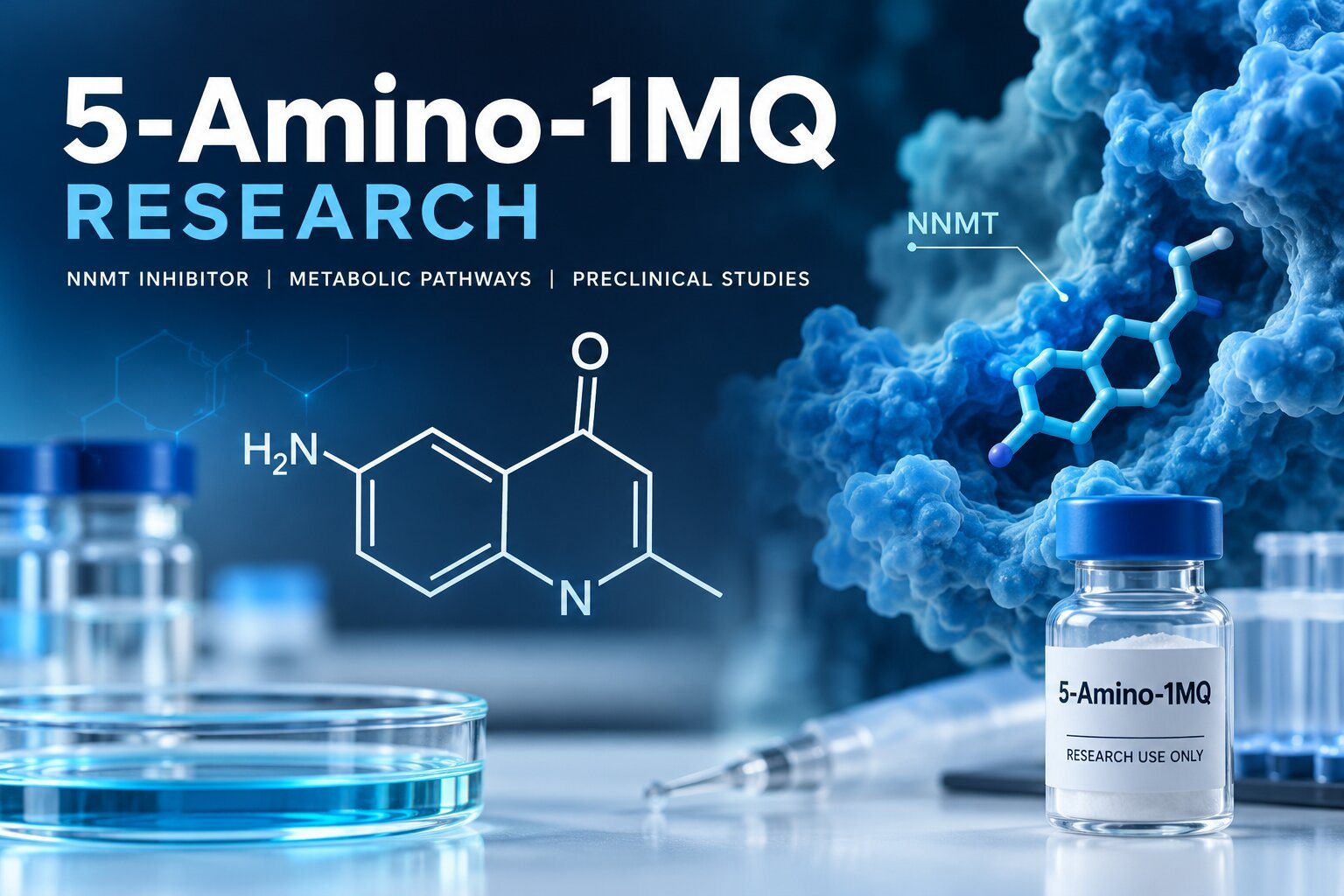
5-Amino-1MQ has gained attention in metabolic and cellular research because it targets an enzyme called nicotinamide N-methyltransferase, or NNMT.
Unlike many compounds discussed in peptide research catalogs, 5-Amino-1MQ is not a peptide. It is a small synthetic quinolinium molecule studied primarily as an experimental NNMT inhibitor. Published work has focused on enzyme activity, cultured cells, and animal models rather than established human clinical use.
This difference matters.
Researchers evaluating 5-Amino-1MQ should approach it as a small-molecule research compound with its own chemistry, analytical requirements, and evidence limitations.
For research purposes only. Not for human or veterinary use.
What Is 5-Amino-1MQ?
5-Amino-1MQ is shorthand for 5-amino-1-methylquinolinium.
Chemically, it belongs to a quinolinium class of small molecules.
Its research interest comes from its interaction with NNMT, an enzyme involved in nicotinamide metabolism.
The core 5-amino-1-methylquinolinium cation has the molecular formula:
C10H11N2+
and a molecular mass of approximately 159.21 g/mol.
However, physical laboratory material usually includes a counterion.
This detail is important when interpreting molecular weight or product labeling.
5-Amino-1MQ Is Not a Peptide
This is one of the most important distinctions researchers should understand.
Peptides are built from amino acids joined by peptide bonds.
5-Amino-1MQ does not have an amino-acid sequence.
Instead, it is a compact synthetic heterocyclic molecule.
That means researchers should not apply peptide-specific assumptions to it.
For example, it does not have:
- A peptide sequence
- A peptide backbone
- A terminal amino-acid chain
- Peptide folding behavior
- Classical peptide degradation patterns
Its analytical and chemical properties should be evaluated as those of a small molecule.
What Is NNMT?
NNMT stands for nicotinamide N-methyltransferase.
It is an enzyme involved in nicotinamide metabolism.
NNMT transfers a methyl group from S-adenosylmethionine, often abbreviated as SAM, to nicotinamide.
This reaction produces:
1-methylnicotinamide, often abbreviated as 1-MNA.
Because this process uses both nicotinamide and methyl-donor resources, NNMT has attracted research interest in areas related to cellular metabolism.
Why Researchers Study NNMT
NNMT sits at an interesting intersection between several biochemical systems.
Its activity can influence pathways connected with:
- Nicotinamide metabolism
- NAD+ salvage
- Methyl-donor availability
- Cellular energy regulation
- Adipocyte biology
- Metabolic signaling
For this reason, researchers have investigated whether changing NNMT activity alters cellular behavior.
5-Amino-1MQ became useful as an experimental tool for studying that question.
What Does NNMT Inhibition Mean?
An inhibitor reduces the activity of a biological target.
In this case, 5-Amino-1MQ has been studied as an inhibitor of NNMT.
Researchers may measure inhibition by examining changes such as:
- Reduced NNMT enzyme activity
- Lower 1-MNA formation
- Changes in nicotinamide metabolism
- Altered NAD+-related measurements
- Changes in methyl-donor pathways
These measurements help researchers understand the role of NNMT in cells.
They do not automatically establish a clinical effect.
Why 1-Methylnicotinamide Matters in Research
1-Methylnicotinamide is produced when NNMT methylates nicotinamide.
Researchers may therefore use 1-MNA as an indirect marker of NNMT activity.
If NNMT activity decreases, 1-MNA production may also decrease under some experimental conditions.
This gives researchers a measurable biochemical endpoint.
Monitoring 1-MNA can help answer questions such as:
- Is NNMT being inhibited?
- How strongly is enzyme activity changing?
- Does the response vary by concentration?
- Are metabolic pathways shifting?
These measurements are useful in mechanistic research.
5-Amino-1MQ and NAD+ Research
Nicotinamide is involved in pathways related to NAD+ metabolism.
NAD+ is an essential cellular cofactor involved in many biochemical reactions.
Because NNMT uses nicotinamide as a substrate, researchers have examined whether NNMT inhibition influences NAD+-related metabolism.
Published preclinical studies have reported changes in NAD+ measurements in experimental systems involving NNMT inhibition.
These findings are mechanistic.
They do not establish the same effects in humans.
Why NAD+ Is Important in Cellular Biology
NAD+ participates in processes involving:
- Cellular energy transfer
- Redox reactions
- DNA-related enzymes
- Metabolic regulation
- Mitochondrial function
Because of these roles, changes in NAD+ availability can influence many cellular systems.
Researchers studying NNMT may therefore monitor NAD+-related changes as part of a larger metabolic picture.
Early NNMT Research
Before 5-Amino-1MQ became a commonly discussed research compound, scientists were already investigating NNMT as a metabolic target.
Earlier genetic studies examined what happened when NNMT expression was reduced in experimental models.
These findings helped establish NNMT as a possible regulator of metabolic pathways.
Later medicinal-chemistry work identified small molecules capable of directly inhibiting the enzyme.
5-Amino-1MQ emerged from this research direction.
Why Small-Molecule Inhibitors Are Useful
Genetic techniques can reduce the expression of a target enzyme.
Small-molecule inhibitors offer another approach.
They allow researchers to modify enzyme activity chemically.
This can be useful because scientists can study:
- Concentration-dependent inhibition
- Timing of enzyme suppression
- Reversibility
- Cellular uptake
- Target selectivity
Small molecules can therefore complement genetic research methods.
Cell Permeability Research
For an inhibitor to affect an intracellular enzyme, it generally needs access to the relevant cellular compartment.
Published experimental work has examined the membrane permeability of NNMT inhibitors, including 5-Amino-1MQ.
Researchers may assess whether the compound can:
- Enter cultured cells
- Reach intracellular NNMT
- Alter downstream metabolite levels
- Produce measurable biochemical changes
Cell permeability is therefore an important part of small-molecule research.
5-Amino-1MQ in Adipocyte Research
One major area of early research involved adipocytes.
Adipocytes are cells specialized for storing lipids.
Researchers used cultured adipocyte models to examine whether NNMT inhibition affected cellular metabolic measurements.
Experimental endpoints have included:
- NNMT activity
- 1-MNA concentration
- NAD+-related measures
- Lipid accumulation
- Cellular metabolic markers
These studies contributed to interest in NNMT as a metabolic research target.
Why Adipocyte Models Are Useful
Cultured adipocytes allow researchers to study cellular metabolism under controlled conditions.
Scientists can adjust:
- Compound concentration
- Exposure time
- Nutrient conditions
- Gene expression
- Enzyme activity
This makes it easier to isolate specific biochemical effects.
However, cultured cells represent only one experimental system.
They do not reproduce the complexity of a whole organism.
Animal Research With 5-Amino-1MQ
5-Amino-1MQ has also been studied in mouse models.
One widely cited preclinical study evaluated the compound in diet-induced obese mice.
Researchers measured endpoints related to:
- Body weight
- Adipose tissue
- Metabolic markers
- NNMT activity
- Cellular metabolites
The findings contributed to interest in NNMT inhibition as a metabolic research strategy.
These were animal results and should remain interpreted as such.
Why Diet-Induced Obesity Models Are Used
Diet-induced obesity models are commonly used in metabolic research.
Researchers expose animals to specific diets and then examine changes in:
- Adipose tissue
- Glucose regulation
- Lipid metabolism
- Energy balance
- Enzyme activity
Such models help scientists test mechanistic hypotheses.
They do not establish whether the same compound would produce the same result in humans.
Research Beyond Adipose Tissue
NNMT research has expanded beyond adipocyte biology.
Studies have investigated NNMT-related pathways in areas including:
- Skeletal muscle
- Aging models
- Muscle regeneration
- Vascular biology
- Fibrosis research
- Cellular metabolism
Some research using NNMT inhibitors has examined aged muscle models and muscle stem-cell behavior.
These findings broaden the scientific interest in NNMT as a metabolic enzyme.
5-Amino-1MQ and Muscle Research
Preclinical work has explored NNMT inhibition in aged muscle models.
Researchers have examined variables such as:
- Muscle regeneration
- Stem-cell activity
- Tissue recovery
- Metabolic function
- Physical performance measures in animals
These studies are useful for understanding possible biological roles of NNMT.
However, they do not establish a human performance or recovery effect.
Why Evidence Boundaries Matter
5-Amino-1MQ is sometimes discussed online in ways that go far beyond the published evidence.
The actual research record remains primarily preclinical.
Current evidence includes:
- Enzyme assays
- Cell-culture experiments
- Rodent studies
As of 2026, no published human clinical trial of 5-Amino-1MQ has established safety, dosing, pharmacokinetics, or effectiveness.
This limitation should be made clear in any responsible research discussion.
No Established Human Dose
Because published human trials are lacking, there is no established human research dose that can be derived responsibly from the current evidence.
Animal doses should not simply be converted into human-use instructions.
Species differ in:
- Metabolism
- Absorption
- Distribution
- Elimination
- Enzyme activity
- Tissue exposure
For this reason, laboratory research data should remain separated from personal-use claims.
No Established Human Safety Profile
Human safety cannot be inferred from short-duration rodent studies.
Current published evidence does not provide a complete human safety dataset for 5-Amino-1MQ.
Important unanswered questions include:
- Human absorption
- Human metabolism
- Human elimination
- Long-term exposure
- Organ-specific effects
- Drug interactions
These gaps are scientifically significant.
Chemical Form Matters
5-Amino-1MQ exists as a positively charged quinolinium species.
A physical laboratory sample therefore includes a counterion.
Commonly documented forms may include different salts, such as iodide or chloride.
These forms share the same positively charged core but have different:
- Molecular formulas
- Molecular weights
- Physical properties
Researchers should identify the exact form being studied.
Why Counterion Identity Is Important
Suppose two samples are both labeled “5-Amino-1MQ.”
One may be an iodide salt.
Another may use a different counterion.
The total molecular mass of these materials will not be identical.
This matters when researchers calculate:
- Molar concentration
- Sample mass
- Analytical standards
- Stoichiometry
A short catalog name may therefore be insufficient for precise laboratory work.
Molecular Weight Should Be Interpreted Carefully
The molecular weight of the 5-amino-1-methylquinolinium cation is different from the molecular weight of a complete salt.
This distinction can create confusion when reading product specifications.
Researchers should confirm:
- Exact chemical form
- Counterion
- Molecular formula
- Molecular mass basis
This helps prevent calculation errors.
Analytical Identification
Small-molecule research materials require clear chemical identification.
Researchers may use analytical methods such as:
- Mass spectrometry
- Liquid chromatography
- NMR spectroscopy
- Reference standards
- Elemental or ion analysis
The appropriate combination depends on the laboratory goal.
No single technique answers every identity question.
Chromatographic Analysis
Liquid chromatography can help separate components within a 5-Amino-1MQ sample.
Researchers may evaluate:
- Main peak
- Retention time
- Minor components
- Relative peak areas
- Batch consistency
Chromatographic purity is useful, but it does not automatically confirm exact chemical form.
Why Purity Alone Is Not Enough
A product may show a high chromatographic purity result.
That number does not necessarily identify:
- Counterion
- Exact formula
- Molecular mass basis
- Residual solvents
- Water content
Researchers should therefore review more than a single purity percentage.
This is especially important for ionic small molecules.
Mass Spectrometry
Mass spectrometry can provide information about molecular identity.
Researchers may compare observed signals with the expected 5-amino-1-methylquinolinium ion.
Depending on the method, mass spectrometry may reveal:
- Parent ion
- Fragment ions
- Molecular patterns
- Sample consistency
However, interpretation should account for the actual chemical form and analytical conditions.
NMR Research
Nuclear magnetic resonance spectroscopy can provide structural information about small molecules.
NMR may help confirm:
- Ring structure
- Proton environment
- Substitution pattern
- Chemical identity
Because 5-Amino-1MQ is a small molecule rather than a peptide, NMR can be particularly useful for structural characterization.
Selectivity Research
An experimental inhibitor is more informative when researchers understand whether it affects other enzymes.
Studies of NNMT inhibitors have therefore examined selectivity against related methyltransferases and biochemical targets.
Selectivity research helps answer whether observed effects are likely associated with NNMT inhibition or with broader off-target activity.
This is an important step in mechanism research.
Why Off-Target Effects Matter
A compound may affect more than one biological target.
If researchers assume perfect selectivity, experimental conclusions can become misleading.
Laboratory studies may therefore examine:
- Related enzymes
- Alternative methyltransferases
- Cellular toxicity
- Unexpected metabolic changes
These controls strengthen interpretation.
Concentration-Response Experiments
Researchers often study several concentrations of 5-Amino-1MQ rather than using only one.
This can help establish a concentration-response relationship.
Measurements may include:
- NNMT inhibition
- 1-MNA changes
- Cellular metabolites
- Cell viability
These data help researchers distinguish specific effects from nonspecific responses.
Experimental Controls
Good controls are important in NNMT research.
Depending on the study, laboratories may include:
- Untreated cells
- Vehicle controls
- Alternative NNMT inhibitors
- NNMT knockdown models
- Reference standards
Using multiple controls helps clarify whether an observed response is actually connected with NNMT.
Genetic and Chemical Approaches Can Be Compared
Researchers can study NNMT using more than one strategy.
For example:
Genetic approach: Reduce NNMT expression.
Chemical approach: Inhibit NNMT activity with a compound such as 5-Amino-1MQ.
If both methods produce similar biological changes, this may strengthen evidence linking the effect to NNMT.
However, differences between the methods can also reveal useful information.
Research Documentation
Laboratories should maintain detailed records for every research batch.
Useful documentation can include:
- Compound name
- Exact salt form
- Molecular formula
- Molecular weight
- Batch number
- Analytical report
- Storage conditions
- Experimental date
This level of detail is particularly important for compounds sold under abbreviated names.
Batch-Specific Verification
Researchers should avoid assuming that one test report represents every production lot.
Batch-specific documentation can help confirm:
- Identity
- Purity
- Chemical form
- Test date
- Lot traceability
This improves experimental reproducibility.
Storage Considerations
Small molecules and peptides can have different storage requirements.
Researchers should use product-specific documentation for 5-Amino-1MQ.
Relevant variables may include:
- Temperature
- Moisture
- Light exposure
- Chemical form
- Container compatibility
Researchers should avoid automatically applying peptide storage practices to this compound simply because it appears in a peptide-related catalog.
5-Amino-1MQ and Bayoupep USA Research
At Bayoupep USA, 5-Amino-1MQ should be understood as a laboratory research compound rather than a peptide.
Researchers evaluating this material should confirm its exact chemical form, batch documentation, analytical identity, and storage requirements before beginning experimental work.
The scientific interest surrounding 5-Amino-1MQ centers primarily on NNMT inhibition and preclinical metabolic research.
Current published evidence does not establish human safety or effectiveness.
For research purposes only. Not for human or veterinary use.
Final Thoughts
5-Amino-1MQ is scientifically distinct from most compounds discussed in peptide research.
It is a synthetic small molecule studied as an inhibitor of nicotinamide N-methyltransferase.
Research involving the compound has examined enzyme activity, adipocyte metabolism, NAD+-related pathways, animal metabolic models, and muscle biology.
However, the evidence remains preclinical.
Researchers should therefore distinguish carefully between what laboratory and rodent studies have shown and what has not yet been demonstrated in humans.
Its chemical form also deserves special attention because different counterions can change molecular weight and sample interpretation.
Accurate compound identification, suitable analytical methods, proper controls, batch-specific documentation, and clear evidence boundaries are essential when studying 5-Amino-1MQ.
This information is provided for scientific and educational research purposes only. 5-Amino-1MQ research material is not intended for human or veterinary use.