
In this article
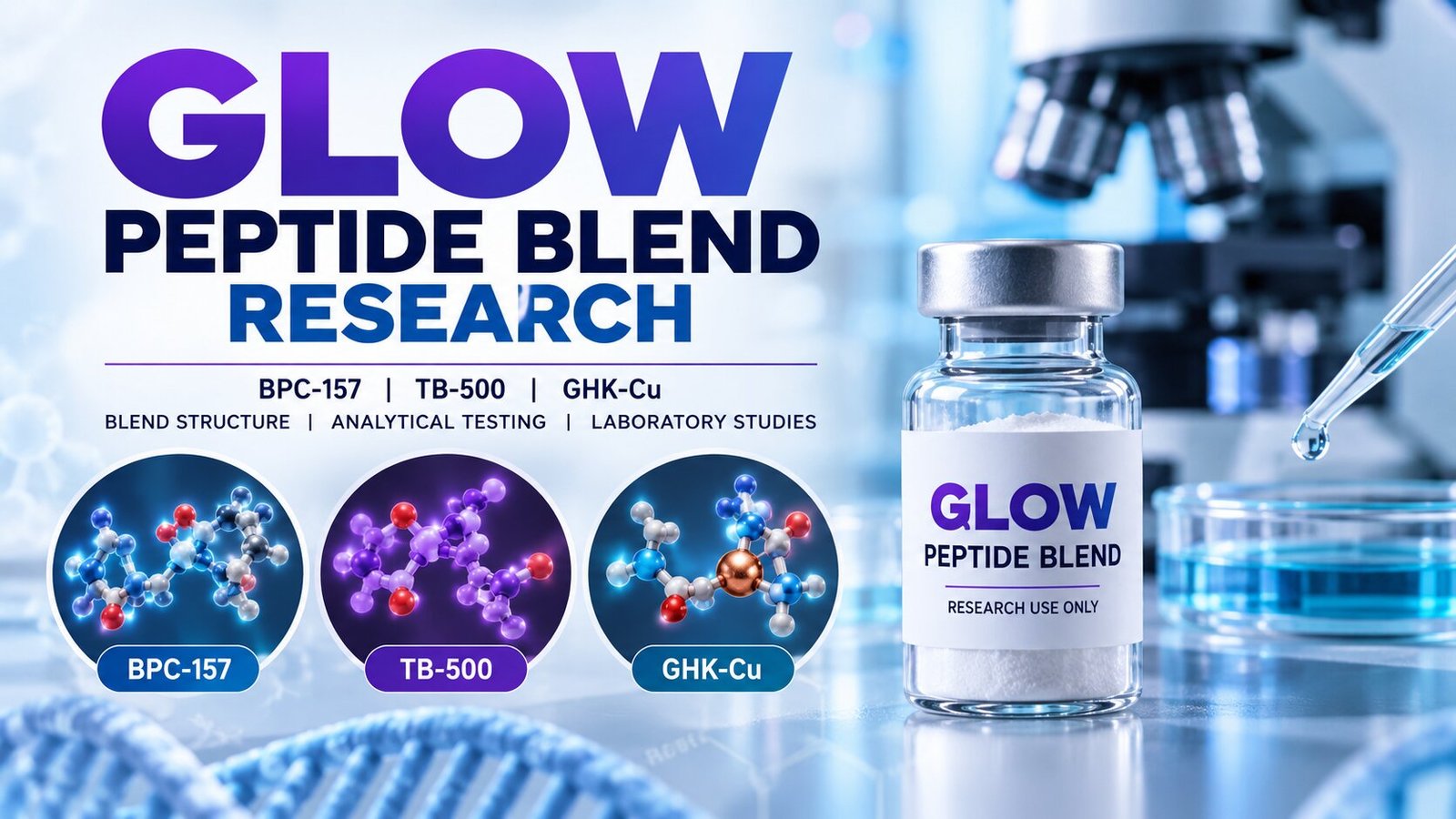
The term GLOW peptide blend is commonly used for a research formulation combining three separate peptide materials:
- GHK-Cu
- BPC-157
- TB-500
The blend is not a single newly discovered peptide. It is a multi-component laboratory formulation containing compounds that have each been studied independently.
That distinction is important.
Published research exists for the individual components, but the exact three-component GLOW formulation has not been established through the same body of published research as its separate ingredients. Researchers should therefore avoid assuming that combining these peptides automatically produces additive or synergistic effects.
This article examines GLOW from a laboratory perspective, including the characteristics of its three components, why multi-peptide formulations require careful analytical verification, and what researchers should consider when evaluating a blended sample.
For research purposes only. Not for human or veterinary use.
What Is the GLOW Peptide Blend?
GLOW is a name used in the research-product market for a formulation containing GHK-Cu, BPC-157, and TB-500 in one preparation.
The important scientific point is that GLOW is a blend, not one chemical entity.
Each component retains its own:
- Molecular identity
- Peptide sequence
- Molecular mass
- Chemical characteristics
- Analytical profile
A laboratory studying a blend therefore has to consider three different research materials at the same time.
This is different from analyzing a single purified peptide.
Why the Blend Should Be Studied Component by Component
When three compounds are placed into one vial, the available scientific literature does not suddenly become evidence for the combination itself.
Researchers need to separate two questions:
What is known about each component individually?
and
What is known about the combined formulation?
For GLOW, most available research belongs to the first category.
Current literature is much stronger for individual GHK-Cu, BPC-157, and thymosin-related research than for the three-material combination as one experimental formulation.
This evidence boundary should remain clear throughout the article.
Component One: GHK-Cu
GHK-Cu is the copper complex of the tripeptide glycyl-L-histidyl-L-lysine.
It is considerably smaller than BPC-157 or thymosin-related peptides.
The copper ion is an important part of the complex.
This gives GHK-Cu distinctive chemical and analytical properties compared with peptides that do not contain a coordinated metal ion.
Researchers have studied GHK-Cu in areas involving:
- Fibroblast biology
- Extracellular matrix signaling
- Collagen-related pathways
- Gene-expression changes
- Skin-related cellular models
- Tissue-remodeling research
Much of this work has involved cell culture, preclinical models, and formulation-specific skin research rather than the GLOW blend itself.
Why Copper Changes the Research Profile
GHK alone and GHK-Cu should not be treated as identical materials.
Copper coordination changes the molecular complex.
Researchers evaluating GHK-Cu may therefore consider:
- Copper binding
- Metal-to-peptide ratio
- Complex stability
- Oxidation conditions
- Analytical detection method
This makes GHK-Cu especially important when characterizing a blended product.
A laboratory should confirm not merely that a GHK-related peptide is present, but that the intended copper-containing form is represented appropriately.
Component Two: BPC-157
BPC-157 is a synthetic 15-amino-acid peptide.
Its sequence is commonly reported as:
Gly-Glu-Pro-Pro-Pro-Gly-Lys-Pro-Ala-Asp-Asp-Ala-Gly-Leu-Val
Its research history is primarily associated with preclinical experimental models.
Scientists have investigated BPC-157 in studies involving:
- Tissue-response pathways
- Gastrointestinal models
- Vascular signaling
- Tendon and ligament models
- Cellular stress responses
- Experimental repair mechanisms
Much of the published evidence remains based on animal research.
This is important when discussing the component within a blend.
Preclinical findings involving BPC-157 alone should not be presented as evidence for the entire GLOW formulation.
Component Three: TB-500
TB-500 is a research name associated with thymosin beta-4-related peptide material.
This area requires careful terminology because commercial products labeled TB-500 may not always use the same molecular definition.
Researchers should therefore verify the exact sequence and molecular specification listed for the material being studied.
Thymosin beta-4-related research has examined areas such as:
- Actin-associated biology
- Cellular migration
- Cytoskeletal organization
- Tissue-response models
- Angiogenesis-related signaling
These research areas help explain why thymosin-derived materials are often discussed alongside other tissue-model peptides.
However, this does not establish that a three-component GLOW preparation behaves in the same way.
Why Exact TB-500 Identity Matters
A catalog name is not enough for precise laboratory work.
Researchers should determine:
- Exact amino-acid sequence
- Molecular weight
- Chemical modifications
- Peptide length
- Batch-specific analytical identity
This is particularly important for TB-500 because terminology can vary across research suppliers and literature.
A reliable laboratory record should describe the actual molecule rather than rely only on the product nickname.
Three Components, Three Different Molecular Profiles
One reason GLOW is analytically more complicated than a single peptide is that its components are chemically different.
GHK-Cu is a very small copper-bound tripeptide.
BPC-157 is a 15-residue peptide.
TB-500-related material represents another distinct peptide structure.
Researchers therefore need analytical methods capable of distinguishing these materials from one another.
A single generic purity figure may not provide enough information.
Why One Purity Number Can Be Misleading
Suppose a blended vial is described as having “99% purity.”
That statement immediately creates a question:
Which component was measured?
A meaningful blend analysis should ideally distinguish:
- GHK-Cu identity
- BPC-157 identity
- TB-500 identity
- Relative or absolute content of each component
- Detected impurities
One overall chromatographic number does not necessarily prove that all three materials are present at the intended levels.
This is why multi-component analytical documentation deserves additional scrutiny.
Identity Testing in a Multi-Peptide Blend
Identity testing becomes more complex when several peptides are present.
Mass spectrometry can help differentiate molecules based on mass-related characteristics.
Researchers may look for signals corresponding to each expected component.
For example, the analysis should be capable of supporting the presence of:
- GHK-Cu
- BPC-157
- The specified TB-500-related peptide
The laboratory should also consider whether ionization behavior differs between the components.
A method optimized for one peptide may not perform equally well for all three.
Chromatographic Separation
Liquid chromatography can help separate components in a blended sample before detection.
Researchers may evaluate:
- Retention times
- Peak separation
- Peak identity
- Minor impurities
- Component-specific peak areas
The analytical method should be able to resolve the mixture adequately.
If two components overlap significantly, interpretation may become more difficult.
Method suitability therefore matters as much as the final reported result.
Quantifying Each Component
Identity and quantity are separate questions.
A laboratory may verify that three compounds are present while still needing to determine whether each is present at the intended amount.
Quantitative analysis can help evaluate:
- Labeled content
- Relative ratio
- Batch consistency
- Component recovery
- Sample uniformity
For a blend, this is especially important.
A vial could contain all three expected compounds but still differ from the intended formulation ratio.
Why Blend Ratios Matter
Different suppliers may formulate GLOW differently.
The term “GLOW” itself does not define one universal scientific ratio.
Researchers should therefore verify the labeled amount of each component rather than assume that every GLOW preparation is identical.
Useful documentation may specify:
- GHK-Cu amount
- BPC-157 amount
- TB-500 amount
- Total vial content
This information should match the batch-specific analytical records.
Co-Lyophilized Research Formulations
Some GLOW products are supplied as a single lyophilized mixture.
Lyophilization removes much of the water from the formulation.
For a multi-component preparation, researchers may study whether co-lyophilization affects:
- Chemical stability
- Moisture sensitivity
- Reconstitution behavior
- Component distribution
- Long-term integrity
These questions are different from studying each peptide separately.
A stable individual peptide does not automatically guarantee equal stability in a mixed formulation.
Why Stability Testing Is More Complex With Blends
When several molecules share one preparation, researchers must consider possible interactions.
Potential areas of investigation include:
- Peptide-peptide interaction
- Copper-associated reactions
- Oxidation
- pH effects
- Differential degradation
- Precipitation or aggregation
The presence of GHK-Cu introduces a metal-bound component that may further influence the chemical environment.
This makes stability data for the actual blend more useful than simply combining storage information from three unrelated single-peptide studies.
GHK-Cu and Blend Appearance
Copper-containing compounds can influence the visible appearance of a formulation.
A GHK-Cu-containing mixture may display a blue or blue-tinted appearance.
However, color should never be treated as proof of:
- Identity
- Purity
- Correct copper content
- Correct peptide ratio
Visual inspection is useful only as a basic observation.
Analytical testing is still required.
Why Researchers Study Multi-Component Systems
A combined formulation can be scientifically interesting because several signaling systems may be present simultaneously.
Researchers may design controlled experiments to ask whether:
- One compound alters another compound’s response
- Effects are additive
- Effects are less than additive
- One component dominates the response
- The combination produces no meaningful difference
These questions require direct testing.
They cannot be answered simply by reading separate studies on each ingredient.
What Would a Proper Combination Study Require?
To determine whether a blend produces an interaction, researchers need appropriate experimental groups.
A study might compare:
- Untreated control
- GHK-Cu alone
- BPC-157 alone
- TB-500 alone
- Two-component combinations
- Full three-component blend
This type of design makes it possible to distinguish individual effects from combination effects.
Without such comparisons, claims of synergy remain speculative.
Why “Synergy” Should Not Be Assumed
The term synergy means that a combination produces an effect greater than would be expected from the individual components.
Simply mixing several peptides does not demonstrate synergy.
Researchers would need quantitative experiments to establish it.
A valid synergy analysis may require:
- Dose-response data
- Individual component controls
- Combination groups
- Statistical interaction analysis
Current literature does not provide strong direct evidence establishing the specific commercial GLOW formulation as a synergistic three-peptide system.
Laboratory Models for GLOW Research
Because the blend itself has limited direct published evidence, researchers may design exploratory studies around well-defined laboratory endpoints.
Possible research systems might include:
- Cultured fibroblasts
- Matrix-related cellular models
- Migration assays
- Gene-expression experiments
- Controlled tissue models
The chosen model should match the research question.
Researchers should avoid selecting endpoints simply because individual components have been associated with them elsewhere.
Fibroblast Research
GHK-Cu has frequently been studied in fibroblast-related research.
Fibroblasts are cells involved in extracellular matrix production.
A laboratory studying a GLOW formulation might measure:
- Fibroblast activity
- Collagen-related gene expression
- Matrix-associated proteins
- Cellular migration
- Viability
However, proper controls would be needed to determine whether any response comes from GHK-Cu alone or from the full mixture.
Cellular Migration Models
Thymosin beta-4-related research has contributed to interest in cellular migration.
Migration assays measure how cells move under controlled conditions.
Researchers can use these experiments to compare:
- Individual peptides
- Combined formulations
- Untreated controls
This approach may help separate component-specific effects from blend-level effects.
Matrix Remodeling Research
Extracellular matrix biology involves proteins and signaling systems surrounding cells.
GHK-Cu, BPC-157, and thymosin-related research have each been discussed in different tissue-model contexts.
A GLOW study could therefore examine matrix-related outcomes.
But the correct scientific approach is to measure the blend directly rather than assume the individual literature automatically predicts the result.
The Importance of Negative Results
Researchers should also be prepared for the possibility that combining several compounds produces no advantage.
A blend may show:
- No additional response
- Reduced response
- Variable response
- Concentration-dependent interaction
These findings can be scientifically valuable.
Negative results help prevent unsupported assumptions about multi-component systems.
Batch-to-Batch Consistency
Blends introduce more opportunities for manufacturing variation.
Researchers may need to verify:
- Identity of all components
- Quantity of each component
- Total vial content
- Batch number
- Analytical date
- Storage history
A change in any one component may affect experimental results.
This makes batch traceability especially important.
Certificate of Analysis for a Blend
A useful COA for a multi-component research material should provide more than the product name “GLOW.”
Researchers should ideally look for information such as:
- Exact component names
- Lot number
- Component identity testing
- Purity data
- Quantitative information
- Testing methods
- Laboratory information
The analytical document should make it clear what was actually measured.
Third-Party Testing
Independent laboratory testing can add another layer of verification.
For a GLOW-type blend, third-party analysis is most useful when the laboratory distinguishes the components rather than reporting only one combined number.
Researchers should verify whether the test confirms:
- All intended molecules
- Correct chemical forms
- Component amounts
- Batch correspondence
This provides stronger information than a generic marketing claim.
Storage Documentation
Storage instructions should relate to the actual blended formulation.
Researchers should consider:
- Temperature
- Light exposure
- Moisture
- Container sealing
- Reconstitution state
- Storage duration
Because GLOW contains chemically different components, product-specific stability information is preferable to assumptions based on individual peptide storage alone.
Research Records for GLOW
A laboratory record for a blended sample may include:
- Product name
- Exact formulation
- omponent amounts
- Batch number
- COA
- ndependent test report
- torage history
- Reconstitution date
- Experimental identifier
Detailed records make later interpretation easier.
They also help researchers compare results between different batches.
Evidence From Individual Components Should Stay Separate
This is one of the most important principles when discussing GLOW.
Evidence involving BPC-157 alone is evidence about BPC-157.
Evidence involving GHK-Cu alone is evidence about GHK-Cu.
Evidence involving thymosin beta-4 or TB-500-related material alone is evidence about that compound.
None of those findings independently proves what the three-component blend will do.
This distinction helps maintain scientific accuracy.
Regulatory and Research Context
GLOW should be treated as a laboratory research formulation rather than an approved therapeutic combination.
The blend itself does not have an established FDA-approved therapeutic indication.
Researchers should also distinguish product-market names from recognized drug names.
“GLOW” is a formulation label rather than the name of one internationally defined molecule.
GLOW Research and Bayoupep USA
At Bayoupep USA, GLOW-related materials should be handled as research formulations intended for controlled laboratory investigation.
Researchers should verify the exact formulation, component identities, batch documentation, analytical reports, and storage requirements before experimental use.
Particular care should be taken with blended products because each component requires appropriate analytical confirmation.
Published evidence involving individual peptides should not be presented as direct evidence for the entire blend.
For research purposes only. Not for human or veterinary use.
Final Thoughts
The GLOW peptide blend brings together three chemically distinct research materials: GHK-Cu, BPC-157, and TB-500.
Its scientific complexity comes from that combination.
GHK-Cu contributes a copper-bound tripeptide system.
BPC-157 provides a separate 15-residue research peptide.
TB-500-related material introduces another distinct thymosin-associated molecular component.
Researchers studying the blend therefore need to consider more than simple purity.
Important questions include whether all components are present, whether their quantities match the formulation, whether they remain stable together, and whether experimental responses differ from those produced by each material alone.
Most importantly, the scientific literature for individual components should not be interpreted as proof of the behavior of the combined GLOW formulation. Published evidence for the exact three-component mixture remains limited.
Careful controls, component-specific analytical testing, batch traceability, and transparent evidence boundaries are essential for meaningful GLOW peptide blend research.
This information is provided for scientific and educational research purposes only. GLOW research materials are not intended for human or veterinary use.