

In this article
ARA-290, also known as cibinetide, is a short synthetic peptide derived from a specific structural region of erythropoietin.
Unlike full-length erythropoietin, which is best known for its role in red blood cell production, ARA-290 was designed to investigate tissue-protective signaling without reproducing the classical erythropoietic response.
This distinction has made the peptide an interesting subject in receptor biology, inflammation research, nerve-related studies, and cellular repair models.
ARA-290 has been examined in laboratory, animal, and early clinical research. However, it remains a research compound rather than an approved general-use therapy.
For research purposes only. Not for human or veterinary use.
What Is ARA-290?
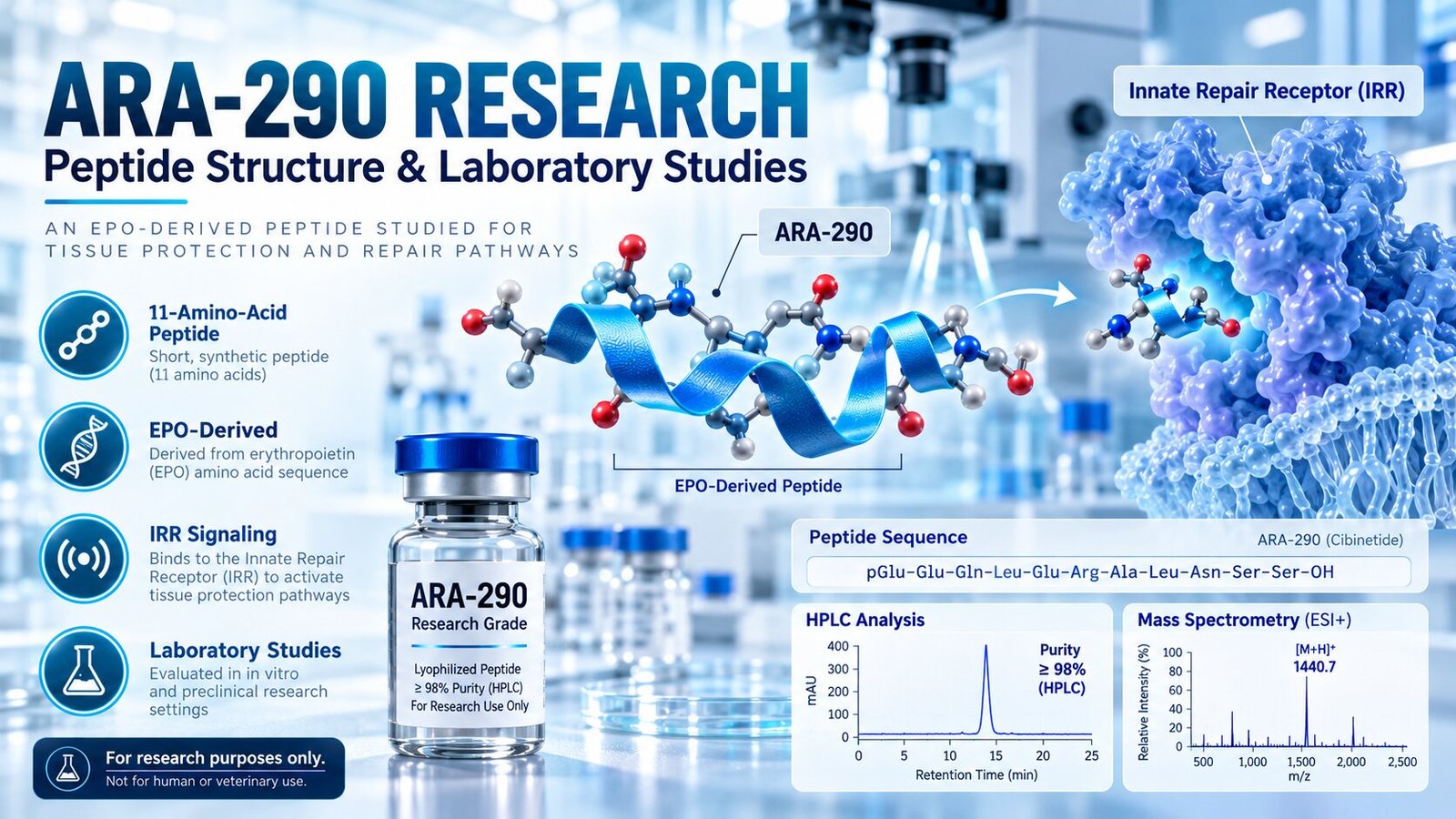
ARA-290 is an 11-amino-acid synthetic peptide.
It was engineered from the helix B surface region of erythropoietin, often abbreviated as EPO.
The peptide is also known by several other names, including:
- Cibinetide
- pHBSP
- Pyroglutamate helix B surface peptide
These names may appear in scientific publications discussing the same compound.
ARA-290 was developed to reproduce selected signaling properties associated with EPO while avoiding its red blood cell-producing effects.
Why Was ARA-290 Developed?
Erythropoietin is a naturally occurring signaling protein.
Its classical biological role involves stimulating red blood cell production.
However, researchers also discovered that EPO-related signaling could influence tissue-protective pathways under certain experimental conditions.
This raised an important question:
Could researchers isolate the tissue-related signaling features of EPO without triggering the erythropoietic pathway?
ARA-290 was designed around that idea.
The peptide contains structural information from the helix B region of EPO but does not behave like full-length erythropoietin in classical blood-cell signaling models.
Understanding the Helix B Region
Proteins often contain structural regions known as helices.
These sections contribute to overall shape and receptor interaction.
ARA-290 was designed from the surface of helix B in erythropoietin.
Researchers believed this region contributed to a tissue-protective signaling pathway separate from the receptor mechanism responsible for red blood cell production.
Instead of using the entire EPO protein, scientists created a much smaller peptide that copied key structural features from this region.
This approach allowed researchers to investigate the pathway with a simpler molecular tool.
ARA-290 Is an 11-Residue Peptide
ARA-290 is much smaller than full-length erythropoietin.
Its sequence is commonly reported as:
pGlu-Glu-Gln-Leu-Glu-Arg-Ala-Leu-Asn-Ser-Ser-OH
The molecule contains 11 residues and begins with an N-terminal pyroglutamate group.
Its reported molecular weight is approximately 1,257 Da.
The compact structure makes ARA-290 useful for studying how a small peptide can reproduce selected molecular interactions associated with a much larger protein.
Why the Pyroglutamate Group Matters
ARA-290 begins with pyroglutamate rather than a standard free amino terminus.
This structural feature can influence peptide behavior.
In laboratory research, N-terminal modifications may affect:
- Molecular stability
- Enzymatic degradation
- Peptide conformation
- Receptor interaction
- Analytical behavior
The pyroglutamate modification is one reason ARA-290 is sometimes described as pHBSP.
Researchers evaluating the molecule should account for this feature during identity testing.
ARA-290 and the Innate Repair Receptor
One of the main research areas involving ARA-290 focuses on a receptor complex often called the innate repair receptor, or IRR.
This receptor has been described as a heteromeric complex involving:
- An erythropoietin receptor component
- The beta-common receptor, also called CD131
Researchers study this receptor because it appears to be involved in signaling associated with cellular stress, inflammation, and tissue responses.
ARA-290 was designed to engage this pathway rather than the classical erythropoietin receptor pathway associated with red blood cell production.
Why This Receptor Difference Is Important
The classical erythropoietin receptor and the innate repair receptor are not identical systems.
This helps explain why ARA-290 and full-length EPO can produce different experimental outcomes.
Researchers may compare:
- Receptor binding
- Downstream signaling
- Gene-expression changes
- Cell survival pathways
- Inflammatory signaling
- Tissue-response patterns
These comparisons help clarify which parts of EPO-related biology can be separated from erythropoiesis.
Non-Erythropoietic Peptide Research
ARA-290 is often described as non-erythropoietic.
This means the molecule was designed to avoid stimulating the red blood cell-producing pathway associated with full-length erythropoietin.
That feature makes it useful in experimental systems where researchers want to study tissue-related signaling without introducing classical EPO activity.
This distinction is central to understanding the scientific purpose behind the peptide.
Cellular Signaling Research
After receptor engagement, ARA-290-related research may examine downstream signaling events inside cells.
Published work has investigated pathways involving signaling proteins such as:
- Akt
- STAT3
- NF-kB-related signaling
- Cellular stress pathways
These pathways can influence how cells respond to inflammation or injury.
However, the exact response depends on the model, tissue, and experimental conditions used.
ARA-290 and Inflammation Research
Inflammatory signaling is one of the main areas studied with ARA-290.
Researchers have used cell and animal models to examine whether activation of the innate repair receptor changes inflammatory responses.
Experimental questions may include:
- Does signaling reduce inflammatory mediator production?
- Are stress-related pathways altered?
- Does receptor activation affect immune-cell behavior?
- How long do signaling changes last?
These studies help researchers understand the molecular role of the IRR pathway.
Tissue-Protection Models
ARA-290 has also been studied in tissue-stress and injury models.
Researchers may expose cells or tissues to damaging conditions and then examine whether receptor signaling changes the response.
Possible laboratory endpoints include:
- Cell survival
- Inflammatory signaling
- Tissue integrity
- Oxidative stress markers
- Recovery-related pathways
These studies are primarily useful for understanding biological mechanisms.
They should not automatically be interpreted as proof of therapeutic effectiveness.
Nerve-Related Research
A substantial amount of ARA-290 research has focused on nerve biology.
Investigators have studied the compound in models related to:
- Small nerve fibers
- Neuropathic signaling
- Sensory pathways
- Corneal nerve density
- Inflammatory nerve injury
ARA-290 reached early human research programs involving small-fiber neuropathy associated with conditions such as sarcoidosis and type 2 diabetes.
These studies remain part of the compound’s research history rather than evidence of general clinical approval.
Why Corneal Nerve Measurements Are Useful
Some studies have used corneal nerve fiber measurements as a research endpoint.
The cornea contains small sensory nerve fibers that can be examined using specialized imaging techniques.
Researchers may monitor:
- Nerve fiber density
- Nerve length
- Structural changes
- Changes over time
These measurements provide an objective way to study small nerve fiber biology.
ARA-290 in Animal Models
Before human research, ARA-290 was examined extensively in preclinical models.
Animal studies explored areas such as:
- Nerve injury
- Inflammatory stress
- Tissue damage
- Metabolic complications
- Ischemic injury
These experiments helped researchers investigate possible receptor mechanisms.
However, animal findings should always be interpreted within the species and model used.
Why Preclinical Findings Have Limits
Animal research is essential for understanding biological pathways.
However, mice, rats, and humans do not always respond to peptides in the same way.
Differences may occur in:
- Receptor distribution
- Peptide metabolism
- Immune signaling
- Enzymatic degradation
- Tissue response
For this reason, positive findings in an animal model do not guarantee the same result in humans.
Human Research Background
ARA-290 has also been evaluated in early clinical research.
Published studies have included small Phase 2 trials involving conditions associated with neuropathic symptoms and small nerve fiber changes.
Some studies reported changes in patient-reported measures or corneal nerve measurements.
However, the overall clinical evidence remains limited, and the compound has not progressed into general regulatory approval.
This makes careful wording especially important when discussing the molecule.
Why Early Clinical Research Should Be Interpreted Carefully
Small clinical studies can provide useful signals.
They can also help researchers identify:
- Suitable endpoints
- Dose-response patterns
- Biological markers
- Safety observations
- Future research questions
However, early studies often involve limited participant numbers.
Their findings generally require confirmation in larger, well-controlled trials.
Researchers should therefore distinguish exploratory results from established evidence.
ARA-290 vs Full-Length Erythropoietin
ARA-290 and erythropoietin share a structural relationship, but they are not interchangeable.
Full-length erythropoietin is a much larger protein.
ARA-290 contains only a small peptide representation of one EPO surface region.
Major differences include:
- Molecular size
- Receptor behavior
- Hematopoietic activity
- Structural complexity
- Research purpose
These differences make ARA-290 an independent research compound rather than a substitute for EPO.
Structure-Function Research
ARA-290 is a useful example of structure-function engineering.
Scientists began with a complex parent protein and identified a smaller region associated with a different biological pathway.
They then created a compact peptide based on that region.
This allows researchers to ask:
- Which structural features are essential?
- Can a short peptide retain receptor activity?
- Which modifications improve stability?
- Can one pathway be separated from another?
- How does peptide length affect function?
These are fundamental questions in peptide engineering.
Laboratory Identification of ARA-290
Research samples should be accurately identified before use.
Researchers may evaluate sample identity using several forms of documentation.
Useful information may include:
- Peptide sequence
- Molecular mass
- Batch number
- Analytical report
- Chromatographic profile
This helps ensure that the material being studied corresponds with the expected compound.
Mass Spectrometry
Mass spectrometry can support ARA-290 identity analysis.
Researchers may compare the detected molecular mass with the expected value.
The technique can also provide fragmentation information.
Important data may include:
- Molecular ion signals
- Expected mass
- Observed mass
- Fragment patterns
- Sample identifiers
These results strengthen analytical characterization.
Chromatographic Analysis
High-performance liquid chromatography may be used to examine sample composition.
The method separates components within the research material.
Researchers may then review:
- Main peak
- Retention time
- Minor components
- Relative peak area
- Batch differences
Chromatography provides information about sample composition but should be considered alongside identity testing.
Why a Purity Percentage Is Not Enough
A sample can display a high chromatographic purity result without proving that the dominant molecule is ARA-290.
For that reason, researchers may evaluate several data sources together.
These can include:
- HPLC results
- Mass spectrometry
- Sequence information
- Batch documentation
- Testing date
This creates a stronger analytical profile.
Stability Research
Short peptides can undergo degradation during storage and handling.
Researchers may study ARA-290 stability under different conditions.
Relevant variables can include:
- Temperature
- Light exposure
- Moisture
- pH
- Solution composition
- Storage duration
Stability research can help identify conditions that preserve sample integrity.
Storage Considerations
Research laboratories should follow product-specific storage instructions.
General peptide storage practices may involve controlling:
- Temperature
- Humidity
- Light
- Container sealing
- Repeated temperature cycling
The best storage condition depends on the material and formulation.
Researchers should document storage history whenever possible.
Batch Traceability
Clear batch documentation helps researchers connect experimental results to the exact sample used.
Useful records may include:
- Product name
- Batch or lot number
- Date received
- Supplier
- Analytical report number
- Storage conditions
- Experiment date
This information becomes valuable when repeating studies.
Experimental Controls
Well-designed controls are especially important in receptor research.
Depending on the study, researchers may include:
- Untreated cells
- Vehicle controls
- Full-length EPO
- Alternative peptide controls
- Receptor-blocking compounds
These comparisons can help identify which responses are specifically associated with ARA-290.
Why Receptor-Blocking Studies Matter
Receptor antagonists or receptor-deficient models can help researchers determine whether a biological effect depends on a specific pathway.
If blocking the innate repair receptor removes a response, that can strengthen evidence for receptor involvement.
Such studies provide more mechanistic detail than simple observation alone.
ARA-290 as a Research Tool
ARA-290 is scientifically useful because it allows researchers to study a narrower part of EPO-related biology.
Instead of activating the full range of erythropoietin signaling, the molecule was designed around a specific tissue-response pathway.
This can help researchers investigate:
- Receptor selectivity
- ellular stress responses
- Nerve biology
- Inflammatory pathways
- Peptide engineering
Its value lies primarily in these research questions.
Regulatory Context
ARA-290, or cibinetide, has been studied experimentally but is not an approved general-use therapeutic product.
Its early clinical research should not be interpreted as evidence that it is suitable for personal use.
Research products should remain clearly separated from approved medicines.
For research purposes only. Not for human or veterinary use.
What Researchers Should Review Before Laboratory Use
Before working with ARA-290, laboratories may want to check:
- Exact peptide identity
- Sequence information
- Molecular mass
- Batch number
- Certificate of Analysis
- Chromatographic data
- Testing date
- Storage instructions
- Research-use labeling
This creates a stronger foundation for experimental work.
ARA-290 Research and Bayoupep USA
At Bayoupep USA, ARA-290-related research materials are intended strictly for controlled laboratory investigation.
Researchers should evaluate each sample using available analytical documentation, batch information, product-specific storage guidance, and established laboratory procedures.
ARA-290 should be treated as a research compound and not as a consumer or therapeutic product.
For research purposes only. Not for human or veterinary use.
Final Thoughts
ARA-290 is an 11-amino-acid synthetic peptide derived from the helix B surface region of erythropoietin.
Its design reflects an important concept in peptide science: a small structural region of a larger protein can sometimes be isolated to study a more specific signaling pathway.
Researchers have examined ARA-290 in connection with the innate repair receptor, inflammatory signaling, tissue-stress responses, and nerve-related models.
The compound has also reached early clinical research, but evidence remains limited and investigational.
From a laboratory perspective, ARA-290 is most valuable as a tool for studying receptor selectivity, structure-function relationships, cellular signaling, and peptide engineering.
Accurate molecular identification, appropriate controls, batch traceability, and careful documentation remain essential throughout ARA-290 research.
This information is provided for scientific and educational research purposes only. ARA-290 research materials are not intended for human or veterinary use.