

In this article
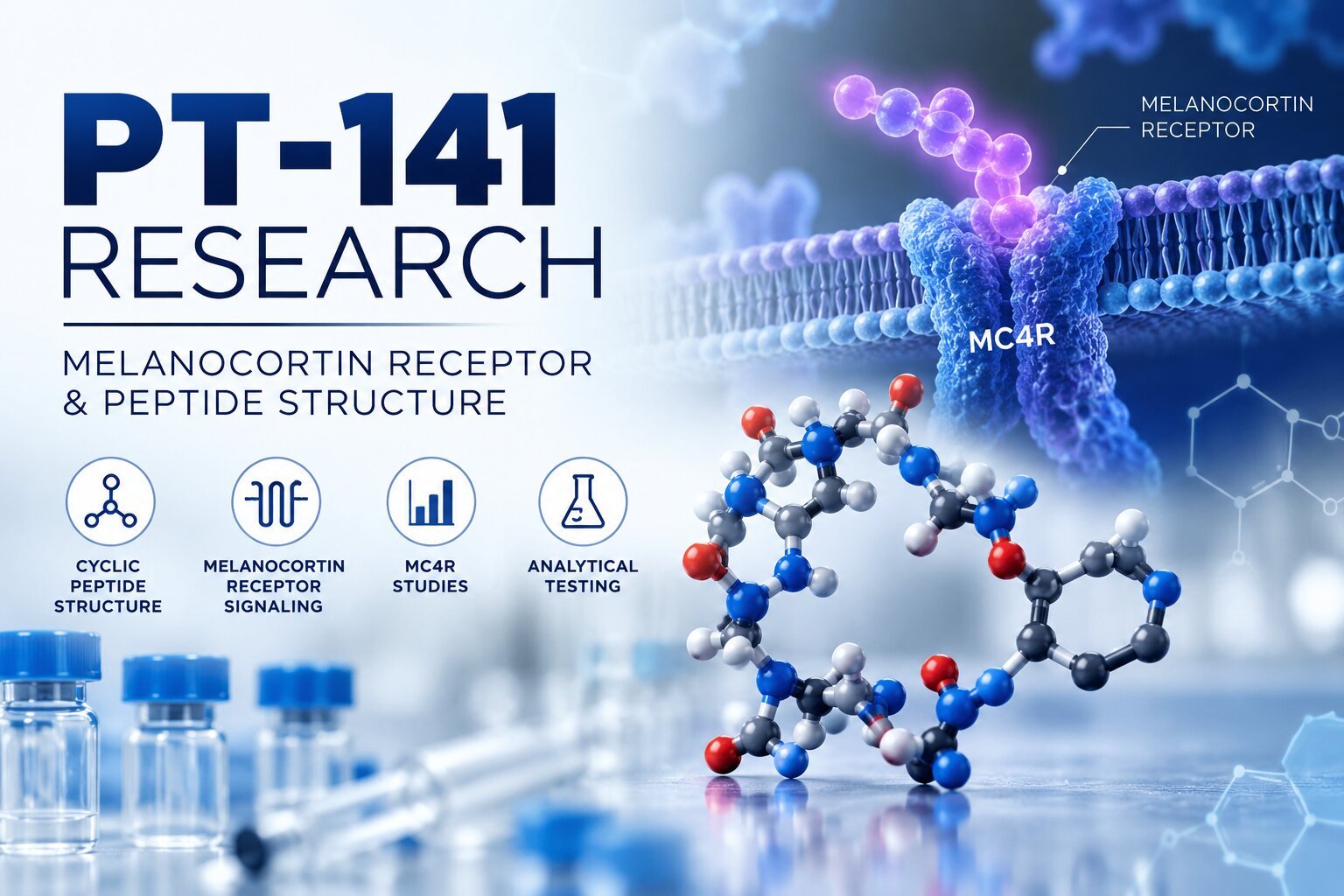
PT-141, also known as bremelanotide, is a synthetic cyclic peptide that has been studied extensively in melanocortin receptor research.
Unlike many linear research peptides, PT-141 contains a constrained ring structure. That cyclic design changes how the peptide folds, how it interacts with melanocortin receptors, and how researchers evaluate its stability and identity.
PT-141 is derived from the broader family of alpha-melanocyte-stimulating hormone, or α-MSH, analogues. Published research shows that it activates several melanocortin receptor subtypes, including MC3R and MC4R, while FDA documentation describes broader activity across multiple melanocortin receptors.
Its receptor profile, compact cyclic structure, and relationship to earlier α-MSH analogues make PT-141 useful for laboratory research involving:
- Melanocortin receptor signaling
- Cyclic peptide structure
- Receptor selectivity
- Peptide conformation
- Structure-activity relationships
- Receptor-binding assays
- Analytical characterization
For research purposes only. Not for human or veterinary use.
What Is PT-141?
PT-141 is the research code historically used for bremelanotide.
Chemically, bremelanotide is a synthetic cyclic heptapeptide.
Its free-base structure can be represented as:
Ac-Nle-cyclo-(Asp-His-D-Phe-Arg-Trp-Lys-OH)
FDA documentation describes bremelanotide acetate as a cyclic heptapeptide with an acetylated N-terminus and a free carboxyl group at the C-terminus.
This structure contains several features that distinguish PT-141 from ordinary linear peptides:
- N-terminal acetylation
- Norleucine
- D-phenylalanine
- Cyclic peptide architecture
- A defined melanocortin receptor-binding motif
These characteristics are central to understanding how the peptide behaves in laboratory systems.
PT-141 Is a Cyclic Peptide
One of the most important structural features of PT-141 is its cyclic backbone.
The peptide is not simply a straight chain of amino acids.
Instead, part of the molecule is constrained into a ring.
This type of cyclization can influence:
- Molecular conformation
- Enzymatic stability
- Receptor recognition
- Binding affinity
- Structural rigidity
For researchers, cyclic peptides provide useful models for examining how restricting molecular movement changes receptor activity.
Why Peptide Cyclization Matters
Linear peptides can adopt many different conformations in solution.
Cyclization limits the number of shapes available.
This may help stabilize a receptor-active conformation.
Researchers studying cyclic melanocortin analogues have shown that molecular topology and the orientation of key side chains are important for receptor recognition. Structure-function research on related cyclic melanocortin peptides demonstrated that changing residue orientation or sequence topology can substantially reduce biological activity.
This makes PT-141 useful for understanding the relationship between:
three-dimensional structure
and
receptor activation.
PT-141 and Alpha-MSH
PT-141 belongs to the larger family of synthetic peptides derived from α-MSH-related research.
Natural α-MSH is a peptide involved in melanocortin signaling.
Its sequence contains a central receptor-recognition region that inspired the development of more stable synthetic analogues.
Researchers learned that certain parts of the α-MSH sequence are especially important for melanocortin receptor activation.
This led to the development of shorter and cyclic analogues that preserve key receptor-binding residues while removing other portions of the natural peptide.
PT-141 emerged from this broader peptide-engineering strategy.
Relationship Between PT-141 and Melanotan II
PT-141 is structurally related to Melanotan II, commonly abbreviated MT-II.
MT-II is another cyclic α-MSH analogue used widely in melanocortin receptor research.
A reported MT-II structure is:
Ac-Nle-c[Asp-His-D-Phe-Arg-Trp-Lys]-NH₂
PT-141 preserves much of this cyclic melanocortin pharmacophore but differs at the C-terminal region.
This relationship is useful scientifically because researchers can compare related cyclic analogues and examine how small structural changes affect receptor activity.
The Melanocortin Receptor Family
PT-141 interacts with members of the melanocortin receptor family.
There are five major melanocortin receptors:
- MC1R
- MC2R
- MC3R
- MC4R
- MC5R
These receptors belong to the G protein-coupled receptor, or GPCR, superfamily.
Although they share structural similarities, they differ in:
- Tissue distribution
- Ligand preference
- Physiological role
- Downstream signaling
PT-141 is not perfectly selective for only one receptor.
That is important when interpreting experimental results.
PT-141 Is Not an MC4R-Only Ligand
PT-141 is often discussed primarily in relation to MC4R.
However, describing it as an exclusively MC4R-specific peptide would be inaccurate.
FDA prescribing information states that bremelanotide activates several melanocortin receptor subtypes, with an order of potency that includes MC1R, MC4R, MC3R, and MC5R.
Earlier scientific literature also describes PT-141 as an agonist of melanocortin receptors including MC3R and MC4R.
Researchers should therefore consider receptor selectivity carefully when designing experiments.
Why MC4R Receives Special Attention
Although PT-141 can interact with multiple melanocortin receptors, MC4R receives particular research attention.
MC4R is expressed in the central nervous system and participates in several neurobiological signaling networks.
Structural research has now resolved MC4R in complex with bremelanotide, helping scientists visualize how the cyclic peptide interacts with the receptor at the molecular level.
These studies provide valuable information about:
- Ligand orientation
- Receptor-binding contacts
- Peptide recognition
- GPCR activation
MC4R Is a G Protein-Coupled Receptor
MC4R belongs to the GPCR family.
Like many GPCRs, it contains seven membrane-spanning helices.
When a suitable agonist binds, the receptor changes conformation and can activate intracellular G proteins.
MC4R commonly couples to Gs proteins.
This can stimulate the enzyme adenylyl cyclase.
Adenylyl cyclase then increases production of:
cyclic AMP, or cAMP.
Researchers can use this signaling pathway to measure PT-141 receptor activity.
cAMP Assays in PT-141 Research
A cAMP assay provides a useful functional measurement.
Researchers can expose receptor-expressing cells to different concentrations of PT-141 and measure intracellular cAMP.
This can provide information about:
- Agonist potency
- Maximum receptor response
- Concentration-response behavior
- Receptor selectivity
Researchers may calculate an EC50, representing the concentration that produces half of the maximum measured response.
These assays are especially useful when comparing PT-141 with modified melanocortin analogues.
Binding and Signaling Are Different Measurements
A peptide can bind strongly to a receptor without producing the same signaling profile as another peptide.
Researchers therefore distinguish between:
Binding affinity
How strongly the ligand interacts with the receptor.
and
Functional potency
How effectively the ligand activates downstream signaling.
Both measurements are useful when evaluating PT-141.
A complete receptor study may therefore combine:
- Competitive binding
- cAMP assays
- Receptor internalization
- Downstream signaling
The Melanocortin Pharmacophore
Researchers studying α-MSH analogues identified a small sequence region that is especially important for receptor recognition.
A widely studied core motif includes:
His-D-Phe-Arg-Trp
Research on cyclic melanocortin peptides has shown that residues in this region make important contributions to melanocortin receptor activity.
PT-141 preserves this receptor-recognition motif.
This is one reason it remains active despite being substantially shorter than natural α-MSH.
Why D-Phenylalanine Is Important
Natural proteins primarily contain L-amino acids.
PT-141 contains D-phenylalanine, abbreviated D-Phe.
A D-amino acid has the opposite stereochemical orientation from the corresponding L-amino acid.
This change can affect:
- Peptide conformation
- Protease recognition
- Receptor affinity
- Metabolic stability
D-Phe is an important feature of several potent synthetic melanocortin analogues.
Stereochemistry Matters in Peptide Research
Two peptides can contain the same amino-acid names yet behave differently if one residue has different stereochemistry.
This is because receptors recognize three-dimensional molecular arrangements.
A D-amino acid can reposition:
- Aromatic groups
- Hydrogen-bond donors
- Charged side chains
- Hydrophobic surfaces
Researchers should therefore confirm stereochemistry when characterizing PT-141.
Merely identifying phenylalanine is insufficient.
The correct D-configuration matters.
The Role of Norleucine
PT-141 also contains norleucine, often abbreviated Nle.
Norleucine is structurally related to methionine but does not contain sulfur.
Substitution with norleucine has been used in melanocortin peptide design to alter stability and molecular behavior.
This is another example of how synthetic analogues can retain receptor-recognition features while changing individual chemical properties.
Why Synthetic Amino-Acid Substitutions Matter
Peptide engineering often involves replacing naturally occurring residues.
Researchers may do this to modify:
- Oxidation susceptibility
- Protease sensitivity
- Receptor selectivity
- Structural conformation
- Synthesis characteristics
PT-141 therefore represents more than a shortened natural peptide.
It is a deliberately engineered molecule.
Why the Ring Structure Helps Structure-Activity Research
Cyclization creates a constrained molecular scaffold.
This can make it easier to study how specific amino-acid side chains are presented to a receptor.
Researchers can synthesize analogues in which one residue is changed while leaving the overall cyclic architecture largely intact.
They can then determine whether receptor activity changes.
This approach helps map:
- Essential residues
- Tolerated substitutions
- Receptor-specific interactions
Alanine-Scanning Research
One traditional method for studying peptide function is alanine scanning.
In this approach, researchers systematically replace residues with alanine.
If receptor activity falls substantially after one substitution, the original residue may be important for receptor recognition.
Research involving cyclic melanocortin analogues has shown that replacing specific aromatic or charged residues can dramatically reduce activity.
Such experiments helped define the melanocortin receptor pharmacophore.
Structural Biology of PT-141 and MC4R
Modern structural biology has provided much more detailed information about PT-141.
Cryo-electron microscopy has been used to determine structures of MC4R bound to several agonists, including bremelanotide.
These studies reveal how peptidic agonists occupy the MC4R binding pocket and stabilize an active receptor conformation.
This type of structural information is valuable for:
- Designing new analogues
- Improving selectivity
- Understanding receptor activation
- Comparing peptide and small-molecule ligands
PT-141 and Receptor Selectivity
One challenge in melanocortin research is that several receptor subtypes recognize similar peptide motifs.
A peptide optimized for MC4R may still activate MC1R, MC3R, or MC5R.
Researchers can study subtype selectivity by expressing one receptor subtype at a time in cultured cells.
They may then compare:
- Binding affinity
- EC50
- Maximum response
This helps determine whether experimental effects are likely linked to one receptor or several.
Why Selectivity Matters
Different melanocortin receptors perform different biological roles.
If a peptide activates multiple receptors, a measured response may not be attributable to one receptor alone.
Researchers may therefore use:
- Selective receptor antagonists
- Receptor knockout models
- Receptor-specific cell lines
- Modified PT-141 analogues
These tools can help identify which receptor contributes to an observed response.
Receptor Antagonist Experiments
A receptor antagonist blocks or reduces receptor activation.
Researchers can expose cells to a melanocortin antagonist before adding PT-141.
If the PT-141 response decreases, this supports involvement of the blocked receptor.
Antagonist experiments can be particularly useful when paired with:
- cAMP assays
- Calcium measurements
- Gene-expression studies
Genetic Knockout Models
Genetic models provide another strategy.
Researchers can compare:
- Normal animals or cells
- MC4R-deficient models
- MC3R-deficient models
Differences in PT-141 response may help separate receptor-specific pathways.
Using both pharmacological and genetic approaches generally strengthens mechanistic conclusions.
PT-141 in Central Nervous System Research
Early PT-141 research examined central nervous system activity.
Animal studies reported activation of hypothalamic neurons after systemic exposure to the peptide.
Later research continued to examine melanocortin signaling in brain regions involved in motivated behavior.
These studies have contributed to understanding of central melanocortin pathways.
However, mechanistic findings from animal models should remain distinct from broad clinical claims.
Hypothalamic Signaling Research
The hypothalamus contains several melanocortin-responsive neural systems.
Researchers may measure neuronal activation using markers such as:
c-Fos
c-Fos expression can increase after neuronal stimulation.
Early PT-141 animal research reported increases in hypothalamic c-Fos immunoreactivity.
Such experiments help identify brain regions that respond to melanocortin agonists.
They do not necessarily reveal the entire signaling mechanism.
Dopamine-Related Research
Some research has explored how melanocortin receptor activation interacts with dopamine signaling.
A scientific review of bremelanotide proposed that MC4R activation in certain hypothalamic pathways may influence dopamine release.
More recent animal research continues to examine melanocortin receptor distribution within dopaminergic systems.
These pathways remain an area of active neurobiological investigation.
Why Neural Signaling Is Complex
A receptor agonist can affect neural activity through multiple pathways.
Changes may involve:
- Direct receptor activation
- Neurotransmitter release
- Feedback circuits
- Receptor desensitization
- Network-level responses
Researchers should therefore avoid reducing PT-141 biology to one neurotransmitter or one brain region.
Receptor Internalization
GPCRs can move from the cell surface into the cell after repeated activation.
This process is called receptor internalization.
Researchers studying PT-141 may examine:
- Surface receptor levels
- Endosomal localization
- Recovery after ligand removal
- Desensitization
Such experiments help explain how repeated or prolonged receptor exposure changes signaling.
Time-Course Studies
Timing is important in receptor pharmacology.
Researchers may measure PT-141 responses at:
- Seconds
- Minutes
- Hours
Short experiments may capture immediate second-messenger signaling.
Longer experiments may reveal:
- Receptor trafficking
- Gene-expression changes
- Desensitization
A time course often provides more information than a single endpoint.
PT-141 vs Natural Alpha-MSH
Natural α-MSH and PT-141 both activate melanocortin receptors.
However, they are structurally different.
Natural α-MSH is a longer linear peptide.
PT-141 is:
- Shorter
- Cyclic
- N-terminally acetylated
- Modified with norleucine
- Modified with D-phenylalanine
These structural differences can influence receptor affinity, stability, and persistence.
Why Cyclic Analogues Can Bind Differently
Research comparing α-MSH with cyclic analogues has shown that cyclic peptides may dissociate more slowly from melanocortin receptors.
For example, older receptor studies found that the related cyclic analogue MT-II remained receptor-bound longer than natural α-MSH under the experimental conditions used.
PT-141 is not identical to MT-II, but this research illustrates how cyclization can substantially change receptor interaction.
Molecular Formula and Mass
PubChem lists bremelanotide free base with the molecular formula:
C50H68N14O10
and a molecular weight of approximately:
1025.2 g/mol.
Researchers should distinguish the free peptide from bremelanotide acetate, because a salt form has different total composition and mass.
This distinction matters during analytical calculations.
Free Base vs Acetate Salt
Research suppliers may describe PT-141 as:
- Bremelanotide
- Bremelanotide acetate
- PT-141 acetate
These descriptions should not automatically be treated as chemically identical weights.
An acetate salt includes associated acetate.
PubChem separately identifies bremelanotide acetate and the active bremelanotide moiety.
Researchers calculating molar concentration should confirm exactly which form is present.
Why Salt Form Matters
The salt form may affect:
- Molecular-weight calculations
- Solubility
- pH behavior
- Sample preparation
A researcher weighing material based on the wrong molecular mass may calculate an incorrect molar concentration.
Therefore, documentation should specify whether the reported mass refers to:
- Free peptide
- Acetate salt
- Another defined form
Analytical Identification of PT-141
Because PT-141 is cyclic and contains non-standard structural features, analytical characterization should verify more than a simple peptide sequence.
Researchers may evaluate:
- Molecular mass
- Cyclic structure
- Sequence
- Stereochemistry
- Purity
- Salt form
A complete analytical profile may require multiple techniques.
HPLC Characterization
High-performance liquid chromatography can help evaluate PT-141 sample composition.
Researchers may examine:
- Main peak
- Retention time
- Minor components
- Relative peak area
- Batch consistency
Reverse-phase HPLC is commonly used for peptide analysis.
However, a high-purity chromatographic result alone does not prove correct molecular identity.
Mass Spectrometry
Mass spectrometry can provide molecular identity information.
Researchers may compare measured mass with the expected value for bremelanotide.
Mass analysis may help detect:
- Incorrect peptide length
- Synthesis-related impurities
- Degradation products
- Incomplete modifications
It can therefore complement HPLC.
Why Mass Alone May Not Confirm Everything
Two structures can sometimes have similar or identical molecular masses while differing in:
- Stereochemistry
- Connectivity
- Ring formation
Because PT-141 contains D-Phe and a cyclic structure, researchers may need additional structural documentation beyond mass alone.
This is another reason analytical methods should be combined.
Cyclization Verification
Correct ring formation is especially important.
A linear precursor containing the same amino acids would not necessarily behave like cyclic PT-141.
Researchers may use analytical methods capable of supporting confirmation of correct cyclization.
Depending on the laboratory, these may include:
- Tandem mass spectrometry
- NMR
- Validated chromatographic comparison
- Synthetic process documentation
NMR in Cyclic Peptide Research
Nuclear magnetic resonance spectroscopy can provide information about peptide conformation.
NMR studies of related cyclic melanocortin agonists have identified defined backbone conformations and highlighted the importance of the receptor-recognition region.
NMR is especially valuable when researchers want to study:
- Ring conformation
- Residue orientation
- Intramolecular interactions
Purity vs Identity
Researchers should distinguish between two analytical questions.
Purity:
How much of the detected material corresponds to the primary component?
Identity:
Is that component actually PT-141?
A sample could theoretically produce a dominant HPLC peak yet still have:
- Incorrect sequence
- Incorrect stereochemistry
- Incorrect cyclization
Strong characterization therefore uses both purity and identity data.
Related Substances
Synthetic cyclic peptides may contain related substances generated during manufacturing or degradation.
Examples may include:
- Linear precursor
- Truncated peptide
- Deletion sequence
- Incorrectly cyclized material
- Oxidized residues
- Epimerized products
Researchers may need to identify these impurities when performing sensitive receptor experiments.
Why Small Impurities Can Matter
Some melanocortin peptides are active at very low concentrations.
Therefore, a biologically active impurity could potentially alter a receptor assay even if present at relatively low abundance.
This makes analytical quality particularly important in pharmacology studies.
PT-141 Stability Research
Researchers may evaluate PT-141 stability under different laboratory conditions.
Variables can include:
- Temperature
- pH
- Light
- Oxidation
- Solution composition
- Storage duration
Cyclic structure can improve resistance to some forms of degradation, but it does not make a peptide universally stable.
Protease Resistance
Cyclization can make peptide cleavage more difficult for some proteolytic enzymes.
The ring structure may limit enzyme access or alter peptide conformation.
Researchers may compare PT-141 with linear melanocortin peptides to examine differences in:
- Degradation rate
- Fragment formation
- Residual receptor activity
Such comparisons help demonstrate why cyclic peptide engineering is useful.
Batch Traceability
Every laboratory experiment should be connected to a specific material batch.
Useful documentation may include:
- Compound name
- Salt form
- Batch number
- Purity
- Identity testing
- Date received
- Storage history
- Experiment date
This improves reproducibility between studies.
Experimental Controls
PT-141 receptor experiments may include several controls.
Examples include:
- Vehicle control
- Natural α-MSH
- MT-II
- Receptor-specific antagonist
- Receptor-negative cells
- Modified PT-141 analogue
Controls help determine whether an observed response is specific to melanocortin receptor activation.
Comparing PT-141 With MT-II
PT-141 and MT-II are closely related but not identical.
Comparative experiments can examine:
- Receptor subtype potency
- Binding affinity
- Signal duration
- Internalization
- Stability
These comparisons help researchers identify how relatively small structural differences alter pharmacology.
Evidence From Animal Models
PT-141 was studied extensively in animal models during its early development.
Research included rodents and nonhuman primates, with investigators examining central melanocortin pathways and behavioral responses.
Animal research can provide useful mechanistic evidence.
However, researchers should avoid assuming that every animal response predicts an identical human outcome.
Human Clinical Research Exists
Bremelanotide has also undergone human clinical investigation.
Ultimately, an FDA-approved bremelanotide pharmaceutical product was developed. FDA labeling describes the approved product as a sterile bremelanotide acetate injection with a defined pharmaceutical formulation.
This fact creates an important distinction for research suppliers.
Research PT-141 Is Not the Same as an Approved Drug Product
The existence of an approved medicine containing bremelanotide does not mean a research-grade PT-141 vial is equivalent to that medicine.
An FDA-approved formulation has specific requirements involving:
- Manufacturing standards
- Concentration
- Excipients
- Sterility
- Packaging
- Quality controls
- Regulatory labeling
A research peptide does not become an approved drug simply because it contains the same nominal active molecule.
This distinction should remain explicit.
Why This Distinction Matters for Bayoupep USA
Bayoupep USA research material should be described according to its intended laboratory context.
Content should focus on:
- Molecular structure
- Receptor research
- Peptide chemistry
- Analytical characterization
- Laboratory evidence
It should not imply that a research-use-only vial is interchangeable with a prescription product.
Melanocortin Receptor Research Is Broader Than One Outcome
PT-141 is often discussed online within one narrow context.
Scientifically, its value is broader.
It provides a useful model for studying:
- Cyclic peptide design
- GPCR pharmacology
- Melanocortin receptor selectivity
- Structural biology
- Central signaling
- Ligand-receptor recognition
This broader research framing is more appropriate for laboratory-focused content.
Structure-Activity Research Remains Important
PT-141 demonstrates how several molecular design choices can work together:
- Shortening a natural peptide
- Cyclizing the backbone
- Introducing D-amino acids
- Using non-natural residues
- Preserving a receptor-binding motif
Researchers can modify each feature to determine how it contributes to receptor activity.
This is one reason melanocortin peptides remain useful tools in medicinal chemistry.
Newer Structural Studies
Modern structural studies of MC4R have provided atomic-level insights unavailable during the earliest PT-141 research.
Cryo-EM structures now show how bremelanotide and related ligands interact with MC4R and promote receptor activation.
These findings allow researchers to connect older structure-activity data with direct structural observations.
Why Structural Data Improve Analogue Design
If researchers know which peptide residues contact specific receptor residues, they can design analogues more rationally.
Possible goals may include:
- Increasing receptor selectivity
- Changing potency
- Reducing off-target activity
- Modifying stability
Structural biology therefore complements traditional peptide screening.
PT-141 Research and Bayoupep USA
At Bayoupep USA, PT-141-related material should be treated as a laboratory research peptide.
Researchers should verify:
- Exact peptide identity
- Cyclic structure
- D-Phe configuration
- Salt form
- Molecular mass
- Batch-specific purity
- Analytical documentation
Experimental findings involving pharmaceutical bremelanotide should not be interpreted as proof that a separate research-grade product is clinically interchangeable with an approved formulation.
For research purposes only. Not for human or veterinary use.
Final Thoughts
PT-141 is a structurally distinctive melanocortin research peptide.
Its molecular architecture combines:
- A cyclic heptapeptide framework
- N-terminal acetylation
- Norleucine
- D-phenylalanine
- The receptor-active His-D-Phe-Arg-Trp motif
These modifications help produce a compact melanocortin receptor agonist with activity across several receptor subtypes. FDA information confirms that bremelanotide activates multiple melanocortin receptors, while research literature has particularly examined MC3R and MC4R signaling.
PT-141 also provides an excellent example of why peptide structure matters.
Cyclization restricts molecular movement.
D-amino-acid substitution changes stereochemistry.
Non-natural residues can influence stability.
Together, these features change how the molecule interacts with melanocortin receptors compared with natural α-MSH.
Modern MC4R structural research has further clarified how bremelanotide occupies and activates the receptor, connecting decades of peptide structure-activity research with direct molecular visualization.
For laboratory work, researchers should evaluate more than a reported purity percentage. Correct cyclization, stereochemistry, molecular identity, salt form, and batch traceability all matter.
Finally, research-grade PT-141 should remain clearly distinguished from regulated pharmaceutical bremelanotide formulations.
This information is provided for scientific and educational research purposes only. PT-141 research materials are not intended for human or veterinary use.