
In this article
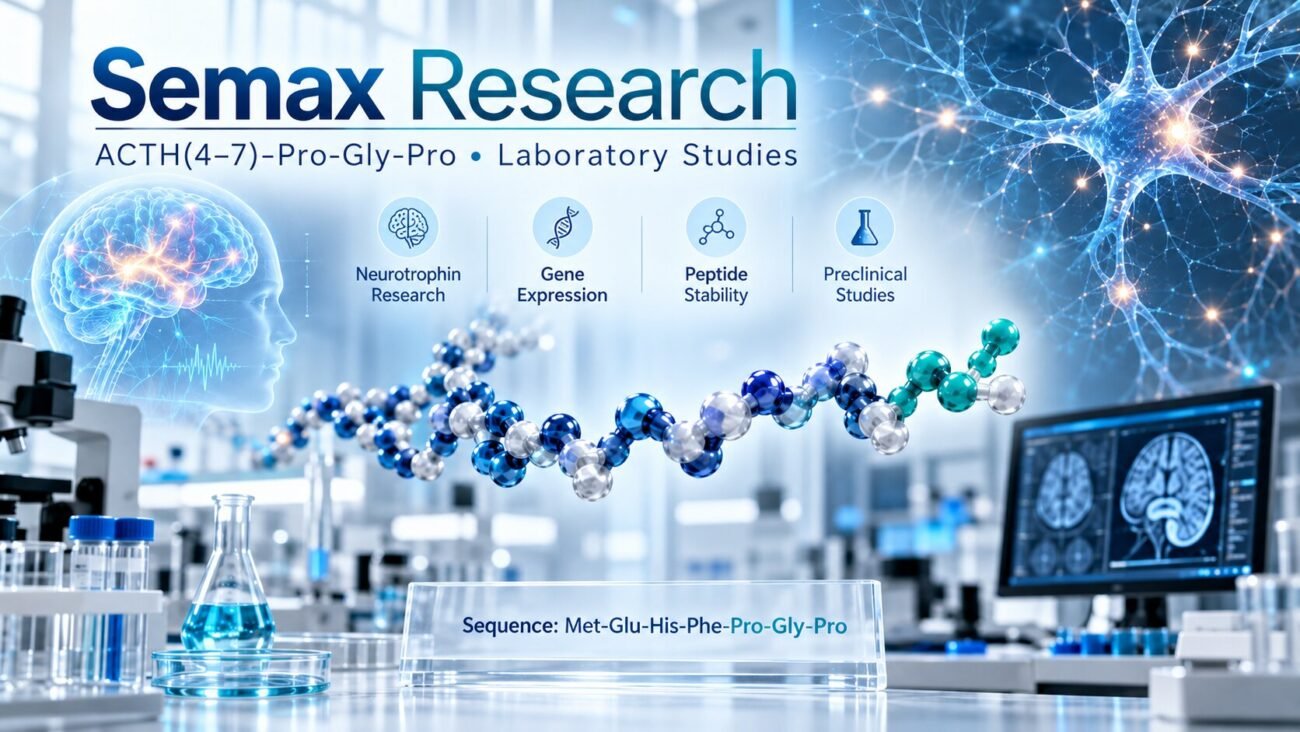
Semax is a synthetic seven-amino-acid peptide developed from a short region of adrenocorticotropic hormone, commonly abbreviated ACTH.
Its sequence is:
Met-Glu-His-Phe-Pro-Gly-Pro
Semax is unusual because its design combines two distinct structural regions.
The first four amino acids:
Met-Glu-His-Phe
correspond to the ACTH(4–7) fragment.
The final three:
Pro-Gly-Pro
form a glyproline sequence added to the C-terminal end.
This combination produced a peptide commonly described scientifically as ACTH(4–7)-Pro-Gly-Pro, or ACTH(4–7)PGP. Published studies have investigated Semax in neuronal, gene-expression, peptide-metabolism, neurotrophin, metal-binding, and animal cerebral-ischemia models.
Importantly, these research findings should be interpreted within the experimental systems in which they were generated.
For research purposes only. Not for human or veterinary use.
What Is Semax?
Semax is a synthetic heptapeptide, meaning it contains seven amino-acid residues.
The complete sequence is:
Met-Glu-His-Phe-Pro-Gly-Pro
Its molecular design can be viewed as:
ACTH(4–7) + Pro-Gly-Pro
This makes Semax structurally related to ACTH without making it equivalent to full-length ACTH.
Full ACTH contains 39 amino-acid residues and participates in endocrine signaling through melanocortin receptors.
Semax contains only a small N-terminal-derived ACTH sequence combined with a PGP extension.
That substantial structural difference is important when interpreting laboratory research.
Why Semax Was Designed From ACTH(4–7)
Scientists have long studied fragments of larger peptide hormones to determine whether individual regions retain biological properties separate from the complete parent molecule.
ACTH provided an interesting model.
Some short N-terminal ACTH fragments were investigated for neurological effects that could be separated experimentally from the classical endocrine activity of intact ACTH.
The sequence corresponding to positions 4 through 7 became particularly important in this research.
Semax was created by combining that four-residue region with a Pro-Gly-Pro extension.
This design allows researchers to examine a broader question in peptide biology:
Can a short fragment preserve selected signaling characteristics of a much larger peptide while losing other functions of the parent hormone?
Semax Is Not Full-Length ACTH
The structural relationship between Semax and ACTH should not be misunderstood.
Semax is not simply a shortened version of ACTH that reproduces all ACTH activity.
It differs from the parent hormone in:
- Peptide length
- Molecular conformation
- Receptor interaction
- Proteolytic processing
- Biological distribution
- Signaling profile
Researchers should therefore evaluate Semax independently.
Data obtained using intact ACTH cannot automatically be applied to Semax.
Likewise, experimental observations involving Semax should not automatically be interpreted as classical ACTH effects.
The ACTH(4–7) Region
The ACTH-derived portion of Semax is:
Met-Glu-His-Phe
This short sequence is often written as MEHF using one-letter amino-acid notation.
The sequence represents residues 4 through 7 of the N-terminal region of ACTH.
The inclusion of this fragment places Semax within a larger area of melanocortin-derived peptide research.
However, Semax does not contain the complete receptor-binding sequence found in full ACTH.
That difference helps explain why its research profile differs substantially from classical ACTH endocrine signaling.
Why Pro-Gly-Pro Was Added
The C-terminal part of Semax is:
Pro-Gly-Pro
This sequence is commonly abbreviated PGP.
Glyproline-containing peptides have been studied independently because proline-rich sequences can influence peptide conformation and enzymatic degradation.
Research comparing Semax with PGP has also shown that the two molecules can produce overlapping but non-identical changes in neurotrophin-related gene expression in animal models.
This suggests that the PGP region should not be viewed merely as an inactive spacer.
It may contribute to how the complete peptide behaves experimentally.
Why Proline Is Structurally Interesting
Proline differs from most standard amino acids.
Its side chain connects back to the backbone nitrogen, restricting molecular movement.
Semax contains proline at positions five and seven.
These residues may affect:
- Backbone flexibility
- Local conformation
- Enzyme recognition
- Peptide cleavage
- Stability
Researchers interested in peptide structure can therefore examine how the PGP extension changes the behavior of the ACTH(4–7) fragment.
Semax and Selank Are Structurally Different
Semax and Selank are sometimes discussed together because both end with Pro-Gly-Pro.
However, their N-terminal regions are completely different.
Semax:
Met-Glu-His-Phe-Pro-Gly-Pro
Selank:
Thr-Lys-Pro-Arg-Pro-Gly-Pro
Selank is related structurally to the naturally occurring peptide tuftsin.
Semax is derived from an ACTH fragment.
Therefore, the two peptides should not be treated as interchangeable merely because both contain PGP.
Their different N-terminal sequences may influence:
- Molecular recognition
- Proteolysis
- Signaling pathways
- Biological response
This distinction is especially important in comparative laboratory research.
Neurotrophin Research With Semax
One of the most frequently studied areas of Semax research involves neurotrophins.
Neurotrophins are signaling proteins involved in neuronal survival, differentiation, growth, and plasticity.
Important examples include:
- BDNF
- NGF
- NT-3
Researchers have investigated whether Semax exposure changes transcription of neurotrophin genes in experimental systems.
Animal studies have reported time-dependent alterations in Bdnf and Ngf expression following Semax administration.
These findings helped generate interest in Semax as a tool for studying gene-regulatory responses in nervous-system models.
BDNF Research
BDNF stands for brain-derived neurotrophic factor.
It is an extensively studied signaling protein involved in neuronal development and synaptic biology.
Researchers examining Semax have measured changes in Bdnf gene expression in brain tissues.
One study reported changes in both Bdnf and Ngf expression in rat hippocampus and frontal cortex after Semax exposure, with the direction and magnitude of the response changing over time and between brain regions.
This is an important observation.
It shows why Semax research should not be reduced to the statement that it simply “increases BDNF.”
The response may depend on:
- Brain region
- Time after exposure
- Experimental model
- Biological state
Why Time-Dependent Gene Expression Matters
Gene-expression responses are dynamic.
A gene may increase in activity at one time point and return toward baseline later.
Semax research provides a good example.
Published rat studies found different Bdnf and Ngf expression patterns at different sampling times following experimental exposure.
Researchers designing similar experiments should therefore avoid relying on a single time point.
A time-course design may provide a more complete picture.
For example, researchers might analyze expression at:
- Early time points
- Intermediate time points
- Later time points
This can reveal temporary regulatory changes that would otherwise be missed.
NGF Research
Another neurotrophin investigated in Semax studies is nerve growth factor, or NGF.
NGF participates in nervous-system development and neuronal signaling.
Published animal research has reported Semax-associated changes in Ngf transcription under specific experimental conditions.
Again, gene expression should not be confused with a guaranteed functional outcome.
A change in RNA concentration represents one step in a larger biological pathway.
Researchers may need additional measurements involving:
- Protein abundance
- Receptor activation
- Cellular function
- Tissue response
to determine the broader biological significance.
Neurotrophin Receptor Research
Researchers have also examined genes encoding neurotrophin receptors.
These include receptor systems such as:
- TrkA
- TrkB
- TrkC
In a rat cerebral-ischemia model, Semax was associated with changes in transcription of neurotrophins and their receptors at different time points.
This expands the research question beyond neurotrophin production alone.
Scientists can ask whether both a signaling molecule and its receptor system change simultaneously.
Why BDNF and TrkB Are Often Studied Together
BDNF signals primarily through the TrkB receptor.
Therefore, measuring only BDNF may provide incomplete information.
A laboratory may study:
- Bdnf transcription
- BDNF protein
- TrkB expression
- TrkB phosphorylation
- Downstream signaling
Combining these measurements can help determine whether a complete signaling pathway is changing rather than one isolated marker.
Gene-Expression Research Beyond Neurotrophins
Semax research has expanded beyond individual neurotrophin genes.
More recent studies have used broad transcriptomic approaches to examine many genes simultaneously.
Research in rat cerebral-ischemia models has reported changes in gene networks associated with:
- Inflammatory signaling
- Neurotransmission
- Cellular stress
- Immune responses
- Tissue recovery pathways
For example, RNA-related research has reported suppression of several pro-inflammatory transcripts following Semax exposure in an experimental ischemia model.
These findings are valuable for generating hypotheses about biological pathways.
They do not establish clinical outcomes by themselves.
What Transcriptomics Can Tell Researchers
Transcriptomics examines RNA expression across many genes at the same time.
This can reveal patterns that would be difficult to detect with one-gene experiments.
Researchers can identify:
- Upregulated genes
- Downregulated genes
- Biological pathways
- Regulatory networks
- Time-dependent molecular responses
Semax therefore provides an interesting experimental model for examining how a short synthetic peptide may produce broad transcriptional changes.
Why RNA Changes Need Confirmation
RNA sequencing can show that a gene becomes more or less active.
However, RNA abundance does not always predict protein abundance directly.
Researchers may therefore follow transcriptomic findings with:
- Western blotting
- ELISA
- Proteomics
- Enzyme activity measurements
- Functional assays
This helps determine whether a transcriptional response leads to measurable protein-level changes.
Protein-Level Research
Researchers have also examined Semax-associated protein changes.
A 2021 rat ischemia-reperfusion study measured proteins involved in inflammation, cell-death signaling, and cellular recovery.
The investigators reported experimental changes involving proteins such as:
- MMP-9
- c-Fos
- JNK
- CREB
following Semax exposure.
These findings support continued research into the relationship between transcriptional changes and protein-level signaling.
CREB Research
CREB stands for cAMP response element-binding protein.
It is a transcription factor involved in many cellular signaling pathways.
Researchers often examine CREB phosphorylation because activated CREB can influence gene transcription.
Semax-related animal research has reported changes in active CREB under ischemic experimental conditions.
Scientists may investigate whether CREB links upstream signaling events with downstream neurotrophin-related gene expression.
Inflammation-Related Research
Inflammatory signaling is another area of Semax research.
Cerebral ischemia can produce extensive changes in inflammatory gene expression.
Studies using experimental rat models have evaluated whether Semax modifies these transcriptional responses.
One investigation reported suppression of multiple pro-inflammatory mRNA transcripts during reversible cerebral ischemia.
These findings remain model-specific.
They should not be generalized into unsupported claims regarding human inflammatory conditions.
Why Ischemia Models Are Frequently Used
Experimental cerebral ischemia models allow researchers to study complex molecular responses after restricted blood flow.
Common endpoints include:
- Gene expression
- Protein signaling
- Tissue injury
- Oxidative stress
- Inflammation
- Neurotrophin activity
Semax has been investigated extensively in these models, particularly in rodents.
This means a significant portion of the Semax literature should be interpreted specifically as preclinical cerebral-ischemia research.
Animal Results Have Important Limits
Rodent experiments can help reveal molecular mechanisms.
However, differences between rodents and humans may involve:
- Peptide metabolism
- Brain anatomy
- Receptor expression
- Enzymatic degradation
- Distribution
- Dose-response relationships
Animal findings should therefore be described accurately as preclinical results.
They should not automatically be presented as established human outcomes.
Semax and Peptide Proteolysis
Another useful research area involves the enzymatic breakdown of Semax.
Like many small peptides, Semax can be cleaved by peptidases.
Researchers have studied how aminopeptidases degrade Semax and structurally modified analogues.
Published experiments found that changing the first amino acid of Semax altered its rate of proteolysis.
This provides a clear example of a peptide structure-stability relationship.
Why the N-Terminal Methionine Matters
Semax begins with:
Methionine
Aminopeptidases can remove amino acids from the N-terminal end of peptides.
Studies using modified Semax analogues found that replacing the N-terminal methionine with other residues changed enzymatic degradation rates.
Researchers can use these findings to explore:
- Enzyme recognition
- Peptide half-life
- Fragment generation
- Structure-dependent stability
This type of research is particularly useful in peptide engineering.
Semax Degradation Products
Proteolysis does not simply make a peptide disappear instantly.
Instead, shorter fragments may appear.
Semax research has identified degradation products such as shorter C-terminal fragments during aminopeptidase experiments.
Researchers may therefore need to distinguish between:
- Intact Semax
- Partially degraded Semax
- PGP-containing fragments
- Individual metabolites
This distinction can become important in biological assays.
Peptide Fragments May Have Their Own Biological Properties
A degradation product is not necessarily biologically inactive.
For Semax, this is particularly relevant because PGP itself has been studied independently.
Research comparing Semax and PGP found partially overlapping effects on neurotrophin-related transcription in a rat ischemia model.
Therefore, experimental responses observed after Semax exposure could potentially involve:
- Intact Semax
- Semax-derived fragments
- PGP-related signaling
Determining the contribution of each species requires controlled experiments.
How Researchers Can Separate Parent Peptide and Metabolite Effects
A laboratory may compare multiple groups:
- Semax
- PGP
- ACTH(4–7)
- Selected degradation fragments
- Untreated control
Researchers can then measure identical endpoints across all groups.
This approach may help determine which part of the Semax structure contributes to a particular response.
Metal-Binding Research
Semax has also been studied from an inorganic chemistry perspective.
Research has shown that the peptide can interact with metal ions, including copper(II).
This is a very different research angle from its neurotrophin or transcriptomic studies.
It demonstrates how peptide chemistry can produce unexpected properties based on amino-acid side chains and backbone coordination.
Semax and Copper(II)
The Semax sequence contains several groups capable of participating in metal coordination.
Researchers have investigated:
- Copper-binding affinity
- Coordination geometry
- Metal-peptide complexes
- Metal-dependent cellular effects
One published study characterized Semax as having significant affinity for Cu(II) and examined Semax-metal complexes in experimental cellular systems.
This does not mean Semax should be considered primarily a copper peptide like GHK-Cu.
Instead, it represents a separate area of peptide coordination chemistry.
N-Terminal Modification Changes Metal Binding
Researchers have also studied an N-terminally acetylated Semax analogue.
Acetylating the N-terminal amino group changed the peptide’s ability to coordinate copper and zinc ions.
This demonstrates an important peptide-chemistry principle:
A small terminal modification can significantly change molecular behavior.
Researchers studying Semax analogues should therefore document whether the peptide is:
- Unmodified
- N-terminally acetylated
- Otherwise chemically modified
These materials should not be treated as identical.
Semax and Receptor Research
Semax is derived from an ACTH fragment, but its mechanism should not be simplified into classical ACTH receptor agonism.
Its structure does not reproduce full ACTH.
Research instead points toward multiple downstream systems involving:
- Neurotrophin transcription
- Neurotransmitter-related genes
- Inflammatory signaling
- Peptide metabolites
- Intracellular transcription factors
This makes Semax mechanistically more complex than a simple one-peptide/one-receptor model.
Why This Makes Semax Different From PT-141
PT-141 is also connected historically to melanocortin peptide research.
However, PT-141 is a cyclic melanocortin receptor agonist with well-characterized receptor pharmacology.
Semax is structurally and functionally different.
PT-141 research commonly focuses on:
- MC3R
- MC4R
- GPCR activation
- cAMP signaling
Semax research more often focuses on:
- ACTH fragment biology
- Gene expression
- Neurotrophins
- Peptide metabolism
- Preclinical nervous-system models
The two should therefore not be grouped together simply because both have historical links to melanocortin peptides.
Molecular Identification of Semax
A Semax research sample should match the expected seven-residue sequence:
Met-Glu-His-Phe-Pro-Gly-Pro
Researchers may evaluate identity using:
- Mass spectrometry
- Chromatography
- Sequence information
- Reference standards
The theoretical molecular characteristics should correspond to the complete intended peptide.
HPLC Characterization
High-performance liquid chromatography can help assess Semax sample composition.
Researchers may examine:
- Main chromatographic peak
- Retention time
- Minor impurities
- Relative peak area
- Batch consistency
HPLC is useful for assessing relative composition.
However, a high HPLC purity percentage does not independently prove that the material is Semax.
Mass Spectrometry
Mass spectrometry can provide complementary identity information.
Researchers may compare the observed molecular mass with the expected mass for:
Met-Glu-His-Phe-Pro-Gly-Pro
Mass analysis can also help identify:
- Truncated sequences
- Degradation products
- Synthetic impurities
- Modified analogues
Using chromatography and mass spectrometry together provides stronger characterization.
Why Purity and Identity Must Be Separated
A chromatographic report may state that a sample is 99% pure.
That means most detectable material behaves as one primary chromatographic component under the test conditions.
It does not independently prove that the component has the correct:
- Sequence
- Molecular mass
- Terminal structure
Researchers should therefore ask two separate questions:
Is the sample pure?
and
Is the sample actually Semax?
Both are necessary for reliable research.
Peptide Sequence Verification
Sequence confirmation becomes especially important because several related peptides contain the PGP motif.
Semax should not be confused with:
- Selank
- Pro-Gly-Pro
- ACTH(4–7)
- Modified Semax analogues
- Shorter degradation products
The complete seven-amino-acid sequence provides the clearest molecular definition.
Stability Research
Semax stability can be influenced by environmental conditions.
Researchers may study variables including:
- Temperature
- pH
- Moisture
- Light
- Oxidation
- Storage duration
- Solution composition
Because the peptide begins with methionine, oxidative chemistry may also deserve attention during stability studies.
The appropriate storage condition should be based on product-specific analytical information.
Methionine Oxidation
Methionine contains sulfur and can undergo oxidation under certain conditions.
Oxidation can change molecular mass and potentially alter peptide behavior.
Researchers evaluating Semax stability may therefore look for oxidized species during:
- Mass spectrometry
- HPLC analysis
- Forced-degradation studies
This is one example of why peptide stability involves more than simply monitoring visible appearance.
Sample Preparation and Experimental Reproducibility
Laboratory results can be affected by sample preparation.
Researchers should document:
- Solvent
- Buffer
- pH
- Concentration
- Preparation date
- Storage duration
Two laboratories using the same peptide but different preparation conditions may not obtain identical results.
Detailed methodology improves reproducibility.
Experimental Controls
A well-designed Semax experiment may include:
- Untreated control
- Vehicle control
- Semax
- ACTH(4–7)
- PGP
- Relevant modified analogue
This design can help separate the contribution of different structural regions.
For neurotrophin studies, researchers may also include known pathway controls.
Concentration-Response Studies
Testing multiple concentrations can reveal whether an experimental response follows a concentration-dependent pattern.
Researchers might measure:
- Gene expression
- Cell survival
- Protein activation
- Enzyme activity
A concentration-response relationship can provide stronger mechanistic evidence than one isolated experimental concentration.
Time-Course Studies Are Especially Important
Semax studies have repeatedly demonstrated that molecular responses can change over time.
Researchers should therefore consider measuring:
- Early signaling
- Intermediate transcriptional responses
- Later protein-level changes
This can help distinguish transient responses from persistent effects.
Evidence Quality and Research Limitations
Semax has been investigated for decades, but the evidence base has several important limitations.
A large portion of the published literature consists of:
- Rodent experiments
- Cell studies
- Molecular studies
- Research from a relatively concentrated group of institutions
This does not make the research unimportant.
It does mean conclusions should remain proportional to the evidence.
Independent replication and broader experimental validation remain valuable.
Avoiding Overstatement
Responsible Semax content should distinguish clearly between:
Observed molecular change
and
established biological outcome.
For example:
A change in Bdnf mRNA is evidence of altered gene expression.
It is not by itself proof of improved cognition.
A change in inflammatory transcripts in a rodent ischemia model is evidence within that model.
It is not automatically evidence of a general anti-inflammatory effect in humans.
This distinction is essential for scientifically accurate research communication.
Semax Research and Bayoupep USA
At Bayoupep USA, Semax should be treated as a laboratory research peptide.
Researchers evaluating a Semax sample should review:
- Full amino-acid sequence
- Batch number
- Purity data
- Molecular identity
- Analytical documentation
- Storage requirements
Studies involving Semax should be discussed within their actual experimental context rather than converted into personal-use claims.
For research purposes only. Not for human or veterinary use.
Final Thoughts
Semax is a structurally simple but scientifically interesting seven-amino-acid peptide:
Met-Glu-His-Phe-Pro-Gly-Pro
Its design combines the ACTH(4–7) sequence with the C-terminal Pro-Gly-Pro motif.
That structure has supported several different areas of research.
Studies have examined Semax in relation to:
- BDNF and NGF transcription
- Neurotrophin receptors
- Broad gene-expression changes
- Inflammatory signaling
- Protein-level regulatory pathways
- Peptide proteolysis
- PGP-containing metabolites
- Copper-binding chemistry
Animal research has shown that Semax-associated gene-expression patterns can vary significantly by brain region and time point, reinforcing the importance of carefully controlled experimental design.
Proteolysis research has also demonstrated that changing even the first amino acid can alter degradation behavior, illustrating how strongly peptide structure can influence stability.
For researchers, Semax is therefore useful not simply as an ACTH-derived peptide but as a model for investigating how short peptide fragments, glyproline extensions, degradation products, and molecular modifications influence biological signaling.
Accurate sequence verification, mass-based identity testing, chromatographic analysis, appropriate controls, and cautious interpretation of preclinical findings are essential for meaningful Semax laboratory research.
This information is provided for scientific and educational research purposes only. Semax research materials are not intended for human or veterinary use.