
In this article
Selank is a synthetic peptide that has been studied in experimental neuroscience, neurochemistry, peptide signaling, and stress-related research.
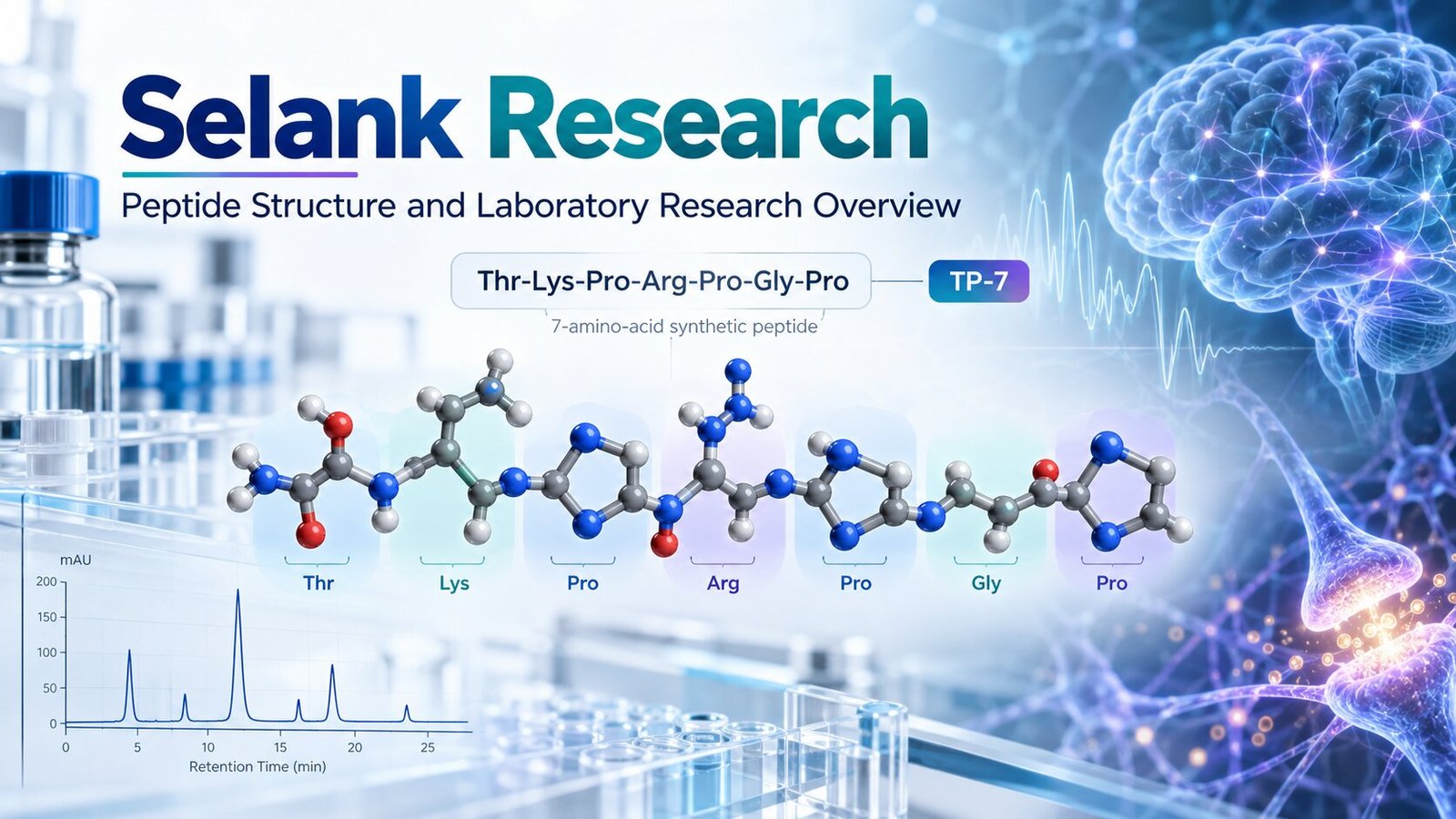
Its amino-acid sequence is:
Thr-Lys-Pro-Arg-Pro-Gly-Pro
This makes Selank a seven-amino-acid peptide, also called a heptapeptide.
Unlike many larger research peptides, Selank was developed from a naturally occurring peptide system related to tuftsin, a short peptide involved in immune-cell biology. The addition of a Pro-Gly-Pro sequence created a longer synthetic analog with different stability and research characteristics.
Selank has been investigated in animal models, biochemical experiments, gene-expression studies, and a limited number of human clinical studies, primarily from Russian research groups.
However, findings from these studies should not be interpreted as proof of broad clinical effectiveness or approval in other jurisdictions.
For research purposes only. Not for human or veterinary use.
What Is Selank?
Selank is a synthetic peptide composed of seven amino-acid residues.
Its sequence can be divided conceptually into two regions:
Thr-Lys-Pro-Arg
and
Pro-Gly-Pro
The first four residues correspond to tuftsin, a naturally occurring tetrapeptide.
Tuftsin has the sequence:
Thr-Lys-Pro-Arg
Historical research established tuftsin as a peptide associated with phagocytic immune-cell activity.
Selank extends this sequence by adding Pro-Gly-Pro at the C-terminal end.
That structural modification is one reason Selank should be considered a tuftsin-derived analog rather than simply another name for tuftsin.
Selank and Tuftsin Are Not the Same Peptide
Although Selank contains the complete tuftsin sequence, the two molecules are chemically different.
Tuftsin contains four amino acids:
Thr-Lys-Pro-Arg
Selank contains seven:
Thr-Lys-Pro-Arg-Pro-Gly-Pro
Those additional three residues change the molecular size and may alter properties such as:
- Enzymatic stability
- Peptide degradation
- Cellular interaction
- Distribution
- Biological signaling
Researchers should therefore avoid using Selank and tuftsin interchangeably when discussing experimental results.
A study performed with tuftsin is not automatically evidence for Selank.
Why Selank Is Sometimes Called TP-7
The name TP-7 may appear in discussions of Selank.
This abbreviation reflects its structure.
The first letters refer to the initial Thr-Pro-related peptide designation, while the number seven refers to its seven-residue length.
In practical research documentation, using the full amino-acid sequence is more precise than relying only on abbreviations.
A sequence provides direct information about molecular identity.
Selank as a Glyproline-Containing Peptide
The final three amino acids of Selank are:
Pro-Gly-Pro
This motif belongs to a broader area of glyproline peptide research.
Glyproline-containing sequences have attracted interest because proline-rich peptides can show distinctive structural and enzymatic characteristics.
Proline is different from many other amino acids because its side chain connects back to the amino nitrogen.
This creates a relatively rigid molecular structure.
As a result, proline-containing peptides may behave differently from more flexible peptide chains.
Selank contains several proline residues, making this feature particularly relevant.
Why Proline-Rich Sequences Are Interesting
Proline can influence peptide conformation.
A peptide containing several proline residues may exhibit:
- Restricted backbone movement
- Altered enzyme recognition
- Different degradation behavior
- Distinct receptor interactions
Selank contains proline at positions three, five, and seven.
Researchers studying its structure may therefore examine whether these residues contribute to stability or biological activity.
This provides a structural reason to study Selank independently from its parent tuftsin sequence.
Early Selank Research
Much of the early Selank literature originated from Russian scientific institutions.
Researchers investigated the peptide in models related to:
- Behavioral stress
- Anxiety-like responses
- Neurochemical signaling
- Memory processes
- Enkephalin metabolism
Animal experiments and biochemical work helped generate hypotheses about how the peptide may affect signaling pathways.
Later studies examined Selank in small human research populations.
The resulting literature is scientifically interesting but geographically concentrated and relatively limited compared with extensively studied approved medicines.
Selank and Enkephalin Research
One important research area involves enkephalins.
Enkephalins are naturally occurring opioid peptides involved in nervous-system signaling.
They are rapidly broken down by enzymes often described collectively as enkephalinases.
Laboratory research reported that Selank could inhibit enzymatic degradation of enkephalins under experimental conditions. One study measured concentration-dependent inhibition of plasma enkephalin hydrolysis.
This observation led researchers to propose enkephalin metabolism as one possible mechanism associated with some experimentally observed Selank effects.
However, this remains a mechanistic hypothesis rather than a complete explanation of Selank biology.
Why Enkephalin Degradation Matters
Peptide signaling is influenced not only by how much of a signaling molecule is produced but also by how quickly it is degraded.
If a peptide-degrading enzyme becomes less active, the signaling molecule may remain present for longer.
Researchers may therefore measure:
- Enkephalin concentration
- Peptide half-life
- Degrading-enzyme activity
- Metabolite formation
Selank provides an experimental tool for examining some of these relationships.
Neurotransmitter Research
Selank has also been studied in relation to neurotransmitter systems.
Animal experiments have evaluated changes involving signaling molecules such as:
- Serotonin
- Dopamine
- Norepinephrine
One animal study examined Selank in rats subjected to prenatal hypoxia and measured changes in serotonin and noradrenaline concentrations in the brain.
Such research may help identify pathways associated with behavioral observations.
However, neurotransmitter changes in rodents should not automatically be translated into human clinical claims.
GABA-Related Research
Some Selank research has explored interactions with the GABAergic system.
GABA, or gamma-aminobutyric acid, is one of the major inhibitory neurotransmitters in the nervous system.
Researchers studying Selank have proposed that its effects may involve changes in GABA-related signaling rather than acting as a classical direct GABA receptor agonist.
Possible experimental questions include:
- Does receptor expression change?
- Are downstream signaling pathways modified?
- Does neurotransmitter balance shift?
- Are receptor subunits regulated differently?
These questions remain areas of mechanistic research.
Why Receptor Modulation Is Different From Direct Binding
It is important to distinguish between direct receptor binding and indirect receptor regulation.
A compound may influence a signaling system without physically binding strongly to the receptor itself.
For example, a peptide might affect:
- Gene expression
- Receptor abundance
- Enzyme activity
- Neurotransmitter availability
- Downstream signaling
Researchers should therefore avoid describing Selank as having a simple single-receptor mechanism unless direct experimental evidence supports that conclusion.
Gene-Expression Research
Selank has also been investigated using gene-expression techniques.
Researchers can expose experimental systems to a peptide and then examine whether particular genes become more or less active.
Possible areas studied include genes involved in:
- Neurotransmitter signaling
- Synaptic processes
- Stress-response pathways
- Immune signaling
- Receptor regulation
Gene-expression data can provide clues about biological pathways.
However, a gene-expression change does not necessarily mean that a corresponding functional outcome occurred.
Additional protein and functional studies are needed.
Why Transcriptomic Research Is Useful
Transcriptomics examines patterns of RNA expression across many genes.
This type of research can identify broad molecular responses that might not be obvious from one biochemical measurement.
For Selank, transcriptomic research can help generate hypotheses about:
- Neural signaling pathways
- Immune-related genes
- Receptor systems
- Cellular adaptation
These findings are most useful when followed by independent experimental confirmation.
Behavioral Research in Animals
Animal models have been used extensively in Selank research.
Researchers may examine behaviors associated with:
- Exploration
- Stress responses
- Learning
- Memory
- Novel environments
These experiments are designed to study neural pathways under controlled conditions.
They do not establish how the same peptide will affect humans.
Behavioral tests in rodents are models, not direct equivalents of complex human emotional states.
Why Animal Behavioral Models Have Limits
Researchers use animal behavior because nervous-system activity can be difficult to study directly.
However, interpretation requires caution.
Rodents differ from humans in:
- Brain organization
- Peptide metabolism
- Receptor distribution
- Behavioral complexity
- Experimental exposure
A finding in a maze or stress-related test should therefore remain described as an animal-model result.
Learning and Memory Research
Selank has also appeared in research examining learning and memory.
Scientists may study outcomes such as:
- Task acquisition
- Retention
- Recall
- Conditioned responses
The aim is usually to understand whether peptide signaling alters neural processes involved in information processing.
These studies are largely preclinical and should not be presented as evidence that Selank improves human cognition.
Immune-System Connections
The relationship between Selank and tuftsin creates another interesting research direction.
Tuftsin is historically associated with immune-cell regulation, especially phagocytic cells such as macrophages and neutrophils.
Because Selank contains the full tuftsin sequence, researchers have investigated whether it may retain or modify some immune-related signaling characteristics.
Potential experimental endpoints may include:
- Cytokine expression
- Immune-cell activity
- Gene regulation
- Inflammatory signaling
The presence of a tuftsin sequence does not mean Selank behaves identically to tuftsin.
Direct testing is still required.
Selank and Peptidase Research
Peptides are often rapidly degraded by peptidases.
Researchers interested in Selank may investigate:
- Which enzymes cleave it
- Where cleavage occurs
- How quickly degradation happens
- Which fragments remain
- Whether fragments retain activity
The Pro-Gly-Pro extension may influence degradation relative to tuftsin.
Understanding these metabolic pathways can help explain experimental duration and observed biological responses.
Peptide Fragments Can Have Their Own Activity
When Selank is enzymatically broken down, smaller fragments may form.
Peptide metabolites are not always biologically inactive.
Researchers may therefore study:
- Parent Selank
- Intermediate fragments
- Terminal fragments
- Fragment stability
This is important because an experimental result may involve both the original peptide and its degradation products.
Human Research Background
Selank has been evaluated in several relatively small human studies.
A 2008 randomized study included 62 patients with generalized anxiety disorder or neurasthenia and compared Selank with medazepam.
A later study compared Selank with phenazepam in 60 patients with anxiety-related disorders.
Another investigation examined Selank in combination with phenazepam.
These studies are part of Selank’s research history.
However, they should be interpreted carefully because they involved relatively small populations and were largely conducted within one regional research environment.
Why Small Clinical Studies Need Cautious Interpretation
Small human trials can generate useful preliminary data.
They may help researchers examine:
- Short-term biological responses
- Measurement methods
- Possible adverse events
- Hypothesis generation
However, stronger conclusions generally require:
- Larger populations
- Independent replication
- Multicenter research
- Standardized protocols
- Consistent outcome measures
The existence of early studies does not automatically establish broad clinical efficacy.
Selank Should Not Be Treated as an Established Universal Therapy
Online discussions sometimes present experimental peptides as though preliminary research proves routine therapeutic usefulness.
That is not scientifically appropriate.
Selank has a research history that includes human studies, but evidence should be considered within its limitations.
Researchers should distinguish:
Experimental observations
from
established clinical evidence
This distinction is especially important when discussing research-use materials.
Molecular Identification of Selank
Before laboratory use, researchers should verify that a sample matches the expected peptide.
Expected Selank sequence:
Thr-Lys-Pro-Arg-Pro-Gly-Pro
Analytical documentation may include:
- Peptide sequence
- Molecular mass
- HPLC results
- Mass spectrometry
- Batch number
- Testing date
Sequence confirmation is especially useful because many research peptides have similar names but different structures.
HPLC Characterization
High-performance liquid chromatography can be used to evaluate sample composition.
An HPLC chromatogram may help researchers assess:
- Major peptide peak
- Secondary components
- Retention time
- Relative peak area
- Batch consistency
However, HPLC primarily provides information about separation and relative composition.
A high-purity peak does not independently prove molecular identity.
Mass Spectrometry
Mass spectrometry can complement chromatographic testing.
Researchers can compare an observed molecular signal with the expected mass of Selank.
This helps answer a separate question from purity:
Is the dominant material consistent with the intended molecule?
Combining chromatographic and mass-based analysis provides stronger characterization than either measurement alone.
Why Sequence Matters More Than the Product Name
A product label may simply say “Selank.”
For rigorous laboratory work, researchers should know the exact sequence.
This prevents confusion with:
- Modified analogs
- Related glyproline peptides
- Tuftsin
- Selank fragments
Molecular documentation is more informative than a trade or shorthand name.
Purity and Identity Are Different Measurements
A common analytical mistake is treating purity and identity as the same thing.
They are different.
Purity asks:
How much of the detectable sample corresponds to the primary component?
Identity asks:
What is that component?
A sample can theoretically produce a strong dominant chromatographic peak while containing the wrong molecule.
Researchers should therefore review both purity and identity data.
Batch Traceability
Good laboratory records should connect experimental data to a specific sample lot.
Useful information may include:
- Product identifier
- Batch number
- Supplier
- Date received
- Analytical report
- Storage location
- Experiment date
This makes repeated studies easier to compare.
It also helps researchers investigate unexpected differences between experiments.
Stability Research
Like other peptides, Selank may be affected by environmental conditions.
Research laboratories may evaluate variables such as:
- Temperature
- Moisture
- Light
- pH
- Solution composition
- Storage duration
Peptide degradation may alter both concentration and molecular identity.
Product-specific storage instructions should therefore be followed.
Freeze-Thaw Considerations
Repeated temperature changes can affect some peptide preparations.
When working with peptide solutions, laboratories may reduce repeated freeze-thaw exposure by dividing samples appropriately for experimental workflows.
The exact handling method should depend on:
- Formulation
- Concentration
- Solvent
- Experimental design
General peptide rules should not replace product-specific stability data.
Selank and Other Neuroactive Peptides
Selank is sometimes grouped with other peptides studied in neurological research.
However, peptides within the same general category can have completely different:
- Sequences
- Molecular targets
- Origins
- Stability
- Evidence profiles
Researchers should evaluate Selank independently rather than assuming similarity based only on the fact that multiple peptides are studied in nervous-system models.
Why Direct Comparisons Require Controlled Experiments
To compare Selank with another research peptide properly, researchers would need to control variables such as:
- Concentration
- Exposure period
- Experimental model
- Endpoint
- Sample quality
Without these controls, statements that one peptide is “stronger” or “better” than another are not scientifically meaningful.
Evidence Quality Matters
Selank research spans several evidence types.
These include:
- Biochemical experiments
- Rodent studies
- Gene-expression research
- Small clinical studies
Each type answers a different question.
Biochemical studies can investigate mechanisms.
Animal studies can examine whole-organism responses.
Clinical studies provide human observations.
Researchers should avoid treating all evidence as equally strong.
Research Documentation for Selank
A well-documented Selank study may record:
- Full peptide sequence
- Lot number
- Purity result
- Identity test
- Preparation conditions
- Storage history
- Experimental concentration
- Exposure duration
- Biological model
- Measured endpoint
These details improve reproducibility.
Selank Research and Bayoupep USA
At Bayoupep USA, Selank-related materials should be treated strictly as laboratory research materials.
Researchers should review:
- Batch-specific documentation
- Analytical identity
- Purity information
- Storage requirements
- Experimental controls
The existence of biochemical, animal, or limited clinical studies should not be interpreted as authorization for personal use.
For research purposes only. Not for human or veterinary use.
Final Thoughts
Selank is a seven-amino-acid synthetic peptide derived structurally from the naturally occurring tetrapeptide tuftsin.
Its sequence:
Thr-Lys-Pro-Arg-Pro-Gly-Pro
combines the full tuftsin structure with an additional Pro-Gly-Pro segment.
This design has made Selank a subject of research involving peptide metabolism, enkephalin degradation, neurotransmitter signaling, gene expression, behavioral models, and nervous-system biology. Experimental studies have also explored its relationship with immune and neurochemical pathways.
A limited number of small human studies have also been published, primarily by Russian investigators.
However, responsible interpretation requires separating biochemical observations, animal findings, and preliminary clinical research from broader claims of established effectiveness.
For laboratory research, accurate peptide identification, sequence verification, batch documentation, appropriate controls, and careful evidence interpretation remain essential.
This information is provided for scientific and educational research purposes only. Selank research materials are not intended for human or veterinary use.