
In this article
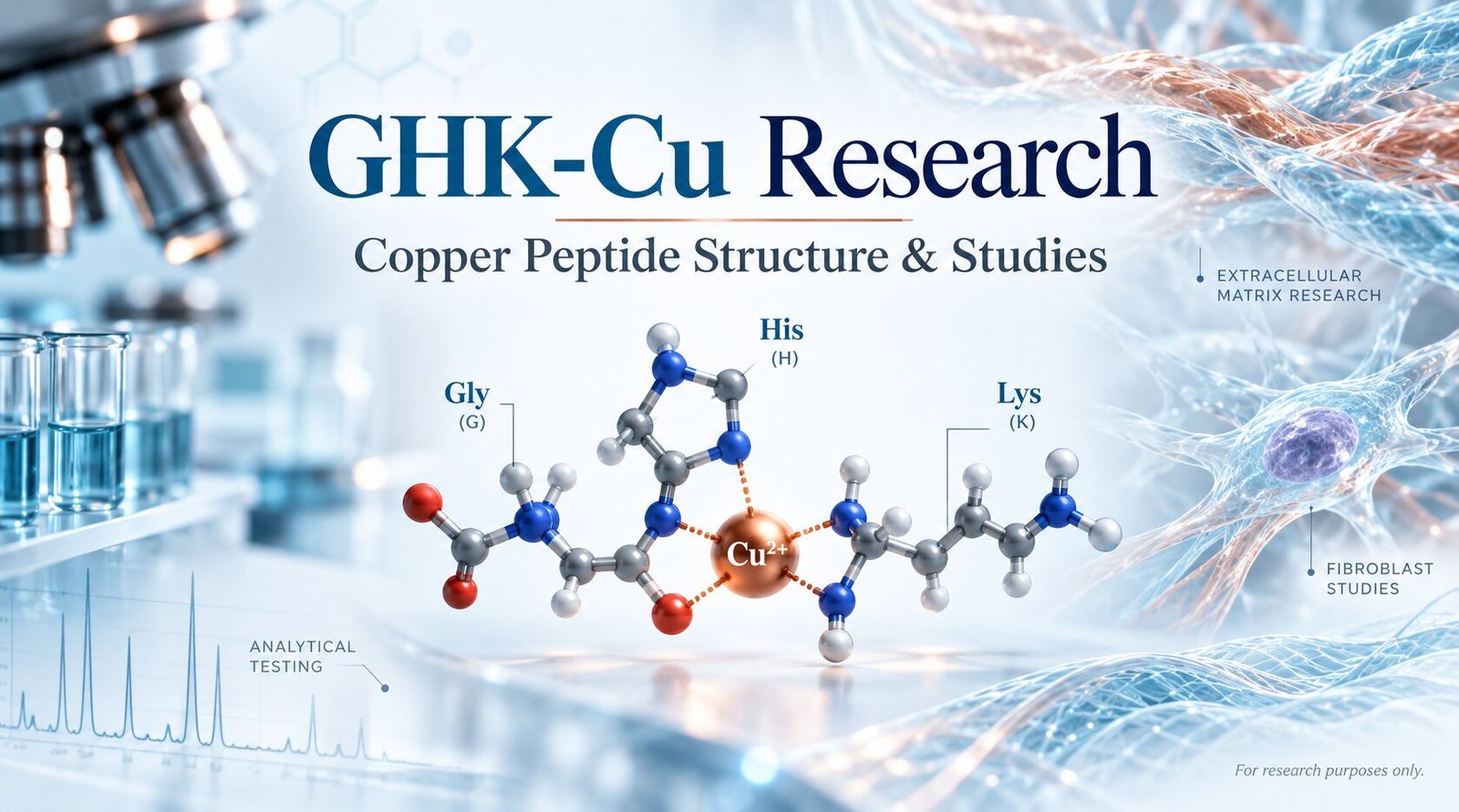
GHK-Cu is a small copper-binding peptide complex that has been studied for decades in laboratory and preclinical research.
The name comes from the three amino acids that form the peptide:
- Glycine
- Histidine
- Lysine
Together, these form the tripeptide GHK.
When GHK coordinates with a copper ion, the resulting complex is commonly called GHK-Cu or copper tripeptide-1.
Researchers have investigated this molecule in areas involving extracellular-matrix biology, fibroblast activity, collagen-related pathways, gene expression, and tissue-model research. However, the strongest evidence remains largely preclinical, with human research more limited and mixed.
For research purposes only. Not for human or veterinary use.
What Is GHK-Cu?
GHK-Cu is the copper complex of the naturally occurring tripeptide glycyl-L-histidyl-L-lysine.
Its amino-acid sequence is:
Gly-His-Lys
This makes GHK one of the smallest peptide structures commonly discussed in laboratory research.
The copper-bound form contains a copper(II) ion coordinated by the peptide.
Researchers therefore need to distinguish between:
GHK — the copper-free tripeptide
and
GHK-Cu — the copper-bound complex
They are related but chemically different research materials.
Why the Copper Ion Matters
The copper ion is not simply an added ingredient.
It changes the chemical identity of the complex.
GHK has several nitrogen-containing sites capable of coordinating copper.
The central histidine residue plays an especially important role because its imidazole group participates in copper binding.
Research into the coordination chemistry of GHK-Cu indicates that the copper ion is held by several donor atoms within the peptide, producing a stable metal-peptide complex.
This coordination helps explain why GHK-Cu behaves differently from copper-free GHK.
GHK-Cu Is a Coordination Complex
In chemistry, a coordination complex forms when a central metal ion binds to surrounding molecules or atoms.
For GHK-Cu:
- Copper(II) is the metal center.
- GHK acts as the ligand.
- Nitrogen atoms in the peptide help hold the metal ion.
This means GHK-Cu research involves more than ordinary peptide chemistry.
Scientists may need to evaluate:
- Peptide identity
- Copper content
- Metal-to-peptide ratio
- Coordination state
- Sample purity
These factors become especially important during analytical characterization.
Why Histidine Is Important
Histidine contains an imidazole side chain.
This side chain can interact strongly with metal ions.
In GHK-Cu, histidine is one of the key residues involved in copper coordination.
Researchers interested in metal-peptide chemistry may study how this interaction affects:
- Molecular geometry
- Copper stability
- Chemical reactivity
- Biological signaling
- Analytical behavior
This makes the His residue especially important within the otherwise very short GHK sequence.
GHK-Cu and Copper Transport Research
Some historical research proposed that GHK may help carry or exchange copper within biological systems.
Because GHK binds copper strongly but not irreversibly, researchers have examined whether it may function as a mobile copper-binding molecule.
This hypothesis contributed to early interest in the peptide.
Scientists have studied whether GHK-Cu can influence:
- Cellular copper availability
- Metal transport
- Copper exchange
- Copper-dependent enzymes
This research remains part of the broader effort to understand why the peptide exists naturally in biological fluids.
Historical Discovery of GHK
GHK was first identified in human plasma during research in the early 1970s.
Researchers observed biological activity associated with a small serum-derived peptide.
The active material was later identified as glycyl-L-histidyl-L-lysine.
Subsequent studies examined its copper-binding behavior and possible biological functions.
This historical work helped establish the foundation for modern GHK-Cu research.
GHK-Cu and Extracellular-Matrix Research
One of the strongest areas of GHK-Cu research involves extracellular-matrix biology.
The extracellular matrix, or ECM, is the network of proteins and other molecules surrounding cells.
Important ECM components include:
- Collagen
- Elastin
- Glycosaminoglycans
- Proteoglycans
- Structural glycoproteins
Researchers have examined whether GHK-Cu influences the production or remodeling of these materials.
Much of this evidence comes from cultured fibroblasts and animal models.
Fibroblast Research
Fibroblasts are cells that help produce extracellular-matrix components.
They are commonly used in laboratory research involving tissue remodeling.
GHK-Cu has been studied in cultured fibroblasts to evaluate changes in:
- Collagen synthesis
- Matrix production
- Proteoglycan expression
- Enzyme activity
- Cellular signaling
These experiments provide mechanistic information about how the copper-peptide complex may influence connective-tissue biology.
Collagen-Related Studies
Collagen is one of the most abundant structural proteins in the extracellular matrix.
Laboratory studies have reported changes in collagen production after exposure to GHK-Cu in some experimental models.
Researchers may measure:
- Collagen synthesis
- Collagen-related gene expression
- Matrix deposition
- Collagen organization
These results are mainly from cellular or preclinical systems.
They should not automatically be interpreted as equivalent human outcomes.
Glycosaminoglycan Research
Glycosaminoglycans are carbohydrate-rich molecules found within the extracellular matrix.
They contribute to tissue structure and hydration.
Some laboratory studies involving GHK-Cu have measured changes in glycosaminoglycan production.
This research helps scientists understand how the peptide may influence more than collagen alone.
Extracellular-matrix remodeling involves many different molecular components.
Proteoglycan Research
Proteoglycans contain proteins linked to glycosaminoglycan chains.
They influence matrix structure and cellular communication.
Research involving GHK-Cu has examined changes in proteoglycan expression, including molecules such as decorin.
These findings suggest that the peptide may influence multiple parts of matrix organization rather than one single structural protein.
Matrix Metalloproteinase Research
Matrix metalloproteinases, or MMPs, are enzymes that help break down extracellular-matrix proteins.
Balanced MMP activity is important for matrix turnover.
Scientists have investigated whether GHK-Cu changes the expression or activity of certain MMPs.
This type of research is useful because tissue remodeling requires both:
- Matrix production
- Matrix breakdown
Studying both processes can provide a more complete view of ECM biology.
Why Matrix Remodeling Is More Complex Than Collagen Production
It can be misleading to describe GHK-Cu research only in terms of “collagen.”
The extracellular matrix is constantly being produced, modified, and broken down.
Researchers therefore study:
- Structural proteins
- Matrix enzymes
- Proteoglycans
- Cellular migration
- Growth factors
- Gene expression
GHK-Cu research spans several of these areas.
This broader context is more scientifically accurate than focusing on one isolated endpoint.
Gene-Expression Research
A more recent area of GHK-related research involves gene-expression analysis.
Researchers have used large gene-expression databases and computational approaches to study whether GHK influences patterns of gene activity.
These studies have examined genes related to:
- Cellular stress
- Tissue remodeling
- Antioxidant pathways
- DNA-related processes
- Inflammation
Gene-expression research can generate useful hypotheses.
However, computational findings need experimental confirmation before biological significance can be established.
Why Gene Expression Does Not Equal Clinical Effect
A change in gene expression means that the activity of certain genes changed under specific conditions.
It does not automatically mean that a meaningful clinical outcome occurred.
Researchers need additional evidence connecting:
- Gene-expression change
- Protein activity
- Cellular function
- Tissue-level response
This distinction is especially important when interpreting broad gene-expression claims about GHK-Cu.
GHK-Cu and Cellular Stress Research
Researchers have also studied the copper peptide in models involving cellular stress.
Experimental endpoints may include:
- Oxidative stress markers
- Inflammatory signaling
- Cell survival
- Protein expression
- Matrix damage
These studies help researchers examine how cells respond to environmental or biochemical stress.
Again, the results depend heavily on the experimental model.
Wound-Model Research
GHK-Cu has been studied in animal wound models.
Researchers have examined endpoints such as:
- Collagen accumulation
- Matrix formation
- Tissue organization
- Cellular migration
- Repair-related signaling
Animal models can provide more complex biological information than cell culture alone.
However, they still do not automatically predict human outcomes.
Human Evidence Is More Limited
GHK-Cu is often described online as though there is extensive human evidence.
The actual research record is more limited.
A recent systematic review identified a literature base dominated by preclinical work, with only a small number of randomized human studies.
This means researchers should distinguish carefully between:
- Cell studies
- Animal studies
- Computational studies
- Human trials
Evidence strength differs considerably across these categories.
GHK-Cu and Cosmetic Research
GHK-Cu is also known in cosmetic science as copper tripeptide-1.
This has led to topical research involving skin-related formulations.
However, cosmetic ingredient use should not be confused with laboratory research material.
The same molecular complex may appear in different regulatory contexts depending on formulation and intended use.
Researchers should clearly identify which type of material is being studied.
GHK-Cu vs GHK
GHK and GHK-Cu should not be used interchangeably in scientific documentation.
GHK is the peptide alone.
GHK-Cu includes coordinated copper.
This changes properties such as:
- Molecular mass
- Charge
- Spectroscopic behavior
- Color
- Chemical reactivity
A study using GHK does not automatically provide evidence about GHK-Cu.
Likewise, analytical verification should distinguish the two materials.
Why the Copper-to-Peptide Ratio Matters
GHK-Cu is commonly discussed as a 1:1 copper-to-peptide complex.
That means one copper ion is associated with one GHK peptide molecule.
If the copper ratio differs, the chemistry may also differ.
Researchers may therefore verify:
- Copper concentration
- Peptide concentration
- Molar ratio
- Free copper
- Unbound GHK
This is especially important in formulation or stability research.
Free Copper vs Bound Copper
Copper can exist in different chemical states within a sample.
Researchers may distinguish between:
- GHK-bound copper
- Free copper ions
- Copper bound to other components
Free copper may behave differently from peptide-bound copper.
Therefore, simply measuring total copper does not always confirm correct GHK-Cu formation.
Additional analytical methods may be needed.
Analytical Identification of GHK-Cu
Because GHK-Cu contains both a peptide and a metal ion, researchers may use several analytical approaches.
These can include:
- HPLC
- Mass spectrometry
- UV-visible spectroscopy
- Copper-specific analysis
- NMR
- Elemental analysis
Each technique provides different information.
A strong analytical profile may require more than one method.
HPLC Analysis
HPLC can help evaluate peptide composition and purity.
Researchers may examine:
- Main peak
- Retention time
- Secondary components
- Batch consistency
However, HPLC alone may not confirm the exact copper coordination state.
This is why GHK-Cu analysis can require additional methods beyond ordinary peptide purity testing.
Mass Spectrometry
Mass spectrometry can provide information about molecular identity.
Researchers may compare observed signals with expected GHK or GHK-Cu-related mass values.
Interpretation can sometimes be more complex for metal-containing compounds because ionization conditions may affect the complex.
Researchers should use validated analytical methods for the specific material.
UV-Visible Spectroscopy
Copper complexes often absorb light differently from their unbound components.
UV-visible spectroscopy can therefore provide useful information about metal coordination.
Researchers may observe spectral features associated with Cu(II) binding.
This method can complement chromatographic or mass-based data.
Why Color Is Not Enough
GHK-Cu often has a blue or blue-green appearance.
This color comes from the copper complex.
However, color alone cannot establish:
- Purity
- Correct molecular ratio
- Peptide identity
- Copper concentration
- Absence of contaminants
Visual appearance can provide a basic observation but not full analytical verification.
Copper Quantification
Researchers may directly measure copper concentration using analytical methods.
Possible approaches include:
- Atomic absorption spectroscopy
- ICP-MS
- ICP-OES
These methods can provide quantitative metal information.
Copper measurements can then be compared with peptide concentration to evaluate whether the expected ratio is present.
Why Batch Verification Matters
GHK-Cu research depends on consistent material.
Researchers may want to confirm:
- Peptide identity
- Copper content
- Copper-to-peptide ratio
- Batch number
- Testing date
- Sample purity
Batch-specific documentation can help identify whether different experimental results might be related to material variation.
Stability Research
Metal-peptide complexes can respond to environmental conditions.
Researchers studying GHK-Cu may evaluate stability under changes in:
- Temperature
- Light
- pH
- Moisture
- Oxidation conditions
- Storage duration
Copper coordination may also be affected by other molecules present in solution.
This makes formulation-specific stability data important.
pH and Copper Coordination
The ability of GHK to coordinate copper depends partly on the chemical environment.
Changes in pH can affect the protonation state of peptide donor atoms.
This may influence:
- Copper binding
- Complex geometry
- Stability
- Spectroscopic behavior
Researchers working with GHK-Cu solutions should therefore document pH conditions carefully.
Competition With Other Metal-Binding Molecules
Biological and laboratory systems may contain other compounds capable of binding copper.
These can compete with GHK for the metal ion.
Researchers may therefore investigate copper exchange between GHK and:
- Proteins
- Amino acids
- Chelators
- Other peptides
This type of work helps clarify how stable the GHK-Cu complex is in complex environments.
GHK-Cu in Multi-Peptide Research
GHK-Cu is sometimes included in blended research formulations.
However, findings involving isolated GHK-Cu should not automatically be applied to a blend.
Other peptides may alter:
- pH
- Stability
- Copper availability
- Analytical separation
- Sample behavior
This is why blend-specific testing remains important.
Why GLOW Research and GHK-Cu Research Are Different
A GLOW formulation typically contains multiple compounds.
GHK-Cu research focuses specifically on the copper tripeptide itself.
The scientific questions are therefore different.
GHK-Cu studies may focus on:
- Copper chemistry
- Fibroblast responses
- Matrix signaling
- Gene expression
- Metal coordination
Blend studies need to account for interactions among several components.
These should remain separate research categories.
Research Documentation
A laboratory record for GHK-Cu may include:
- Compound name
- GHK sequence
- Copper form
- Copper-to-peptide ratio
- Batch number
- Analytical report
- Storage conditions
- Experimental date
This level of documentation improves reproducibility.
Evidence Limitations
GHK-Cu has a long research history, but much of the evidence comes from laboratory and animal studies.
Human research remains limited compared with the volume of claims often seen online.
Researchers should therefore avoid overstating conclusions.
A strong evidence review should specify whether a result came from:
- Cell culture
- Animal models
- Computational analysis
- Human trials
This distinction helps maintain scientific accuracy.
GHK-Cu Research and Bayoupep USA
At Bayoupep USA, GHK-Cu-related materials should be treated as laboratory research compounds.
Researchers should verify peptide identity, copper content, batch documentation, and analytical characteristics before experimental use.
Particular attention should be given to the distinction between copper-free GHK and the GHK-Cu complex.
For research purposes only. Not for human or veterinary use.
Final Thoughts
GHK-Cu is a compact but chemically interesting research molecule.
Its three-amino-acid GHK sequence is capable of coordinating copper(II), producing a metal-peptide complex with properties different from the peptide alone.
Researchers have studied GHK-Cu in areas involving fibroblast biology, extracellular-matrix remodeling, collagen-related pathways, gene expression, and tissue-model research.
However, the evidence base remains dominated by laboratory and preclinical studies, while human evidence is more limited.
From an analytical perspective, GHK-Cu also requires more than standard peptide purity testing.
Copper content, coordination state, peptide identity, and metal-to-peptide ratio can all influence sample interpretation.
For meaningful laboratory research, accurate chemical characterization, appropriate controls, batch-specific documentation, and careful evidence boundaries are essential.
This information is provided for scientific and educational research purposes only. GHK-Cu research materials are not intended for human or veterinary use.